Yemrehanna Kristos Church
A striped church of alternating wood and stone built inside a cave north of Lalibela, older than the famous rock churches.
Updated 19 October 2026
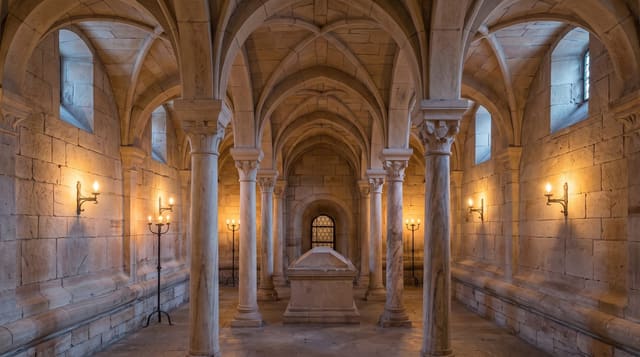
Yemrehanna Kristos is built rather than carved, which sets it apart from the churches at Lalibela: it stands inside a cave in a basalt hillside, constructed in alternating layers of pale stone and dark timber in the Aksumite manner, with a decorated wooden ceiling of coffered panels and inlay that survives because the cave has kept it dry for perhaps nine hundred years. It is attributed to a Zagwe king of the twelfth century whose name it carries. Behind the church, in the depth of the cave, lie the remains of many pilgrims who came here to die, stacked and visible, which visitors are usually shown. The road out from Lalibela is rough and takes an hour or more each way, and far fewer people make the trip than see the town's own churches.
History
The church is credited to the king Yemrehana Krestos and was probably built in the 11th or 12th century, of stone and wood in the tradition of Aksum, its walls showing the same pattern of inset beams and projecting stonework as the ancient church of Debre Damo; Stuart Munro-Hay called its interior decoration the most elaborate of any known ancient Ethiopian church, and the murals high on the nave walls are thought to be the oldest surviving wall paintings in Ethiopia. Tradition links it to an Ethiopian embassy recorded at the court of Saladin in 1173, and the king's life tells how he obtained a door from the caliph's palace for his church. Francisco Alvares described the church in the early 16th century; beside it in the cave stand a building said to have been the king's palace, now used by the priests, and a cloth-covered tomb, and the back of the cave holds the skeletons of monks and pilgrims buried in this holy place. The modern wall that closes the cave mouth was built in the 1980s (Wikipedia, Yemrehana Krestos Church).
What you'll find
- Layered wood and stone - the Aksumite building technique in banded courses.
- The cave setting - the whole church standing inside a basalt hollow.
- The coffered ceiling - decorated woodwork preserved by the dry cave.
- Pilgrim remains - the bones stacked at the back of the cave.
When to go
October to March for the road, which is rough and difficult after rain. Morning light is better at the cave mouth. The church is open daily with a priest present.
What to expect
The drive is an hour or more each way on a bad road. There is a climb of some minutes up to the cave. The interior is dark and photography may be restricted or charged. The display of human remains is not to everyone's taste and is not optional to walk past.
Nearby
Lalibela lies southwest; Mount Abuna Yosef rises to the east.
Key facts
Source: Wikidata, item Q8052169, read on 18 October 2026.
What to pack for Yemrehanna Kristos Church
Chosen from what this place is for. Tap a kit for the full checklist.
- Head torch + spare batteries - Hands-free light is essential; caves are truly dark. Find on Amazon
- Comfortable walking shoes - Sightseeing means kilometres of pavement and cobbles daily. Find on Amazon
- Modest clothing - Shoulders and knees covered - the single most common requirement. Find on Amazon
- Grippy closed shoes - Cave floors are wet, muddy and slick with formations. Find on Amazon
Some links on this page are Amazon affiliate links - if you buy through them we may earn a small commission at no extra cost to you.
All packing kitsPlan your trip
Where to start if Yemrehanna Kristos Church is going on the list.
Booking links on this page are affiliate links - if you book through them we may earn a small commission at no extra cost to you. It never changes what we write about a place.
Opening times, ticket prices and seasonal closures change - check the official source before you go: official site.