Lake Nasser
One of the largest reservoirs in the world, holding relocated Nubian temples along shores with almost no settlement.
Updated 19 October 2026
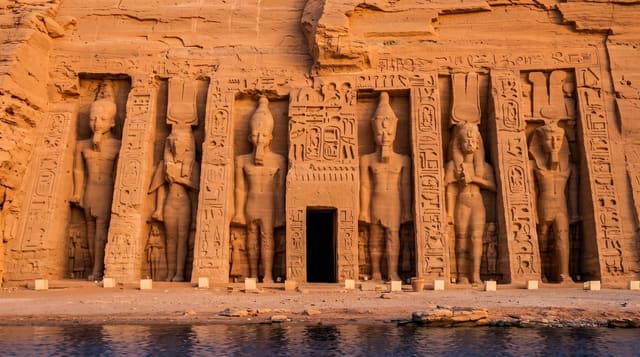
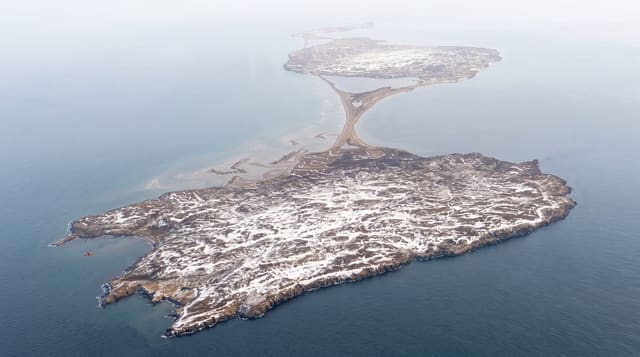
Lake Nasser was created by the High Dam and runs roughly five hundred kilometres south from Aswan into Sudan, where it is called Lake Nubia, making it one of the largest artificial lakes in the world. Its shores are almost entirely empty: there are no towns, no roads along most of it, and the water level rises and falls enough to prevent permanent settlement, so the landscape is bare desert meeting flat water with rocky islands. Along it stand the Nubian temples relocated during the salvage campaign, Kalabsha, Wadi es-Sebua, Amada, Abu Simbel and others, most of them reachable only by boat, which is why the small cruise fleet exists. The lake also holds very large Nile perch, and fishing safaris camping on the shore run out of Aswan.
History
Before the lake existed, its area was a large part of Nubia, home to several pharaohs and to empires such as Kush. Construction of the Aswan High Dam began in 1960 and was finished in 1970, replacing the insufficient Low Dam of 1902 to give a more stable water supply, more farm production and electricity, and the lake and dam were inaugurated in 1971; the lake is named after Gamal Abdel Nasser, and the Sudanese call their smaller part of it Lake Nubia. Tens of thousands of Nubians had to leave their homes, which now lie under the water. The flooding prompted the international campaign led by UNESCO to save the monuments of Nubia, which moved the temples of Kalabsha, Wadi es-Sebua, Amada and, most famously, Abu Simbel to higher ground, while others, such as the fortress of Buhen, now lie underwater (Wikipedia, Lake Nasser).
What you'll find
- Relocated Nubian temples - Kalabsha, Wadi es-Sebua and Amada along the shore.
- Empty desert shoreline - no towns and almost no roads for hundreds of kilometres.
- Nile perch fishing - the reason the fishing safaris run.
- Crocodiles and shore birds - wildlife on the islands and shallows.
When to go
October to April for temperature; the lake is punishing in summer. Cruises run on set schedules of three to five days between Aswan and Abu Simbel. Fishing safaris are arranged privately and camp on the shore.
What to expect
Access is entirely through operators; there is no independent way to travel the lake. The cruise fleet is small and boats vary a great deal in condition. Water levels affect which temples can be landed at. Crocodiles are present and swimming is not advisable.
Nearby
Aswan and the High Dam are at the northern end; Abu Simbel lies at the southern.
Key facts
Source: Wikidata, item Q182796, read on 18 October 2026.
What to pack for Lake Nasser
Chosen from what this place is for. Tap a kit for the full checklist.
- Travel rod + reel - A packable multi-piece rod fits in a case and covers most holiday fishing. Find on Amazon
- Reef-safe sunscreen - High SPF that will not bleach the coral you are swimming over. Find on Amazon
- Binoculars - The single best wildlife tool - even a compact pair transforms a sighting. Find on Amazon
- Loose, light, long clothing - Covering up beats bare skin in the desert - and locals dress this way for a reason. Find on Amazon
Some links on this page are Amazon affiliate links - if you buy through them we may earn a small commission at no extra cost to you.
All packing kitsPlan your trip
Where to start if Lake Nasser is going on the list.
Booking links on this page are affiliate links - if you book through them we may earn a small commission at no extra cost to you. It never changes what we write about a place.
Opening times, ticket prices and seasonal closures change - check the official source before you go: official site.