Dakhla Oasis
A long green oasis under a pink escarpment, with a medieval mud-brick town, Roman tombs and hot springs.
Updated 19 October 2026
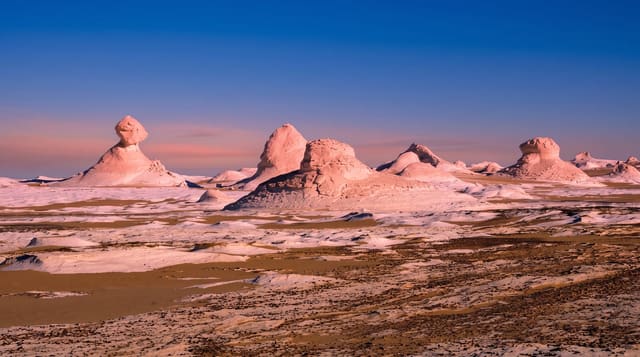
Dakhla stretches for about eighty kilometres along the foot of a pink and orange escarpment, a chain of villages and cultivation among palm groves fed by springs and wells, and it is the most immediately attractive of the Western Desert oases. Its centre is the modern town of Mut, but the reason to come is what lies around it: the medieval mud-brick town of Al-Qasr with its covered lanes and minaret, the Roman cemetery of Muzawaka with painted tombs, the temple of Deir el-Hagar, Balat with its Old Kingdom governors' cemetery at Ain Asil, and hot springs scattered through the groves. Sand dunes push against the cultivation on the northern side. It is quiet, with almost no organised tourism outside the desert circuits.
History
Nomads settled in the oasis at times during the Pleistocene, when the Sahara was wetter, and hunter-gatherers began to live here almost permanently in the Holocene; in the 3rd millennium BC the people of the Sheikh Muftah culture lived here, and contacts with the pharaonic state began around 2550 BC. In the late 6th Dynasty, far from any source of papyrus, officials at the governor's palace of Ayn Asil at Balat incised hieratic script into clay tablets, some five hundred of which have been found, with inventories, accounts and about fifty letters. The Roman temple of Deir el-Hagar was built under Nero and decorated under Vespasian, Titus and Domitian for the Theban triad and Seth, and the fortified Islamic town of al-Qasr was built in the 12th century on the remains of a Roman fort, its houses reusing inscribed blocks from the temple of Thoth at Amheida. European travellers arrived from 1819, the Egyptologist Herbert Winlock first recorded the monuments in 1908, and detailed study began with Ahmed Fakhry in the 1950s and the Dakhleh Oasis Project in the late 1970s (Wikipedia, Dakhla Oasis).
What's there
- The escarpment backdrop - pink and orange cliffs above the green.
- Al-Qasr - a medieval mud-brick town of covered lanes.
- Painted Roman tombs at Muzawaka - decorated chambers in the desert.
- Hot springs - bathing pools among the palms.
When to go
October to April. Two to three days to see the sites along the oasis properly. Winter nights are cold; days are pleasant. Buses connect to Kharga and Farafra, but a car makes the scattered sites practical.
Before you go
Sites are spread over eighty kilometres and public transport between them is poor, so a vehicle or a hired driver is close to necessary. Some tombs are locked and need a guard. Accommodation is limited. Restaurants are few and basic.
Nearby
Al-Qasr and Deir el-Hagar are within the oasis; Kharga lies east.
Key facts
Source: Wikidata, item Q1015386, read on 18 October 2026.
What to pack for Dakhla Oasis
Chosen from what this place is for. Tap a kit for the full checklist.
- Broken-in walking shoes or boots - Grip and ankle support matter more than looks; never hike in brand-new boots. Find on Amazon
- Loose, light, long clothing - Covering up beats bare skin in the desert - and locals dress this way for a reason. Find on Amazon
- Modest clothing - Shoulders and knees covered - the single most common requirement. Find on Amazon
- Swimwear - Needed at most public thermal pools; some traditional baths are nude and single-sex. Find on Amazon
Some links on this page are Amazon affiliate links - if you buy through them we may earn a small commission at no extra cost to you.
All packing kitsPlan your trip
Where to start if Dakhla Oasis is going on the list.
Booking links on this page are affiliate links - if you book through them we may earn a small commission at no extra cost to you. It never changes what we write about a place.
Opening times, ticket prices and seasonal closures change - check the official source before you go: official site.