Alexandria National Museum
A restored Italianate villa telling the city's story on three floors, Pharaonic in the basement and modern at the top.
Updated 19 October 2026
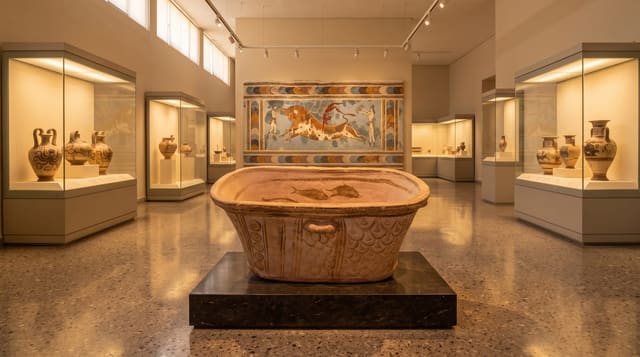
The museum opened in 2003 in the restored Al-Saad Bassili villa, a merchant's house of 1926 in Italian style that had later served as the American consulate, and its organisation is straightforward and effective: the basement holds Pharaonic material, the ground floor Graeco-Roman, and the upper floor Coptic, Islamic and modern, so a visitor walks up through the city's history in order. The collection is not enormous but it is well chosen and well lit, with underwater finds from the harbour, a reconstructed tomb chamber, coins, jewellery and everyday objects. Because it was designed as a coherent narrative rather than assembled over a century, it is the easiest museum in Alexandria for a first-time visitor to read.
History
The museum occupies an Italianate mansion of 1926, set in a large garden on Tariq al-Horreya, formerly Rue Fouad; built for a timber merchant, it was a meeting place of Alexandria's upper-class society and later housed the United States consulate. It was inaugurated as the Alexandria National Museum on 31 December 2003 (Wikipedia, Alexandria National Museum).
The main sights
- A chronological climb - Pharaonic below, modern at the top.
- Underwater harbour finds - objects raised from the sunken city.
- A reconstructed tomb chamber - built into the basement gallery.
- The 1926 villa - staircases and rooms of an Italianate merchant house.
When to go
April to November for Alexandria, though this is a good rainy-day option in winter. Mornings are quiet. Two hours covers all three floors comfortably. It is central and easy to reach on foot from the Corniche.
Practical notes
The collection is modest compared with Cairo and some visitors find it slight for the ticket price. Photography rules vary and are sometimes enforced strictly. The upper modern floor is the weakest section. There is limited seating.
Nearby
The Graeco-Roman Museum and Kom El Dikka are close; the Corniche is a short walk north.
Key facts
Source: Wikidata, item Q201383, read on 18 October 2026.
What to pack for Alexandria National Museum
Chosen from what this place is for. Tap a kit for the full checklist.
- Comfortable walking shoes - Sightseeing means kilometres of pavement and cobbles daily. Find on Amazon
- A slim anti-theft daypack - Zips that close properly; keep it in front in crowds and on transit. Find on Amazon
- A refillable water bottle - Many cities have public fountains; save money and plastic. Find on Amazon
- A light layer + compact umbrella - For museum air-con and a sudden shower. Find on Amazon
Some links on this page are Amazon affiliate links - if you buy through them we may earn a small commission at no extra cost to you.
All packing kitsPlan your trip
Where to start if Alexandria National Museum is going on the list.
Booking links on this page are affiliate links - if you book through them we may earn a small commission at no extra cost to you. It never changes what we write about a place.
Opening times, ticket prices and seasonal closures change - check the official source before you go: official site.