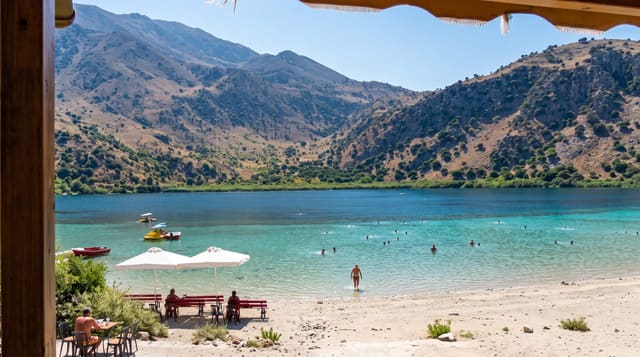
Cuicocha Lagoon
A crater lake 3 km wide and up to 200 m (656 ft) deep at the foot of the Cotacachi volcano, with two forested lava-dome islands.
Updated 6 November 2026

AI illustration
Cuicocha is a caldera and crater lake 3 km wide at the southern foot of the Cotacachi volcano, at the southern end of the Cotacachi-Cayapas Ecological Reserve, which runs from about 300 m (980 ft) in the west, part of the Chocó rainforest, up to the volcano. The caldera was blown out about 3,100 years ago by an eruption that sent out some 5 km³ of pyroclastic flows and covered the land around in ash up to 20 cm (8 in) deep; activity went on until 650 CE, and the highest dome of the caldera rises to 3,246 m (10,650 ft). In the lake, which is highly alkaline, up to 200 m (656 ft) deep and has no known outlet, four dacite lava domes form two steep forested islands, the smaller Yerovi and the larger Teodoro Wolf, named after the geologist Theodor Wolf, and no one is allowed on either. The name comes from Kichwa and is usually translated as lake of guinea pigs, after the shape of the larger island, or as rainbow lake. The islands support some wildlife, above all the silvery grebe, of which 44 were counted in 1974, and the lake is popular with hikers, with small boats on the water.
Background
Cuicocha, from Kichwa words read as lake of guinea pigs or rainbow lake, is a caldera 3 km wide holding a crater lake at the foot of the Cotacachi volcano, in the western range of the Ecuadorian Andes. It was formed about 3100 years ago by an eruption that released around 5 km³ of pyroclastic flows and buried the surroundings under ash up to 20 cm deep, and activity lasted until 650 CE. Four dacite lava domes in the lake form two steep wooded islands, Yerovi and Teodoro Wolf. The lake, 200 m (656 ft) deep at most, is highly alkaline, holds little life and has no known outlet.
Source: Wikipedia, "Cuicocha"
The landscape
- The crater rim - the walls of a caldera 3 km wide, popular with hikers and so steep that little sediment gathers for water plants.
- Boats on the lake - small boats ply the water; landing on the two lava-dome islands is not allowed.
- Cotacachi town - the "Leather Capital of Ecuador", with more than 50 artisanal leather shops, about 11 km to the east.
- Island plants and birds - about 400 plant species on the islands, home to Andean birds, and the silvery grebe in the reeds.
When to go
June to September and December to January. At the Sigsicunga weather station, 3,111 m (10,207 ft) up, average highs stay between 14.1 and 15.3 °C and lows between 5.0 and 6.1 °C all year; rain falls in every month, from about 60 mm in May and September to 119 mm in April. On the second day of Inti Raymi, at the June solstice, Kichwa shamans bathe in the lake for ritual cleansing.
Practical notes
No one is allowed on the islands. The volcano is regarded as potentially active: after an earthquake in 1987 the lake dropped by 6 m (20 ft) in a few days and has kept falling by up to 30 cm a year, gas escapes from several points on the lake floor, most strongly in the west at a depth of about 78 m (256 ft), and the water is slowly warming, so the caldera is monitored. In 2022 the International Union of Geological Sciences named the Cotacachi-Cuicocha volcanic complex one of its 100 geological heritage sites.
Nearby
In a straight line, the Cotacachi volcano rises about 7 km to the north-northeast, the town of Cotacachi is about 11 km to the east and Otavalo, whose Saturday market sells the woven textiles of the Otavalo people, about 13 km to the south-east; Imbabura volcano is about 21 km to the east-southeast, Ibarra about 27 km to the east-northeast and Quito about 60 km to the south-southwest. The Intag area of the Cotacachi and Otavalo cantons, with cloud forest between 1,800 and 2,800 m (5,900 and 9,190 ft), borders the reserve.
Key facts
Source: Wikidata, item Q1143300, read on 18 October 2026.
What to pack for Cuicocha Lagoon
Chosen from what this place is for. Tap a kit for the full checklist.
- Broken-in walking shoes or boots - Grip and ankle support matter more than looks; never hike in brand-new boots. Find on Amazon
- Reef-safe sunscreen - High SPF that will not bleach the coral you are swimming over. Find on Amazon
- Binoculars - The single best wildlife tool - even a compact pair transforms a sighting. Find on Amazon
- Strong insect repellent - DEET or picaridin; the jungle is where bites and disease risk are highest. Find on Amazon
Some links on this page are Amazon affiliate links - if you buy through them we may earn a small commission at no extra cost to you.
All packing kitsPlan your trip
Where to start if Cuicocha Lagoon is going on the list.
Booking links on this page are affiliate links - if you book through them we may earn a small commission at no extra cost to you. It never changes what we write about a place.
Opening times, ticket prices and seasonal closures change - check the official source before you go: official site.