The Columbus Lighthouse
An enormous cross-shaped concrete monument east of Santo Domingo that projects a cross of light into the sky when the power allows.
Updated 21 October 2026
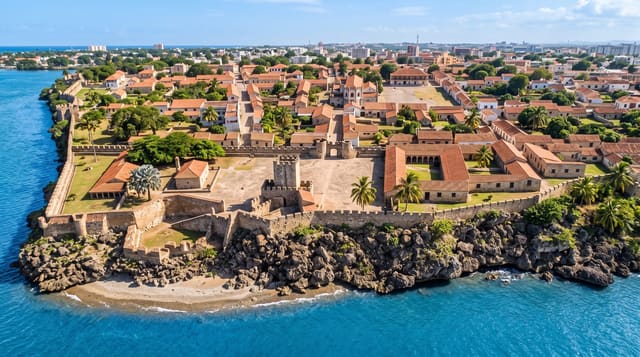
AI illustration
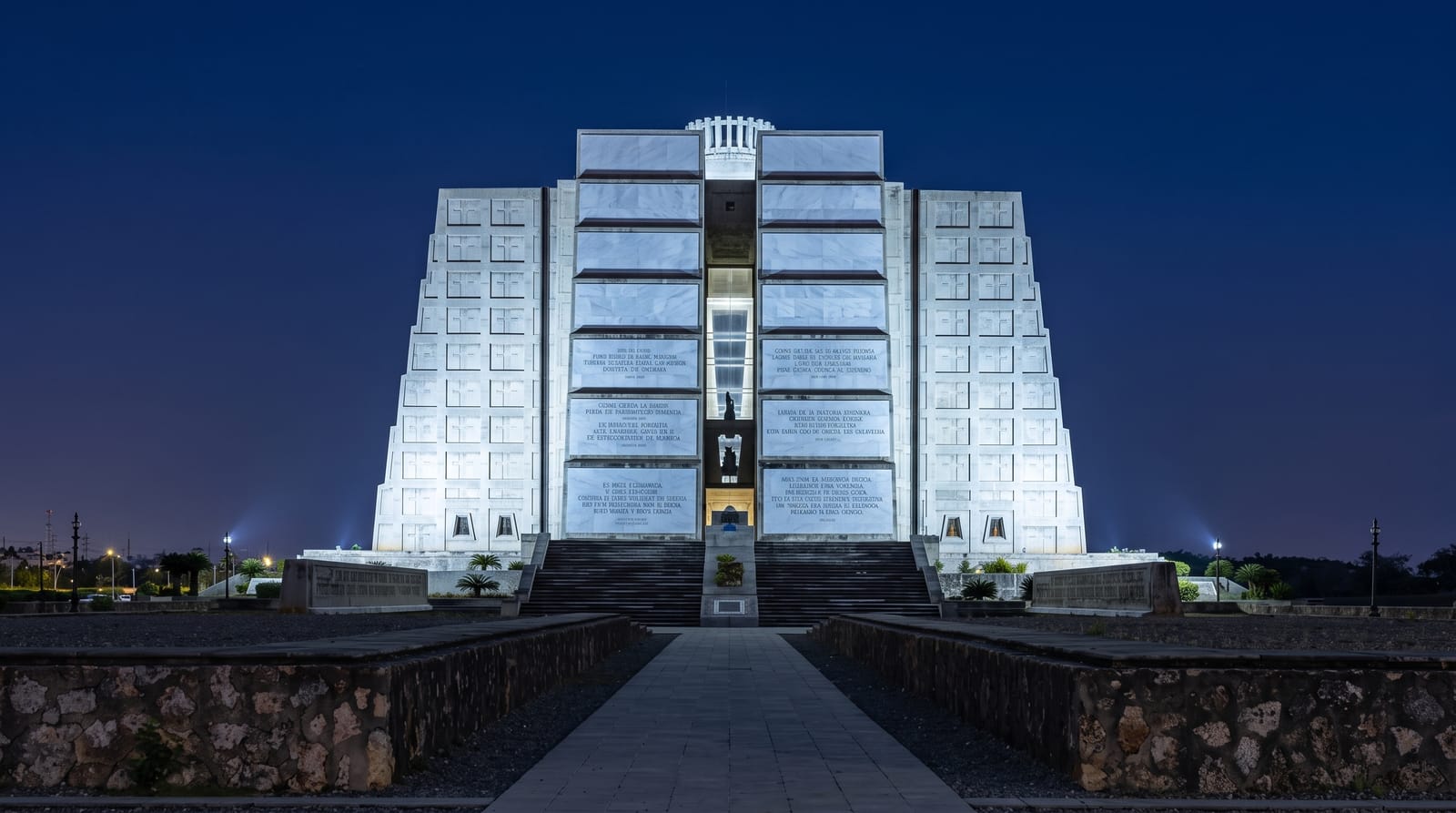
The idea of a monumental lighthouse to Columbus dates from the nineteenth century, and an international competition decided in 1931 was won by the Scottish architect Joseph Lea Gleave with a design for a colossal reclining cross. It was finally built for the 1992 quincentenary: a concrete slab some two hundred metres long lying flat on the ground in the shape of a cross, its arms holding museum galleries with displays donated by countries across the Americas and Europe. Set into it are 149 searchlights designed to throw a cross of light onto the clouds, visible for many kilometres, though they are fired rarely because of the strain on the electricity supply. A tomb inside claims to hold Columbus's remains, a claim Seville also makes.
History
The Dominican historian Antonio Delmonte y Tejada proposed a monument to Columbus in Santo Domingo in his History of Santo Domingo of 1852; from 1914 the American William Ellis promoted a monumental beacon in the first city of the New World, and in 1923 the Fifth International Conference of American States in Chile called on all the governments and peoples of the Americas to help build it. A competition held in Brazil in 1931, with 455 entrants from 48 countries and judges including Eliel Saarinen and Frank Lloyd Wright, was won by the Scottish architect Joseph Lea Gleave. By 1950 only eight countries had contributed, and although the foundation was dug in 1948 work stopped until 1986, when construction resumed under the Dominican architect Teófilo Carbonell; the monument was inaugurated in 1992 for the quincentenary of Columbus's first voyage, at a cost of about US$70 million. Conceived as a mausoleum, it was adapted to hold exhibitions from countries of the Americas, Europe and Asia, and its beams of light form a cross that can be seen from Puerto Rico (Wikipedia, Columbus Lighthouse).
What you'll find
- The structure - a two-hundred-metre concrete cross lying on the ground.
- The country galleries - displays contributed by nations across the Americas.
- The tomb - the disputed resting place of Columbus.
- The light beams - a cross projected onto the clouds, on the rare nights it runs.
When to go
November to April is drier. The searchlights are switched on only for particular occasions, so do not plan around seeing them. Mornings are cooler; the interior is not air-conditioned throughout. Closed on Mondays.
Practical notes
The building was hugely expensive and its construction displaced a large number of households, which remains a live grievance in the city and is not mentioned inside. The galleries are dated and unevenly maintained. The claim to Columbus's remains is contested by Seville, where DNA testing has supported the Spanish case. The surrounding district warrants ordinary caution.
Nearby
The Zona Colonial is across the river; the Tres Ojos caves are ten minutes east.
Key facts
Source: Wikidata, item Q2983646, read on 18 October 2026.
What to pack for The Columbus Lighthouse
Chosen from what this place is for. Tap a kit for the full checklist.
- Head torch + spare batteries - Hands-free light is essential; caves are truly dark. Find on Amazon
- Comfortable walking shoes - Sightseeing means kilometres of pavement and cobbles daily. Find on Amazon
- Grippy closed shoes - Cave floors are wet, muddy and slick with formations. Find on Amazon
- A slim anti-theft daypack - Zips that close properly; keep it in front in crowds and on transit. Find on Amazon
Some links on this page are Amazon affiliate links - if you buy through them we may earn a small commission at no extra cost to you.
All packing kitsPlan your trip
Where to start if The Columbus Lighthouse is going on the list.
Booking links on this page are affiliate links - if you book through them we may earn a small commission at no extra cost to you. It never changes what we write about a place.
Opening times, ticket prices and seasonal closures change - check the official source before you go: official site.