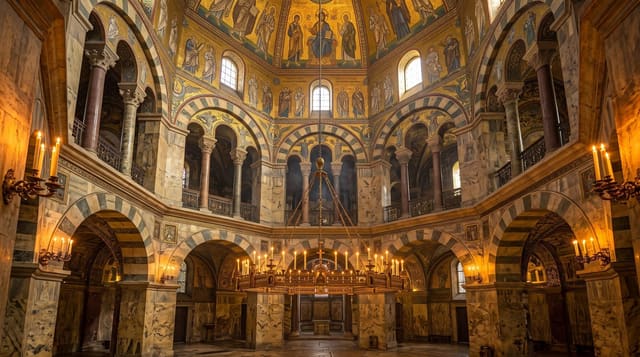
Soro Abbey
A twelfth-century Cistercian abbey church by a lake, holding royal tombs and the grave of Bishop Absalon.
Updated 21 October 2026
Soro Abbey was founded around 1140 by Bishop Absalon's father and uncle, passed to the Cistercians under Absalon in 1161, and became one of the wealthiest Cistercian houses in Denmark, and its church survives largely intact as the largest brick church of its period in the country, a long austere basilica of the plain Cistercian type on the shore of Soro Lake. Inside are the tombs of Absalon himself, buried behind the high altar, along with several medieval Danish kings including Valdemar Atterdag and Christopher II, and the poet Ludvig Holberg, who endowed the academy here. A crucifix of about 1247 hangs in the nave. After the Reformation the monastic buildings were converted into a school, Soro Academy, which still occupies the site in eighteenth-century buildings among mature trees by the water.
History
The brothers Ebbe Skjalmsen Hvide and Asser Rig, the most powerful nobles on Zealand, founded the abbey in 1140 and had it consecrated in 1142, and Asser spent his last years as a monk here before his death in 1151. His son Absalon, the warrior bishop of Zealand and adviser to several kings, replaced the Benedictines with Cistercian monks from Esrum in 1161, and they built the church and monastery in a new material, large red bricks, with technique and style brought from northern Germany. Gifts of land, beginning with Absalon's friend Peder Strang, made it the wealthiest monastic house in medieval Denmark, with an income larger than the royal family's. Absalon was buried behind the high altar, along with members of the Hvide family and three kings, Christopher II, Valdemar IV Atterdag and Oluf II; Queen Margaret I was also buried here before being moved to Roskilde. Much of the abbey burned in 1247 and lay in ruins for about ten years until a gift from the widow Ingeborg Strangessen paid for its rebuilding with vaults. After the Reformation of 1536 the crown confiscated it, and in 1623 it became Sorø Academy, a knight academy and later a boarding school (Wikipedia, Sorø Abbey).
Highlights
- A large plain brick basilica - the Cistercian church, largely unaltered.
- Absalon's tomb - the bishop buried behind the high altar.
- Medieval royal graves - Valdemar Atterdag and other kings.
- The academy and lakeside grounds - the school that replaced the monastery.
When to go
April to October for the grounds and the lake walk; the church is open year round outside services. Two hours. Autumn colour among the academy trees is very good. It is quiet at all times.
Practical notes
The monastic buildings themselves are gone, replaced by the school, so only the church is medieval. The academy grounds are a working school and access is limited in term time. Interpretation inside the church is minimal. The town has little else.
Nearby
Soro Lake is at the door; Ringsted and Roskilde lie east.
Key facts
Source: Wikidata, item Q4992573, read on 18 October 2026.
What to pack for Soro Abbey
Chosen from what this place is for. Tap a kit for the full checklist.
- Comfortable walking shoes - Sightseeing means kilometres of pavement and cobbles daily. Find on Amazon
- Modest clothing - Shoulders and knees covered - the single most common requirement. Find on Amazon
- A slim anti-theft daypack - Zips that close properly; keep it in front in crowds and on transit. Find on Amazon
- A scarf or shawl - To cover the head or shoulders on entry; women especially at mosques. Find on Amazon
Some links on this page are Amazon affiliate links - if you buy through them we may earn a small commission at no extra cost to you.
All packing kitsPlan your trip
Where to start if Soro Abbey is going on the list.
Booking links on this page are affiliate links - if you book through them we may earn a small commission at no extra cost to you. It never changes what we write about a place.
Opening times, ticket prices and seasonal closures change - check the official source before you go: official site.