Osek Monastery
A Cistercian abbey under the Ore Mountains with an early Gothic chapter house and a Dientzenhofer church.
Updated 21 October 2026
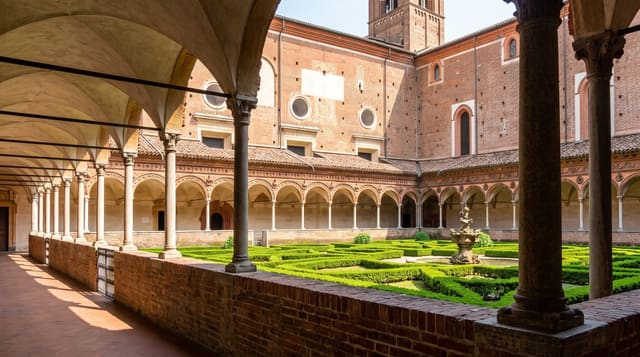
Osek was founded around 1196 and is one of the oldest Cistercian houses in Bohemia, sitting at the foot of the Ore Mountains where the range meets the brown-coal basin. Its most important survival is the chapter house of about 1240, an early Gothic room with a ribbed vault on slender columns and, in the middle, a stone reading desk of remarkable carving - a lectern of twisted columns, considered one of the finest pieces of thirteenth-century sculpture in the country. The church alongside was rebuilt from 1712 by Octavio Broggio in baroque with an interior of stucco, frescoes and altarpieces. In the twentieth century the surrounding landscape was reshaped by open-cast mining. Cistercians came back in 1991, though no monastic community lives there now.
History
The nobleman Milhošť invited Cistercian monks from Waldsassen Abbey in Bavaria to his manor at Mašťov at the end of the 12th century, but he diverted the monastery's income, and in 1198 the monks moved to Osek with the support of Slávek of the Hrabišici, chamberlain of King Ottokar I, whose heirs became the lords of Riesenburg. The abbey flourished in the first half of the 13th century, suffered when the future King Ottokar II sacked it during his rebellion, and in 1260 received from Boreš II of Riesenburg a relic of a finger of St John the Baptist. King John made it a royal abbey in the 14th century, and it prospered until Prague's Hussite armies burned it in 1421, after which it declined until Pope Gregory XIII dissolved it in 1580. Re-established in 1626 with the support of Archbishop John Lohelius, it appointed its own abbot again in 1650 and in the 18th century was rebuilt in Baroque style by Octavio Broggio. Cistercians returned after 1989, the last abbot, Bernhard Thebes, died in 2010 and lies in the church crypt, and in 1995 the monastery was declared a national cultural monument (Wikipedia, Osek Monastery).
Highlights
- A chapter house of about 1240 - early Gothic vaulting on slender columns.
- A carved stone lectern - twisted columns, among the finest Czech sculpture of its date.
- Broggio's baroque church - stucco, frescoes and altarpieces from 1712.
- A mining landscape - open-cast mining right up to the boundary.
When to go
April to October. Half a day.
Before you go
Guided tours only, seasonal, and it is a working monastery so access is limited. Restoration is unfinished. The surroundings are a post-mining landscape, which some visitors find bleak.
Nearby
Duchcov is south; the Ore Mountains rise directly behind.
Key facts
Source: Wikidata, item Q1775777, read on 18 October 2026.
What to pack for Osek Monastery
Chosen from what this place is for. Tap a kit for the full checklist.
- Comfortable walking shoes - Sightseeing means kilometres of pavement and cobbles daily. Find on Amazon
- Modest clothing - Shoulders and knees covered - the single most common requirement. Find on Amazon
- A slim anti-theft daypack - Zips that close properly; keep it in front in crowds and on transit. Find on Amazon
- A scarf or shawl - To cover the head or shoulders on entry; women especially at mosques. Find on Amazon
Some links on this page are Amazon affiliate links - if you buy through them we may earn a small commission at no extra cost to you.
All packing kitsPlan your trip
Where to start if Osek Monastery is going on the list.
Booking links on this page are affiliate links - if you book through them we may earn a small commission at no extra cost to you. It never changes what we write about a place.
Opening times, ticket prices and seasonal closures change - check the official source before you go: official site.