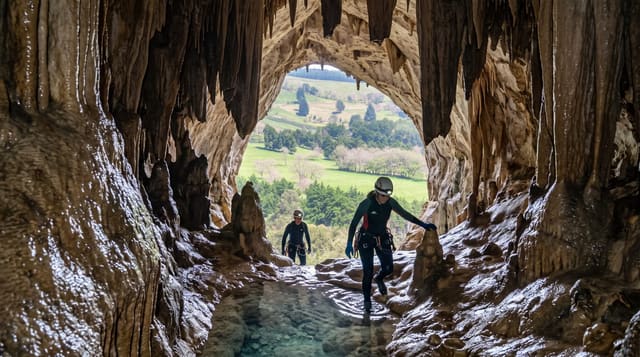
Mladec Caves
Caves holding some of the earliest modern human remains in Europe, found in the nineteenth century.
Updated 29 August 2026
The Mladec caves are a system of chambers and passages in limestone north of Litovel, and their importance is archaeological rather than scenic. Excavations from the 1880s recovered human skulls and bones together with animal remains and worked bone and stone, and the human material has been dated to around thirty-one thousand years, which places it among the earliest securely dated remains of anatomically modern humans in Europe and makes Mladec a reference site in the debate about how and when modern humans spread into the continent. Much of the original material was lost in a fire at Mikulov castle in 1945; what survived is in museums. The visitor route is about four hundred metres through chambers with dripstone and a display on the finds. The caves are also a bat hibernation site, so opening is seasonal and parts are closed in winter.
What's there
- Early modern human finds - remains dated to around thirty-one thousand years.
- A reference site - central to the debate on when modern humans reached Europe.
- A four-hundred-metre route - chambers with dripstone and a display on the finds.
- A bat hibernation roost - which closes parts of the system in winter.
When to go
April to October. Two hours.
What to expect
Guided tours only, seasonal, with parts closed in winter for bats. The dripstone is modest compared with Javoricko - the reason to come is the archaeology. The original finds are in museums elsewhere.
Nearby
Javoricko caves are south; Litovel and its floodplain forests are close.
Key facts
Source: Wikidata, item Q11087651, read on 18 October 2026.
What to pack for Mladec Caves
Chosen from what this place is for. Tap a kit for the full checklist.
- Head torch + spare batteries - Hands-free light is essential; caves are truly dark. Find on Amazon
- Grippy closed shoes - Cave floors are wet, muddy and slick with formations. Find on Amazon
- A warm layer - Many caves sit near 10°C year-round, even in a hot country. Find on Amazon
- Gloves - Protect your hands on rough rock and cold metal handrails. Find on Amazon
Some links on this page are Amazon affiliate links - if you buy through them we may earn a small commission at no extra cost to you.
All packing kitsPlan your trip
Where to start if Mladec Caves is going on the list.
Booking links on this page are affiliate links - if you book through them we may earn a small commission at no extra cost to you. It never changes what we write about a place.
Opening times, ticket prices and seasonal closures change - check the official source before you go: official site.