Pulu Keeling National Park
The northern atoll - the uninhabited ring 24 kilometres north, seabird metropolis and the group's strictest sanctuary.
Updated 16 October 2026
AI illustration
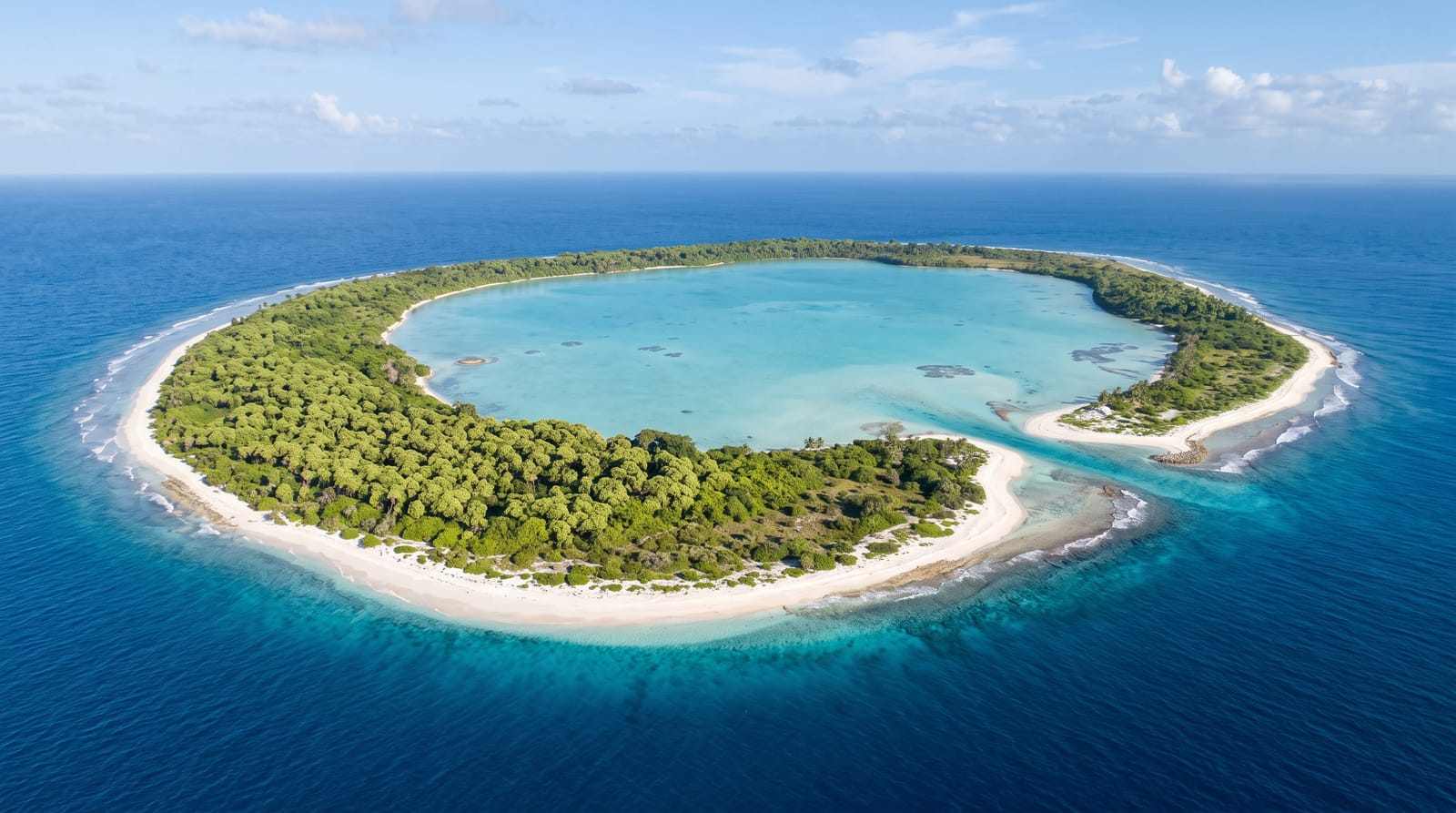
Twenty-four kilometres north of the inhabited atoll, North Keeling rings its lagoon as Pulu Keeling National Park - the group's sanctuary absolute, uninhabited and landing-restricted, where the seabird metropolis compensates the emptiness: red-footed boobies in tens of thousands, frigatebirds, terns and the endemic Cocos buff-banded rail holding its recovered numbers on the one ring where cats and rats never ruled. The park's history includes the SMS Emden's 1914 end on the reef - the wreck's remnants a protected footnote. Landings run rare, permitted and swell-dependent through the park's arrangements; the sanctuary's point is precisely how seldom.
Background
North Keeling is a coral atoll of approximately 1.2 square kilometres. It lies about 25 kilometres to the north of Horsburgh Island. It is a single C-shaped island, a ring almost closed around a lagoon of about 0.5 square kilometres, with a small opening of about 50 metres on its eastern side. The national park dates from 12 December 1995 and reaches 1.5 kilometres out to sea. It became Ramsar Site 797 on 17 March 1996. A Swedish captain, Ekeberg, sketched the island in 1749 with coconut palms on it. In 1836 Robert FitzRoy and Charles Darwin came by in the Beagle but could not land. After Cyclone John hit the red-footed booby colony in 1989, legal hunting stopped.
Source: Wikipedia, "North Keeling"
What you'll find
- The booby metropolis - tens of thousands on the ring.
- The endemic rail - the recovered island survivor.
- The sanctuary lagoon - the closed ring's green-blue heart.
- The Emden footnote - the 1914 wreck's protected trace.
When to go
April to October in principle - permits, park arrangements and swell govern the rare landings entirely.
Before you go
Access is deliberately exceptional - most visitors meet the park as a horizon and a story; that scarcity is the conservation working.
Nearby
The southern atoll's islands across the open water.
Key facts
Source: Wikidata, item Q1336227, read on 18 October 2026.
What to pack for Pulu Keeling National Park
Chosen from what this place is for. Tap a kit for the full checklist.
- Broken-in walking shoes or boots - Grip and ankle support matter more than looks; never hike in brand-new boots. Find on Amazon
- Reef-safe sunscreen - High SPF that will not bleach the coral you are swimming over. Find on Amazon
- Binoculars - The single best wildlife tool - even a compact pair transforms a sighting. Find on Amazon
- Layers + a waterproof shell - Mountain weather turns fast; a packable rain jacket saves the day. Find on Amazon
Some links on this page are Amazon affiliate links - if you buy through them we may earn a small commission at no extra cost to you.
All packing kitsPlan your trip
Where to start if Pulu Keeling National Park is going on the list.
Booking links on this page are affiliate links - if you book through them we may earn a small commission at no extra cost to you. It never changes what we write about a place.
Opening times, ticket prices and seasonal closures change - check the official source before you go: official site.