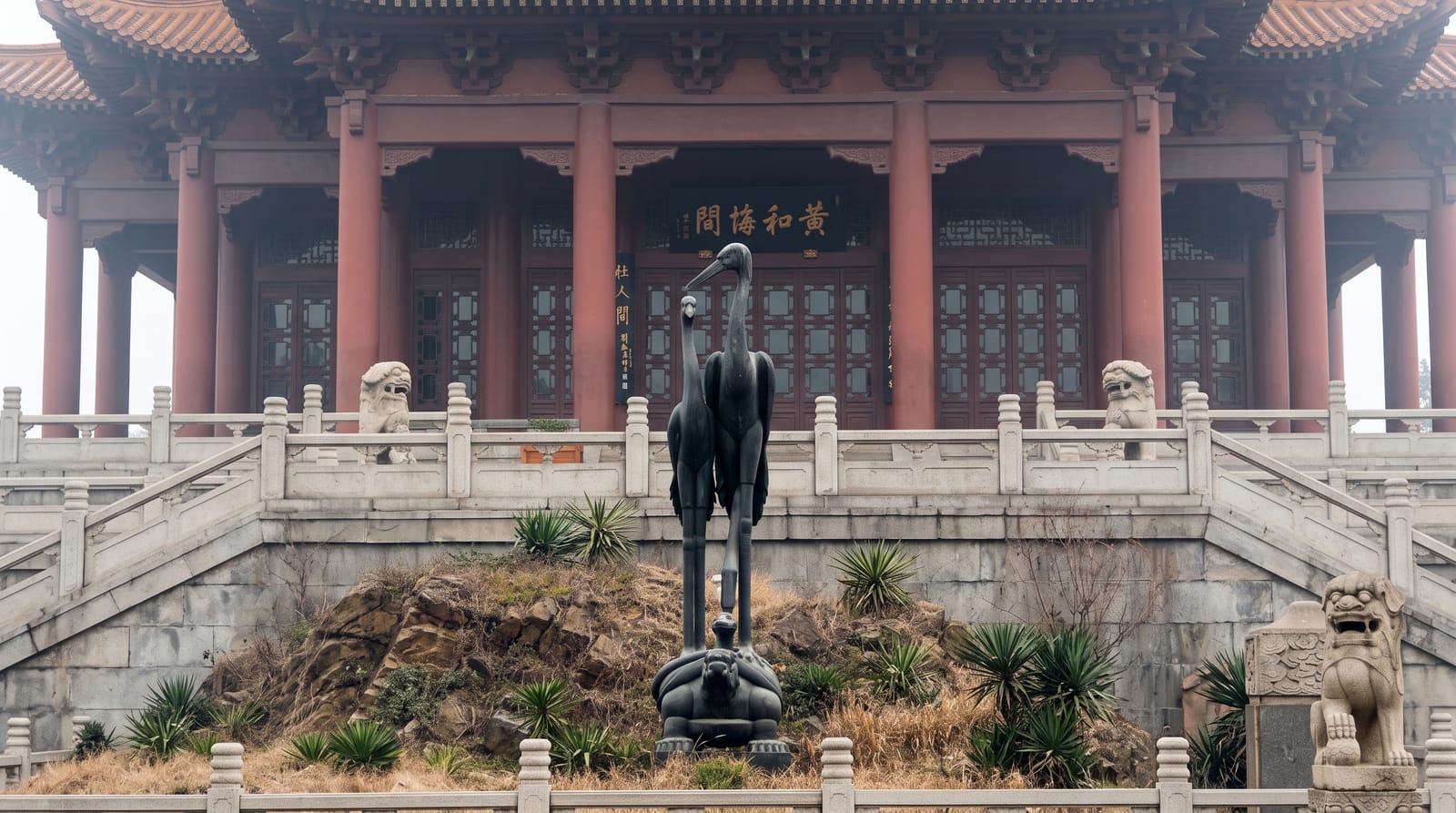
Wudang Mountains
A UNESCO Taoist mountain of Ming palaces and a bronze hall on the summit, and the traditional home of internal martial arts.
Updated 18 October 2026
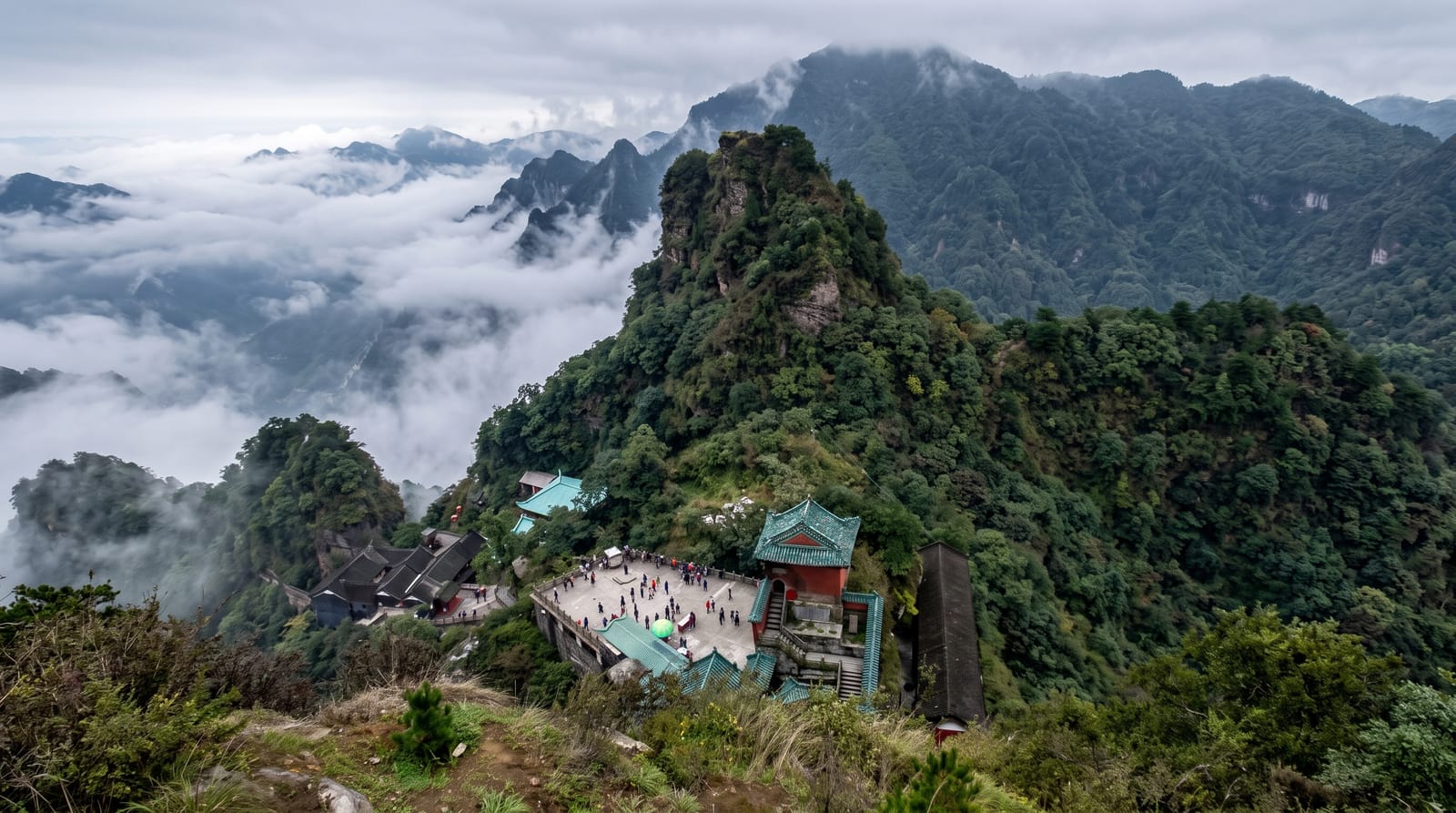
AI illustration
UNESCO World Heritage
The Yongle Emperor built a vast complex on Wudangshan in the early fifteenth century, employing hundreds of thousands of workers over a decade to construct palaces, monasteries and halls up the mountain in an arrangement that culminates at the Golden Hall on the Heavenly Pillar Peak, a hall cast entirely in gilded bronze in 1416 and assembled at 1,612 metres. UNESCO inscribed the ancient buildings in 1994. The mountain is the traditional home of Wudang internal martial arts, associated with the semi-legendary Zhang Sanfeng, and schools on the mountain teach taijiquan, qigong and sword forms to Chinese and foreign students. The Purple Cloud Palace of 1119 is the largest surviving complex.
History
The first sacred site on Wudang, the Five Dragons Temple, was built at the behest of the Tang emperor Taizong, more structures followed under the Song and Yuan, and the largest complex went up in the Ming dynasty, when the Yongle Emperor claimed the protection of the god Xuantian Shangdi; at that time the mountain held 9 palaces, 9 monasteries, 36 nunneries and 72 temples. Among the oldest surviving buildings are the Golden Hall and the Ancient Bronze Shrine of 1307, along with the Nanyang Palace (1285-1310), the walled Forbidden City of the Taihe Palace on the peak (1419) and the Purple Cloud Temple, built in 1119-1126 and rebuilt in 1413; 53 ancient buildings survive, and they were made a World Heritage Site in 1994. On 19 January 2003 a fire started accidentally by an employee of a martial arts school reduced three rooms of the 600-year-old Yuzhen Palace to ashes (Wikipedia, Wudang Mountains).
The main sights
- The Golden Hall - the gilded bronze hall of 1416 on the summit.
- The Purple Cloud Palace - the largest surviving Ming temple complex.
- The martial arts schools - Wudang forms taught on the mountain.
- The summit approach - stairways and cable car to the Heavenly Pillar Peak.
When to go
April to June and September to November; the summit is often in cloud and can be cold in any season. Summer holidays and Chinese festivals bring severe crowds on the summit stairs. Winter brings ice.
What to expect
Compulsory shuttle buses within the park plus cable car plus entry make it expensive. The final stairs to the Golden Hall are steep and extremely crowded at peak times. Martial arts training needs advance arrangement with a school.
Nearby
Shiyan lies west; the Danjiangkou reservoir is north.
Key facts
Source: Wikidata, item Q4034, read on 18 October 2026.
What to pack for Wudang Mountains
Chosen from what this place is for. Tap a kit for the full checklist.
- Comfortable walking shoes - Sightseeing means kilometres of pavement and cobbles daily. Find on Amazon
- Modest clothing - Shoulders and knees covered - the single most common requirement. Find on Amazon
- A slim anti-theft daypack - Zips that close properly; keep it in front in crowds and on transit. Find on Amazon
- A scarf or shawl - To cover the head or shoulders on entry; women especially at mosques. Find on Amazon
Some links on this page are Amazon affiliate links - if you buy through them we may earn a small commission at no extra cost to you.
All packing kitsPlan your trip
Where to start if Wudang Mountains is going on the list.
Booking links on this page are affiliate links - if you book through them we may earn a small commission at no extra cost to you. It never changes what we write about a place.
Opening times, ticket prices and seasonal closures change - check the official source before you go: official site.