The Great Wall of China
The greatest fortification ever built - an ancient wall snaking for thousands of kilometres over mountains and desert, one of the world's most awe-inspiring sights, a UNESCO wonder.
Updated 18 October 2026
AI illustration
UNESCO World Heritage
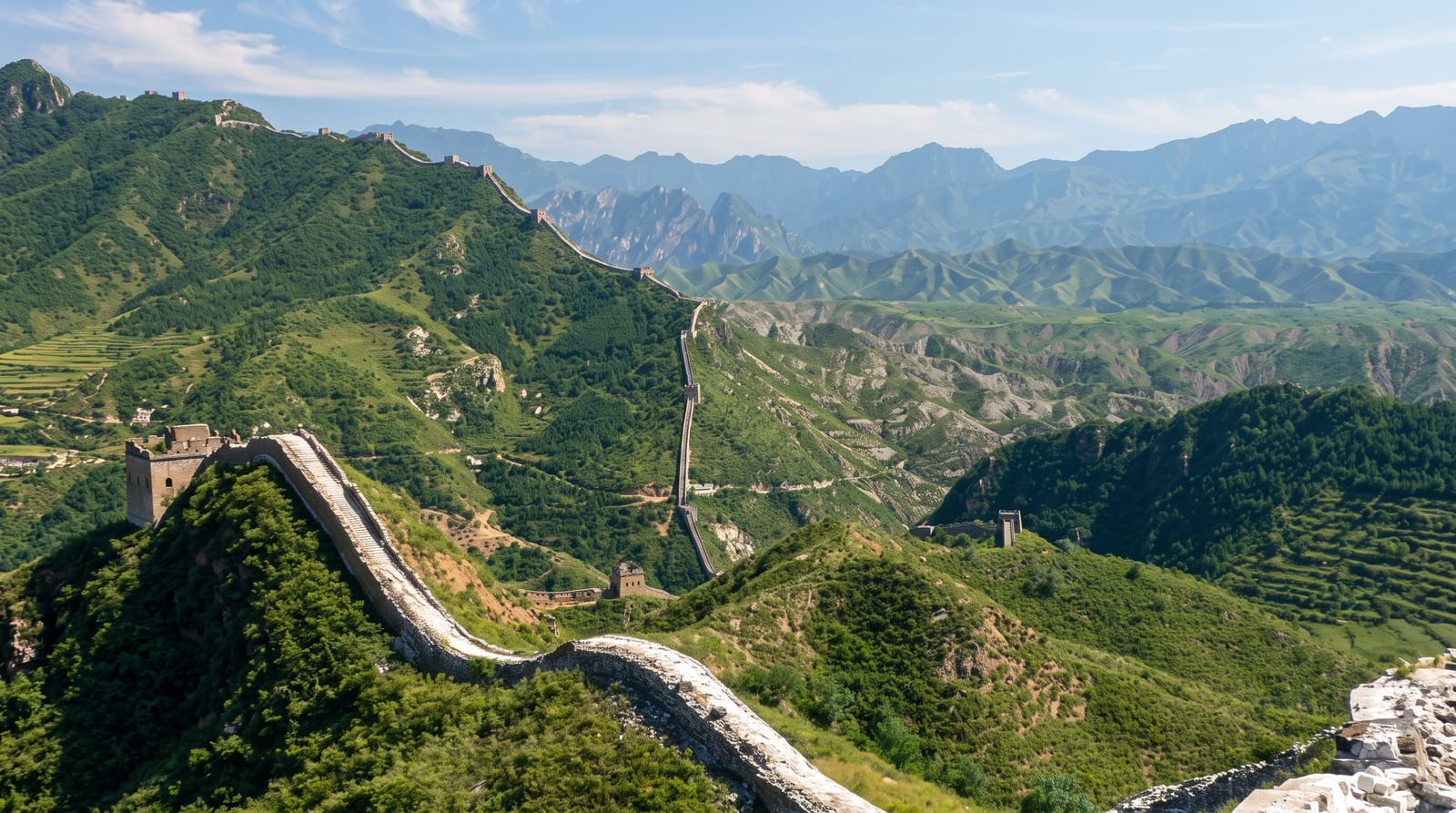
The Great Wall of China is the greatest fortification ever built, an ancient network of walls, watchtowers and ramparts that snakes for thousands of kilometres across the mountains, grasslands and deserts of northern China. Built and rebuilt over two millennia to guard the empire from northern invaders, its most spectacular restored sections climb dizzyingly steep ridges near Beijing, a UNESCO wonder and one of the most awe-inspiring human achievements on earth.
History
The first walls date to the 7th century BC, when states such as Qi, Chu, Qin, Zhao and Yan fortified their borders with stone and rammed earth. After Qin unified China in 221 BC, the First Emperor had the walls between the former states pulled down and ordered new ones to join the remaining fortifications along the northern frontier against the Xiongnu; the Han, the Northern dynasties and the Sui repaired and extended them, and the Northern Wei, Liao, Jin and Western Xia built walls further north. The best-known sections are those of the Ming dynasty (1368-1644), which after its defeat by the Oirats at Tumu built stronger walls of brick and stone along the southern edge of the Ordos Desert, with up to 25,000 watchtowers (Wikipedia, Great Wall of China).
Highlights
- The restored ramparts - the wall climbing the steep ridges near Beijing.
- The watchtowers - the beacon towers strung along the wall.
- Mutianyu - the popular, less crowded restored section with a cable car.
- The wild wall - the crumbling, unrestored stretches for the adventurous.
When to go
Spring and autumn for the mildest weather and clearest skies, avoiding the summer heat and haze and winter cold; go early to beat the crowds. Mutianyu is generally less crowded and more scenic than the very busy Badaling.
Things to know
The nearest and most famous section, Badaling, is extremely crowded, so Mutianyu or the quieter, wilder sections are far more rewarding. The wall is genuinely steep and strenuous in places, with uneven steps, so it is more of a hike than a stroll. It is a day trip from Beijing, and the restored parts are just a fraction of the whole.
Nearby
Beijing with the Forbidden City and the Ming Tombs are within reach.
Key facts
Source: Wikidata, item Q12501, read on 18 October 2026.
What to pack for The Great Wall of China
Chosen from what this place is for. Tap a kit for the full checklist.
- Broken-in walking shoes or boots - Grip and ankle support matter more than looks; never hike in brand-new boots. Find on Amazon
- Loose, light, long clothing - Covering up beats bare skin in the desert - and locals dress this way for a reason. Find on Amazon
- Comfortable walking shoes - Sightseeing means kilometres of pavement and cobbles daily. Find on Amazon
- Layers + a waterproof shell - Mountain weather turns fast; a packable rain jacket saves the day. Find on Amazon
Some links on this page are Amazon affiliate links - if you buy through them we may earn a small commission at no extra cost to you.
All packing kitsPlan your trip
Where to start if The Great Wall of China is going on the list.
Booking links on this page are affiliate links - if you book through them we may earn a small commission at no extra cost to you. It never changes what we write about a place.
Opening times, ticket prices and seasonal closures change - check the official source before you go: official site.