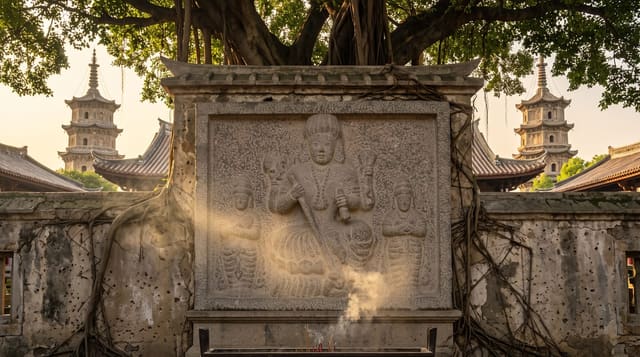
Chongwu Ancient Town
A Ming coastal fortress built entirely of granite in 1387 against pirate raids, its walls still complete.
Updated 4 September 2026

AI illustration
Chongwu was built in 1387 as one of a chain of coastal garrisons against Japanese pirate raids, and unlike most such towns its wall survives complete: around two and a half kilometres of granite, four gates and towers, standing on a headland above the sea. Granite defines the whole town, since Hui'an is a centre of stone carving and the local quarries supplied the material; houses, lanes and even roof weights are stone. The Hui'an women are known for a distinctive dress of short jacket, wide trousers and bright headscarf, still worn by older generations, and for their historic role in heavy work including stone carving and construction.
What you'll find
- The granite wall - two and a half kilometres of Ming fortification, complete.
- The stone town - houses and lanes built almost entirely of granite.
- The Hui'an dress - the distinctive local women's clothing still worn.
- The stone carving - the sculpture park and workshops of the district.
When to go
October to April for mild weather; summer is hot and typhoon-prone. The town is quiet on weekdays. Coastal wind is constant on the headland.
Good to know
Parts of the wall and town have been restored for tourism, with a sculpture park that some find kitsch. The Hui'an dress is worn mainly by older women and photographing people without asking is intrusive. Entry is charged.
Nearby
Quanzhou lies west; Xiamen is southwest along the coast.
Key facts
Source: Wikidata, item Q17498509, read on 18 October 2026.
What to pack for Chongwu Ancient Town
Chosen from what this place is for. Tap a kit for the full checklist.
- Comfortable walking shoes - Sightseeing means kilometres of pavement and cobbles daily. Find on Amazon
- A slim anti-theft daypack - Zips that close properly; keep it in front in crowds and on transit. Find on Amazon
- A refillable water bottle - Many cities have public fountains; save money and plastic. Find on Amazon
- A light layer + compact umbrella - For museum air-con and a sudden shower. Find on Amazon
Some links on this page are Amazon affiliate links - if you buy through them we may earn a small commission at no extra cost to you.
All packing kitsPlan your trip
Where to start if Chongwu Ancient Town is going on the list.
Booking links on this page are affiliate links - if you book through them we may earn a small commission at no extra cost to you. It never changes what we write about a place.
Opening times, ticket prices and seasonal closures change - check the official source before you go: official site.