Bamingui-Bangoran National Park
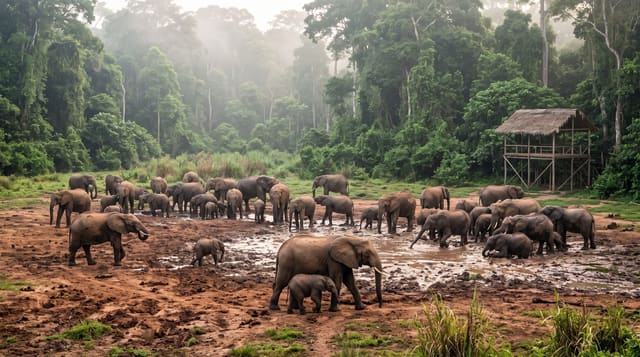
The wild savanna of the north - the vast Bamingui-Bangoran National Park, a remote wilderness of wooded savanna, rivers and rock outcrops sheltering elephants, antelope, lions and rich birdlife across one of central Africa's great protected landscapes.
Updated 1 November 2026
Bamingui-Bangoran National Park, spread across the wooded savannas of northern Central African Republic, is one of the country's great wilderness areas, part of a vast biosphere reserve of grassland, gallery forest, rivers and scattered granite outcrops. Far from the rainforests of the south, this is classic central African savanna country, sheltering elephants, buffalo, antelope such as roan and hartebeest, lions and a wealth of birdlife across an immense and little-visited landscape. Rivers and seasonal water holes draw wildlife across the plains, and the landscape is roadless and little visited. Poaching, timber and mining concessions and farm clearing have thinned its wildlife: antelope have declined sharply since 1960, and the western black rhino, once found here, has been gone from the country since 1986.
Background
The park and biosphere reserve was established in 1993 in the centre-north of the country, west of N'Délé and close to the border with Chad; it lies west of Manovo-Gounda St. Floris and holds more wild animals, at a higher density, than that park. It covers 1,070,000 hectares of plateau at 400 to 500 metres, draining north-west to the Chari, and protects 202 km of floodplain on the left bank of the Bamingui and 105 km on the Bangoran. Rains fall from May to October in the south and from June to September in the north, on dry forest, wooded and edaphic savanna and gallery forest with Terminalia, Isoberlinia doka and Anogeissus. BirdLife International lists it as an Important Bird Area, and it shares the red-faced lovebird only with Gashaka Gumti in Nigeria.
Source: Wikipedia, "Bamingui-Bangoran National Park and Biosphere Reserve"
What's there
- The savanna wildlife - the elephants, buffalo, antelope and lions.
- The gallery forests - the wooded ribbons along the rivers.
- The granite outcrops - the rocky hills rising from the plains.
- The wild rivers - the waters and water holes drawing wildlife.
When to go
December to April, the dry season, is the most practical time to reach the remote north and for wildlife viewing, when animals gather at shrinking water sources and tracks are passable; the rains make the region largely inaccessible. This is an expedition destination requiring specialist organisation.
Before you go
Bamingui-Bangoran is exceptionally remote with almost no tourism infrastructure, so it is a true expedition destination for the committed and well-organised rather than a conventional safari, and wildlife is wild and dispersed. Its wildlife has been thinned by poaching and clearing, and security conditions in the region change, so check official travel advice before planning a visit.
Nearby
The town of Ndélé and the wider northern savanna lie around the park.
Key facts
Source: Wikidata, item Q1885849, read on 18 October 2026.
What to pack for Bamingui-Bangoran National Park
Chosen from what this place is for. Tap a kit for the full checklist.
- Broken-in walking shoes or boots - Grip and ankle support matter more than looks; never hike in brand-new boots. Find on Amazon
- Binoculars - The single best wildlife tool - even a compact pair transforms a sighting. Find on Amazon
- Strong insect repellent - DEET or picaridin; the jungle is where bites and disease risk are highest. Find on Amazon
- Shelter suited to the place - Tent, tarp or hut booking - match it to the terrain and rules. Find on Amazon
Some links on this page are Amazon affiliate links - if you buy through them we may earn a small commission at no extra cost to you.
All packing kitsPlan your trip
Where to start if Bamingui-Bangoran National Park is going on the list.
Booking links on this page are affiliate links - if you book through them we may earn a small commission at no extra cost to you. It never changes what we write about a place.
Opening times, ticket prices and seasonal closures change - check the official source before you go: official site.