Sherbrooke Village
A gold-rush village where the buildings never moved, restored in place with residents still living around them.
Updated 16 October 2026
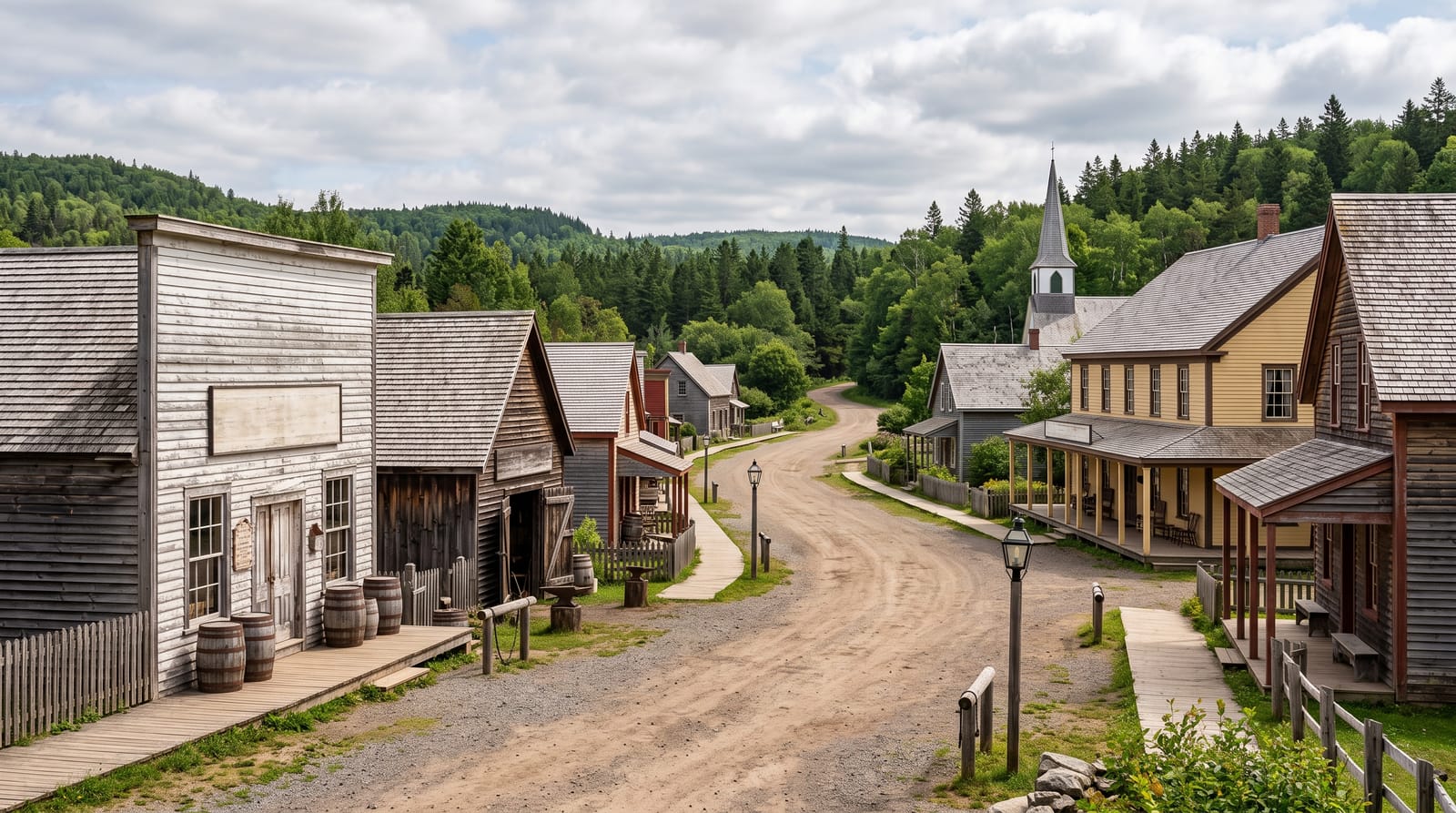
AI illustration
Sherbrooke boomed on gold and lumber in the 1860s and 1870s and then declined, leaving its buildings in place. Restoration began in 1969, and what distinguishes the site from most living history villages is that nothing was moved: about twenty-five buildings stand where they were built, in a village where people still live and work around them. Costumed staff run a working blacksmith, a pottery, a printing office and a boat shop, and a water-powered sawmill operates upstream. The ambrotype photographic studio makes portraits by the wet-plate process on request, which few places anywhere still do.
Background
The community lies on the St. Mary's River, which runs for over 200 kilometres in three main branches. Among the first settlers, in 1805, were James Fisher and his three sons, who came from New Hampshire. A schoolhouse followed in 1815, and by 1818 the place had two sawmills, a gristmill, a post office and about twenty houses. An Anglican church went up in 1850. Gold was found in 1861 and the rush lasted two decades. Mining went on into the early 20th century and then stopped, and by 1921 the population had fallen steeply. In 1907 a Roman Catholic church dating from 1871 was moved here from nearby Goldenville. Sherbrooke Village belongs to the Nova Scotia Museum system.
Source: Wikipedia, "Sherbrooke, Nova Scotia"
What you'll find
- The in-place buildings - about twenty-five restored where they were built.
- The wet-plate studio - portraits made by the ambrotype process.
- The working sawmill - a water-powered mill cutting timber upstream.
- The living village - residents and a working community around the site.
When to go
June to October for the staffed village; the site closes for winter apart from a Christmas programme. Weekdays outside school trips are quieter.
Practical notes
Closed for most of the winter. The Eastern Shore is a long drive with few services. Not every building is staffed on quiet days.
Nearby
The 100 Wild Islands lie south-west; Antigonish is north.
Key facts
Source: Wikidata, item Q3481907, read on 18 October 2026.
What to pack for Sherbrooke Village
Chosen from what this place is for. Tap a kit for the full checklist.
- Comfortable walking shoes - Sightseeing means kilometres of pavement and cobbles daily. Find on Amazon
- A slim anti-theft daypack - Zips that close properly; keep it in front in crowds and on transit. Find on Amazon
- A refillable water bottle - Many cities have public fountains; save money and plastic. Find on Amazon
- A light layer + compact umbrella - For museum air-con and a sudden shower. Find on Amazon
Some links on this page are Amazon affiliate links - if you buy through them we may earn a small commission at no extra cost to you.
All packing kitsPlan your trip
Where to start if Sherbrooke Village is going on the list.
Booking links on this page are affiliate links - if you book through them we may earn a small commission at no extra cost to you. It never changes what we write about a place.
Opening times, ticket prices and seasonal closures change - check the official source before you go: official site.