Pliska
The first capital of the Bulgarian state, a very large walled site on the plain near Shumen.
Updated 19 October 2026
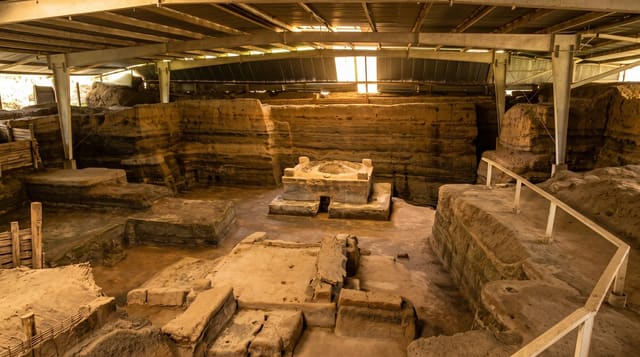
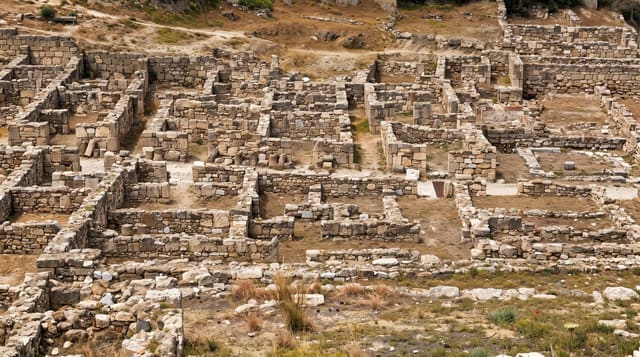
Pliska was founded around 681 as the capital of the first Bulgarian state and held that role for two centuries, and its scale is the striking thing: an outer earth rampart enclosing about twenty-three square kilometres, with an inner stone-walled town of half a square kilometre inside it holding the palace, a throne hall, a bath, water systems and, after the conversion in the 860s, the Great Basilica, which was among the largest churches in Europe when it was built. The site was abandoned when the capital moved to Preslav. What is visible is foundations, wall stretches, the reconstructed eastern gate and the basilica plan, spread over open ground with a museum at the entrance.
History
Pliska was the capital of the First Bulgarian Empire from 681 to 893; tradition says Khan Asparuh founded it, though archaeology has not confirmed this, and by the early 9th century an outer earthwork 21 kilometres long enclosed some 2,300 hectares around a walled inner town with a palace. In 811 the Byzantine emperor Nikephoros I burned the largely wooden royal residence, under Boris I the pagan temples began to be turned into churches after the conversion of 864-865, and the literary school Boris founded here in 886 moved to Preslav when the capital did (Wikipedia, Pliska).
What you'll find
- A twenty-three-square-kilometre enclosure - the scale of the outer rampart.
- The Great Basilica - among the largest churches in Europe when built.
- Palace and throne hall foundations - the inner town plan.
- The reconstructed eastern gate - the rebuilt entrance to the inner walls.
When to go
April to October. Two hours. There is no shade on the open site and summer is hot. Mornings are better. It combines with Veliki Preslav and Madara on one circuit.
Before you go
Everything is at foundation level and the scale is hard to grasp on the ground. There is no shade. Interpretation is limited in English. The museum is small. Distances between the parts of the site require walking or driving.
Nearby
Madara Rider is south; Veliki Preslav lies south-west.
What to pack for Pliska
Chosen from what this place is for. Tap a kit for the full checklist.
- Comfortable walking shoes - Sightseeing means kilometres of pavement and cobbles daily. Find on Amazon
- Modest clothing - Shoulders and knees covered - the single most common requirement. Find on Amazon
- A slim anti-theft daypack - Zips that close properly; keep it in front in crowds and on transit. Find on Amazon
- A scarf or shawl - To cover the head or shoulders on entry; women especially at mosques. Find on Amazon
Some links on this page are Amazon affiliate links - if you buy through them we may earn a small commission at no extra cost to you.
All packing kitsPlan your trip
Where to start if Pliska is going on the list.
Booking links on this page are affiliate links - if you book through them we may earn a small commission at no extra cost to you. It never changes what we write about a place.
Opening times, ticket prices and seasonal closures change - check the official source before you go: official site.