Why Japan Runs on 100 Volts
Japan has the lowest mains voltage in the world, and half the country runs on a different frequency than the other half. The odd history of the world's plugs.

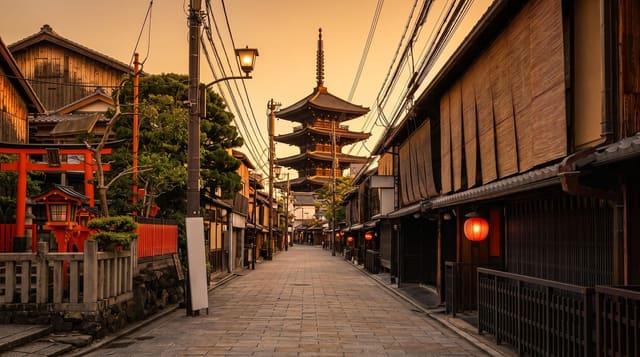
AI illustration.
Some links on this page are Amazon affiliate links - if you buy through them we may earn a small commission at no extra cost to you.
Plug a kettle into a Tokyo socket and it boils noticeably slower than at home. Japan runs on 100 volts, the lowest mains voltage of any country on earth, and that is only half of the story: east and west Japan do not even share the same frequency.
A country split down the middle
In the 1890s, Tokyo's electric company bought its generators from Germany, which ran at 50 hertz. Osaka bought American generators, which ran at 60. Both halves grew their grids outward until they met in the middle, and by then it was far too late to change. To this day, eastern Japan (Tokyo, Sendai, Hokkaido) runs at 50 Hz and western Japan (Osaka, Kyoto, Nagoya) at 60 Hz, with special converter stations stitching the two halves together. It is the only major country in the world split this way.
Why 100 volts
Japan settled on 100 volts early, when electric lighting was the main use for power, and lower voltage meant safer wiring in wooden houses. While Europe later climbed to 230 volts for efficiency and America stayed at 120, Japan kept its gentle 100. Modern electronics do not mind at all: phone chargers, laptops and cameras are built for anything from 100 to 240 volts. The things that suffer are heating appliances, which is why your hotel kettle takes its time.
The world's plug chaos, briefly
The reason a "universal" adapter has so many sliding parts is that electricity spread before anyone agreed on standards. Britain built its chunky three-pin Type G around post-war copper shortages and put fuses in the plugs. Europe's two round pins became Type C and its cousins. America's flat pins went everywhere its industry did, which is why Japan's sockets look American even though the voltage is not. More than a dozen plug types survive today, and every one of them made sense to somebody at the time.
What this means for your bag
- A universal travel adapter solves the pin problem everywhere; check our essentials kit for the rest.
- Check the label on hair dryers and straighteners: if it does not say 100-240V, leave it at home.
- Every country page on Meridiela now lists its plug types and voltage in the practical facts, so you can check before you fly - see Japan for the 100-volt proof.
Japan's grid is a museum of early electricity that simply never closed. Your phone will not notice. Your kettle will.
When to go and how long
- Shibuya Crossing, Tokyo Japan Best season Year-round Time to allow One to two hours
- Higashiyama and Gion, Kyoto Japan Best season March to May and October to November Time to allow A day
Taken from each place page, where opening rules and the official link are kept.