The Tiger's Nest (Paro Taktsang)
Paro Taktsang, the Tiger's Nest: a sacred Vajrayana Buddhist site on a cliff about 900 metres above the Paro valley, with a shrine built in 1692 around the cave where Guru Rinpoche is said to have meditated.
Updated 15 November 2026
AI illustration
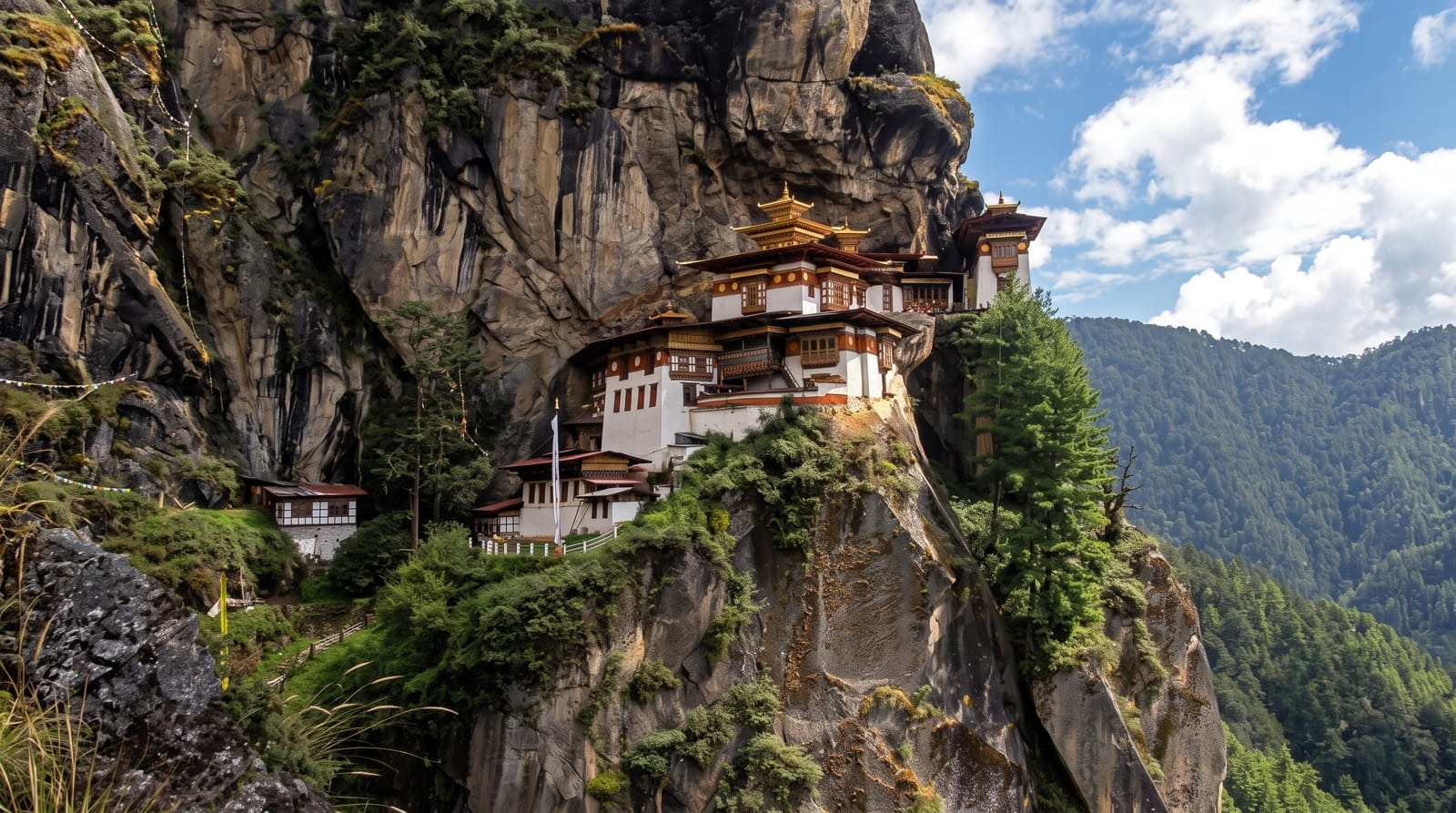
Paro Taktsang, also known as the Taktsang Palphug Monastery or the Tiger's Nest, is a sacred site of Vajrayana Buddhism on the cliffside of the upper Paro valley (Wikipedia, Paro Taktsang). Its buildings hang on a nearly vertical cliff at 3,120 metres, about 900 metres above the valley (Wikipedia, Paro Taktsang). Legend holds that Padmasambhava, or Guru Rinpoche, who is credited with bringing Vajrayana Buddhism to Bhutan, flew here on the back of a tigress and meditated in a cave on the cliff, and in 1692 Tenzin Rabgye built a shrine to him around that cave (Wikipedia, Paro Taktsang).
Background
Paro Taktsang, the Tiger's Nest, is a sacred site of Vajrayana Buddhism built into a cliff of the upper Paro valley in Bhutan. Tradition holds that Padmasambhava, the teacher credited with bringing Vajrayana Buddhism to the country, came here on the back of a tigress and meditated in a cave on the cliff, and the place is the best known of thirteen caves named for a tiger's lair where he and his students meditated. Tibetan saints came here to meditate from the 11th century, and the first sanctuary in the area dates from the 14th century. Tenzin Rabgye built the present shrine around the cave in 1692, and the complex sits about 900 metres above the valley floor.
Source: Wikipedia, "Paro Taktsang"
What to look for
- The clifftop monastery - four main temples and residential shelters fitted to the granite ledges, caves and rocky ground, each building with a balcony over the Paro valley (Wikipedia, Paro Taktsang).
- The path up - a mule track through pine forest hung with moss and prayer flags, with a water-powered prayer wheel turned by a stream near the start, and further on a bridge over a waterfall that drops 60 metres into a sacred pool (Wikipedia, Paro Taktsang).
- The viewpoint - on the approach path, visitors look across a ravine to the monastery buildings, and there is a cafeteria for refreshments (Wikipedia, Paro Taktsang).
- The caves - four of the eight caves are fairly easy to reach; the main cave, entered through a narrow passage, holds a dozen images of Bodhisattvas lit by butter lamps, and the cave where Guru Rinpoche meditated is open to the public only once a year (Wikipedia, Paro Taktsang).
When to go
The Tsechu, a popular festival in honour of Padmasambhava, is held in the Paro valley sometime in March or April, and a dance performed in Paro during the festival is based on the Copper-Coloured Mountain, the Guru's abode, which is held to be the same place as Taktsang (Wikipedia, Paro Taktsang). On many days the monastery is hidden in cloud (Wikipedia, Paro Taktsang).
What to expect
The rock slopes are nearly vertical and the buildings are built into the rock face, joined by stone steps and stairways with a few rickety wooden bridges to cross (Wikipedia, Paro Taktsang). In April 1998 a fire, thought to have started from an electrical short circuit or from butter lamps that set hanging tapestries alight, broke out in the main building, which held valuable paintings, artifacts and statues; the damaged monastery and its contents were restored in 2005 (Wikipedia, Paro Taktsang). Monks who practise at the cave monastery are said to spend three years here, rarely going down into the valley (Wikipedia, Paro Taktsang).
Nearby
Near the shrine is Ugyen Tsemo, the "Peak of Urgyan", with a small Mani Lakhang; the Ugyen Tsemo complex is said to go back to 1408 and was rebuilt after a fire in 1958 (Wikipedia, Paro Taktsang). In a straight line, Drukgyel Dzong is about 3 km west-north-west, Kyichu Lhakhang about 6 km south-south-east and the town of Paro about 8 km south-east, with Paro Rinpung Dzong about 9 km south-east.
Opening times, ticket prices and seasonal closures change - check the official source before you go: official site.
Plan your trip
Where to start if The Tiger's Nest (Paro Taktsang) is going on the list.
Booking links on this page are affiliate links - if you book through them we may earn a small commission at no extra cost to you. It never changes what we write about a place.
What to pack for The Tiger's Nest (Paro Taktsang)
Chosen from what this place is for. Tap a kit for the full checklist.
- Head torch + spare batteries - Hands-free light is essential; caves are truly dark. Find on Amazon
- Layers for big temperature swings - Warm sun by day, near-freezing at night, even near the equator. Find on Amazon
- Comfortable walking shoes - Sightseeing means kilometres of pavement and cobbles daily. Find on Amazon
- Modest clothing - Shoulders and knees covered - the single most common requirement. Find on Amazon
Some links on this page are Amazon affiliate links - if you buy through them we may earn a small commission at no extra cost to you.
All packing kits