Yanar Dag
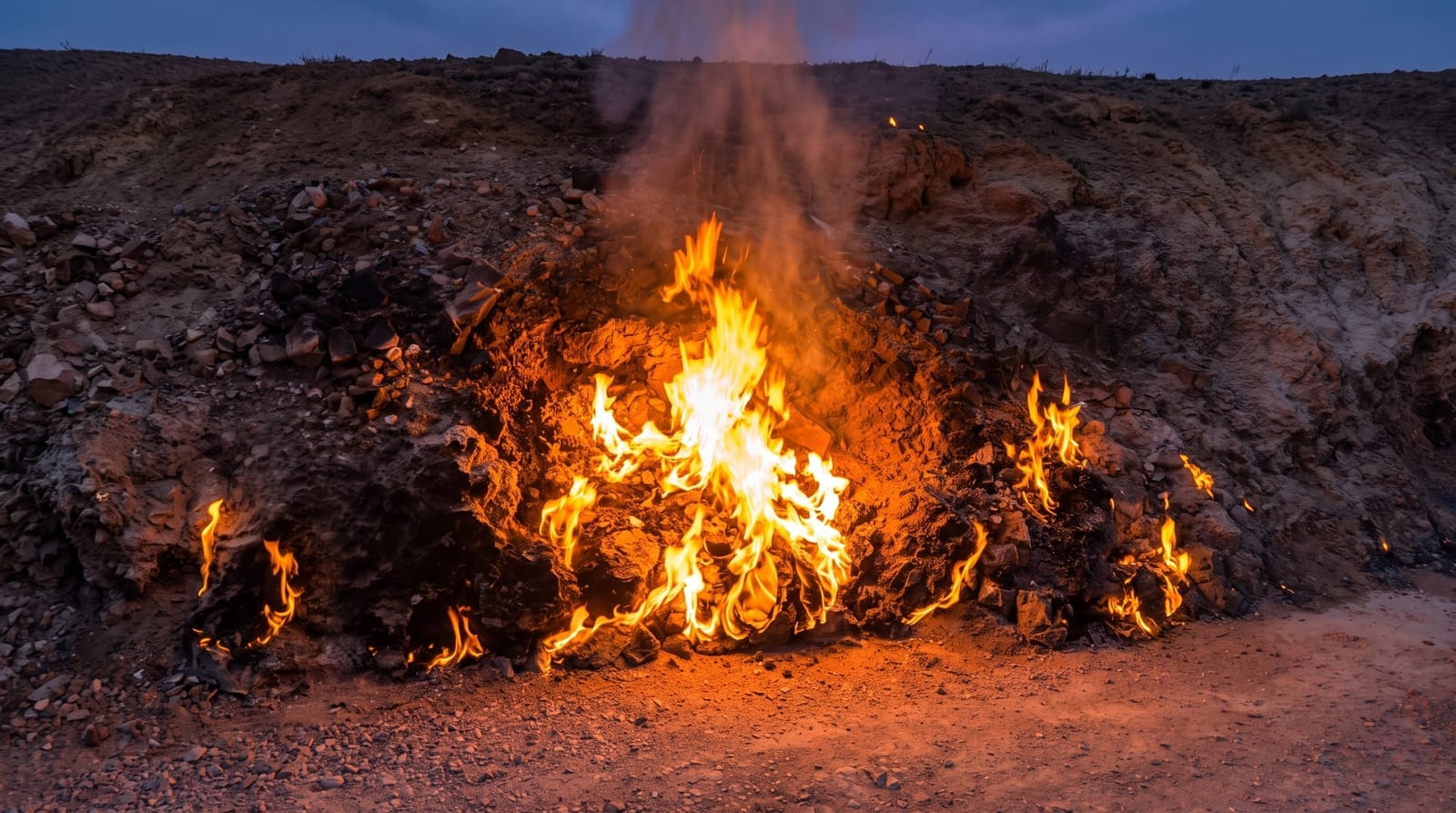
A hillside that has burned continuously for decades - natural gas seeping through sandstone and alight, the country's fire-worship legacy in one place.
Updated 18 October 2026
AI illustration
Getting there
Around Yanar Dag
- By car from Baku: about 20 km (12 mi) by road (computed)
- Car park
- Area of the second map
The car park near Yanar Dag
Points on the map
- ACar parkunder 100 m (330 ft) in a straight line from Yanar Dag; no path mapped between them40.50152, 49.89038Google Maps
- BYanar Dag40.50184, 49.89120Google Maps
Roads, paths and coordinates as mapped in OpenStreetMap on 16 Nov 2026; distances computed from it. Check signs on site.
Directions to the car park: Google Maps · OpenStreetMap
© OpenStreetMap contributors
Azerbaijan is the land of fire, and Yanar Dag is the literal version: a stretch of hillside where natural gas seeps up through porous sandstone and burns in a continuous wall of flame a couple of metres high, running along the base of the slope. It has reportedly burned without interruption for decades, and similar eternal fires across the Absheron peninsula fed Zoroastrian fire worship for centuries - the Ateshgah fire temple nearby was built around another such vent. The flames are most striking after dark, when the whole slope glows and the heat is felt from the viewing terrace.
History
Natural gas under the Absheron peninsula has fed fires here throughout history, described by travellers such as Marco Polo, and fire was a link with the divine in Zoroastrian belief; once common in Azerbaijan, only a few such fires remain, and at the nearby Ateshgah the natural flow has stopped and the flame is now fed by a gas main. Some local accounts say the Yanar Dagh flame was found only in the 1950s, lit by accident by a shepherd, others that it has burned for 4,000 years; a state reserve was set up here by decree on 2 May 2007, and a museum opened after renovation between 2017 and 2019 (Wikipedia, Yanar Dagh).
The landscape
- The burning hillside - the continuous wall of flame at the slope's base.
- Evening visits - the fire at its most dramatic after dark.
- The site museum - the geology and fire-worship history.
- Ateshgah fire temple - the Zoroastrian and Hindu temple nearby, built on another vent.
When to go
Year round, and best at dusk or after dark when the flames dominate. Winter adds drama with cold air and mist around the fire. Combine with Ateshgah in one half-day trip from Baku.
Good to know
It is small - a stretch of flame perhaps ten metres long, viewed from a terrace, and visitors expecting a volcanic spectacle are often deflated. The entry price feels steep for what it is. Going after dark roughly doubles the impression. The site is heavily developed now with a modern visitor centre, which some find removes the mystery.
Nearby
Ateshgah fire temple, the Absheron peninsula's mud volcanoes and Baku.
Key facts
Source: Wikidata, item Q917489, read on 18 October 2026.
Opening times, ticket prices and seasonal closures change - check the official source before you go: official site.
Plan your trip
Where to start if Yanar Dag is going on the list.
Booking links on this page are affiliate links - if you book through them we may earn a small commission at no extra cost to you. It never changes what we write about a place.
What to pack for Yanar Dag
Chosen from what this place is for. Tap a kit for the full checklist.
- Broken-in walking shoes or boots - Grip and ankle support matter more than looks; never hike in brand-new boots. Find on Amazon
- Spare batteries + cards - Cold and long shoots drain power; never run out at the good light. Find on Amazon
- Modest clothing - Shoulders and knees covered - the single most common requirement. Find on Amazon
- Layers + a waterproof shell - Mountain weather turns fast; a packable rain jacket saves the day. Find on Amazon
Some links on this page are Amazon affiliate links - if you buy through them we may earn a small commission at no extra cost to you.
All packing kits