Natural History Museum Vienna
A Ringstrasse museum of thirty-nine halls holding the Venus of Willendorf and cases from the 1880s still in use.
Updated 18 October 2026
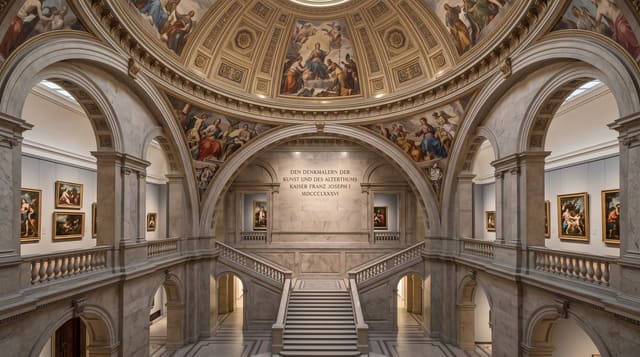
The Naturhistorisches Museum opened in 1889 in one of the twin palaces on Maria-Theresien-Platz, built to hold collections that go back to Franz Stephan of Lorraine's cabinet bought in 1750, and it holds around thirty million objects across thirty-nine halls. Much of the display furniture is original, so you are looking at nineteenth-century museum practice as well as at the specimens - dense cases, hand-lettered labels, and rooms arranged by systematic order rather than by narrative. The single most important object is the Venus of Willendorf, a limestone figure about eleven centimetres high carved some twenty-nine thousand years ago and found in Lower Austria in 1908. There are meteorites in the largest such display anywhere, a Stellar's sea cow skeleton, dinosaur halls and a digital planetarium.
History
The collections go back to 1750, when Emperor Francis I, husband of Maria Theresa, bought what was then the world's largest natural history collection, some 30,000 objects, from the Florentine scholar Jean de Baillou; Francis also founded the Schönbrunn zoo in 1752 and the botanical garden in 1753, and in 1755 sent Nicolaus Joseph Jacquin to the Caribbean, Venezuela and Colombia, who brought back live animals and plants and 67 cases of specimens. After his death Maria Theresa gave the collection to the state and opened it to the public, and later expeditions added to it, among them the voyage to Brazil from 1817 that accompanied Archduchess Leopoldine to her marriage and the world voyage of the frigate Novara in 1857-1859 (Wikipedia, Natural History Museum, Vienna).
What you'll find
- The Venus of Willendorf - the 29,000-year-old limestone figure in its own room.
- Original 1889 display cases - nineteenth-century museum practice still in use.
- The meteorite collection - the largest on public display anywhere.
- Thirty-nine halls - systematic collections across the whole building.
When to go
All year; the roof tour runs in season. Half a day.
Things to know
It is enormous and the old-style dense cases tire people quickly - pick halls rather than trying all of them. Taxidermy is everywhere. Some galleries are dated by design and by intent.
Nearby
The Kunsthistorisches Museum is the twin building opposite; the Hofburg is next door.
Key facts
Source: Wikidata, item Q688704, read on 18 October 2026.
What to pack for Natural History Museum Vienna
Chosen from what this place is for. Tap a kit for the full checklist.
- Comfortable walking shoes - Sightseeing means kilometres of pavement and cobbles daily. Find on Amazon
- Shelter suited to the place - Tent, tarp or hut booking - match it to the terrain and rules. Find on Amazon
- A slim anti-theft daypack - Zips that close properly; keep it in front in crowds and on transit. Find on Amazon
- A warm sleeping bag + mat - Rated a little colder than you expect the nights to be. Find on Amazon
Some links on this page are Amazon affiliate links - if you buy through them we may earn a small commission at no extra cost to you.
All packing kitsPlan your trip
Where to start if Natural History Museum Vienna is going on the list.
Booking links on this page are affiliate links - if you book through them we may earn a small commission at no extra cost to you. It never changes what we write about a place.
Opening times, ticket prices and seasonal closures change - check the official source before you go: official site.