Hyde Park Barracks
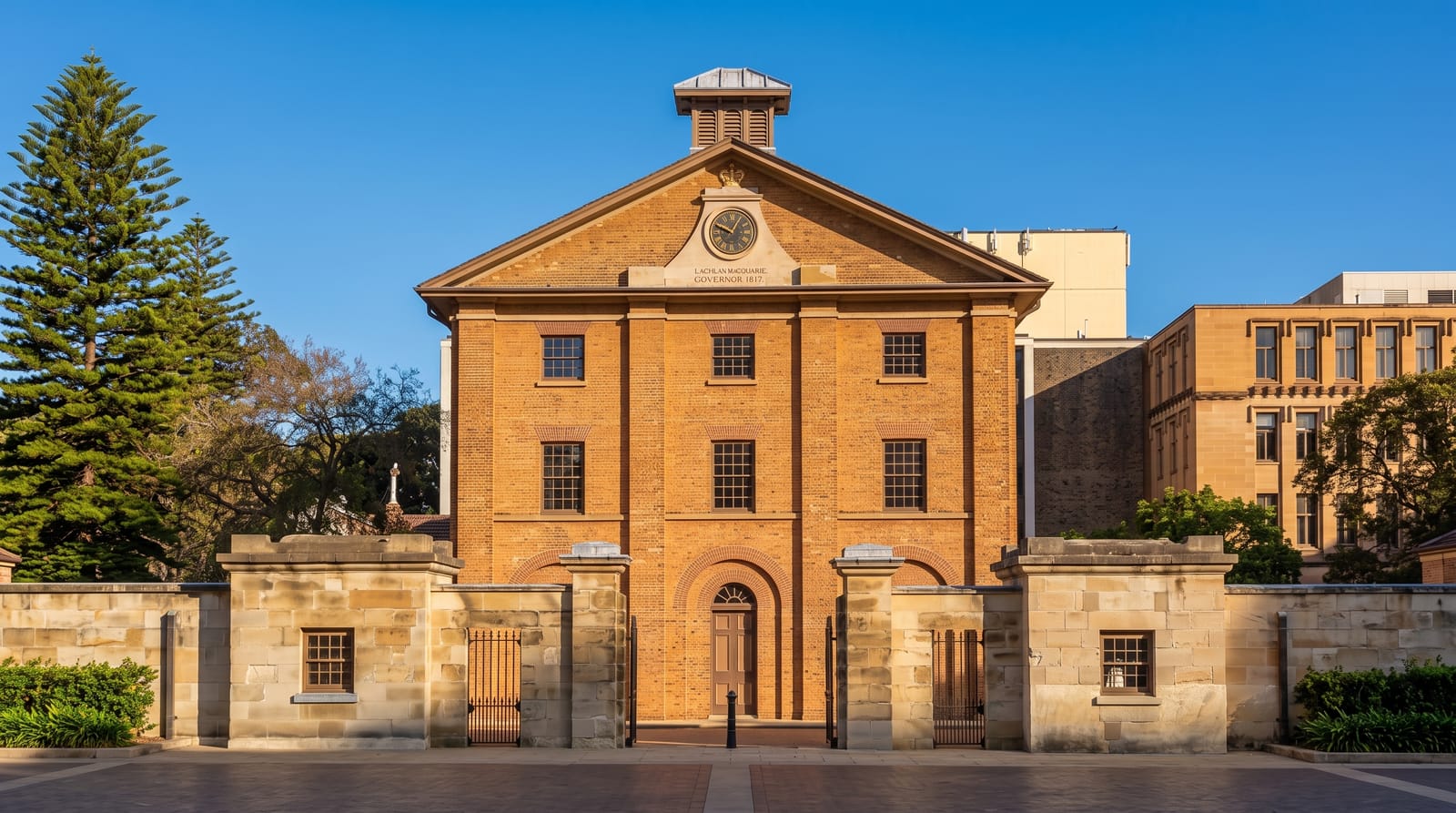
A Georgian brick barracks on Macquarie Street, built in 1819 to house convict men and now a World Heritage site.
Updated 18 October 2026
AI illustration
UNESCO World Heritage
Hyde Park Barracks stands at the top of Macquarie Street, a plain three-storey brick building with a clock in its pediment, finished in 1819 to designs by Francis Greenway, himself a convict. It was built to house convict men who had been sleeping wherever they could find space in the young town, and it later served as an immigration depot for single women, then an asylum, then law courts. The compound is small by the standards of Australia's convict sites, which makes it easy to grasp: a walled yard, a stair, rows of hammocks reconstructed on the upper floor. Archaeologists recovered thousands of objects from under the floorboards, dropped or hidden by the people who lived here, and much of the display is built around them.
History
Governor Lachlan Macquarie asked the architect Francis Greenway to design the barracks, laid the foundation stone on 6 April 1817, and saw them completed in 1819 to house convicts. By 1848 the remaining convicts had been moved to Cockatoo Island, and the building became the Female Immigration Depot, used until 1886; from the late 1880s courts and many government offices occupied it. Conservation work was completed in 1984, when the Museum of Applied Arts and Sciences opened a museum of Sydney here, a further conservation and adaptation followed in 1994, and in July 2010 the barracks were inscribed on the World Heritage List among the Australian Convict Sites (Wikipedia, Hyde Park Barracks, Sydney).
The main sights
- The hammock floor - the reconstructed sleeping room where convict men were bunked in rows.
- Greenway's brickwork - the plain Georgian facade and clock pediment by a convict architect.
- The underfloor finds - objects recovered from beneath the boards, from playing cards to scraps of cloth.
- The walled yard - the compound and gates that controlled who came and went.
When to go
The barracks are indoors and open year-round, which makes them a good choice on a wet or very hot Sydney day. Mornings are quieter than early afternoons, when school groups often arrive. Allow around two hours, more if you listen to the full audio material. Combined tickets with other Sydney historic houses work out cheaper if you plan several visits.
What to expect
It is a small site, and visitors expecting the scale of Port Arthur will find one building and a yard. The presentation leans heavily on audio, which some people find immersive and others find hard to follow in a group. Entry is charged for what is a short visit. The subject matter is bleak in places, and the site does not soften it.
Nearby
The Domain, the Royal Botanic Garden and the Mint sit within a few minutes' walk.
What to pack for Hyde Park Barracks
Chosen from what this place is for. Tap a kit for the full checklist.
- Comfortable walking shoes - Sightseeing means kilometres of pavement and cobbles daily. Find on Amazon
- A slim anti-theft daypack - Zips that close properly; keep it in front in crowds and on transit. Find on Amazon
- A refillable water bottle - Many cities have public fountains; save money and plastic. Find on Amazon
- A light layer + compact umbrella - For museum air-con and a sudden shower. Find on Amazon
Some links on this page are Amazon affiliate links - if you buy through them we may earn a small commission at no extra cost to you.
All packing kitsPlan your trip
Where to start if Hyde Park Barracks is going on the list.
Booking links on this page are affiliate links - if you book through them we may earn a small commission at no extra cost to you. It never changes what we write about a place.
Opening times, ticket prices and seasonal closures change - check the official source before you go: official site.


