Echuca
The busiest inland port of nineteenth-century Australia, with a red gum wharf and the largest fleet of working paddle steamers.
Updated 18 October 2026
AI illustration
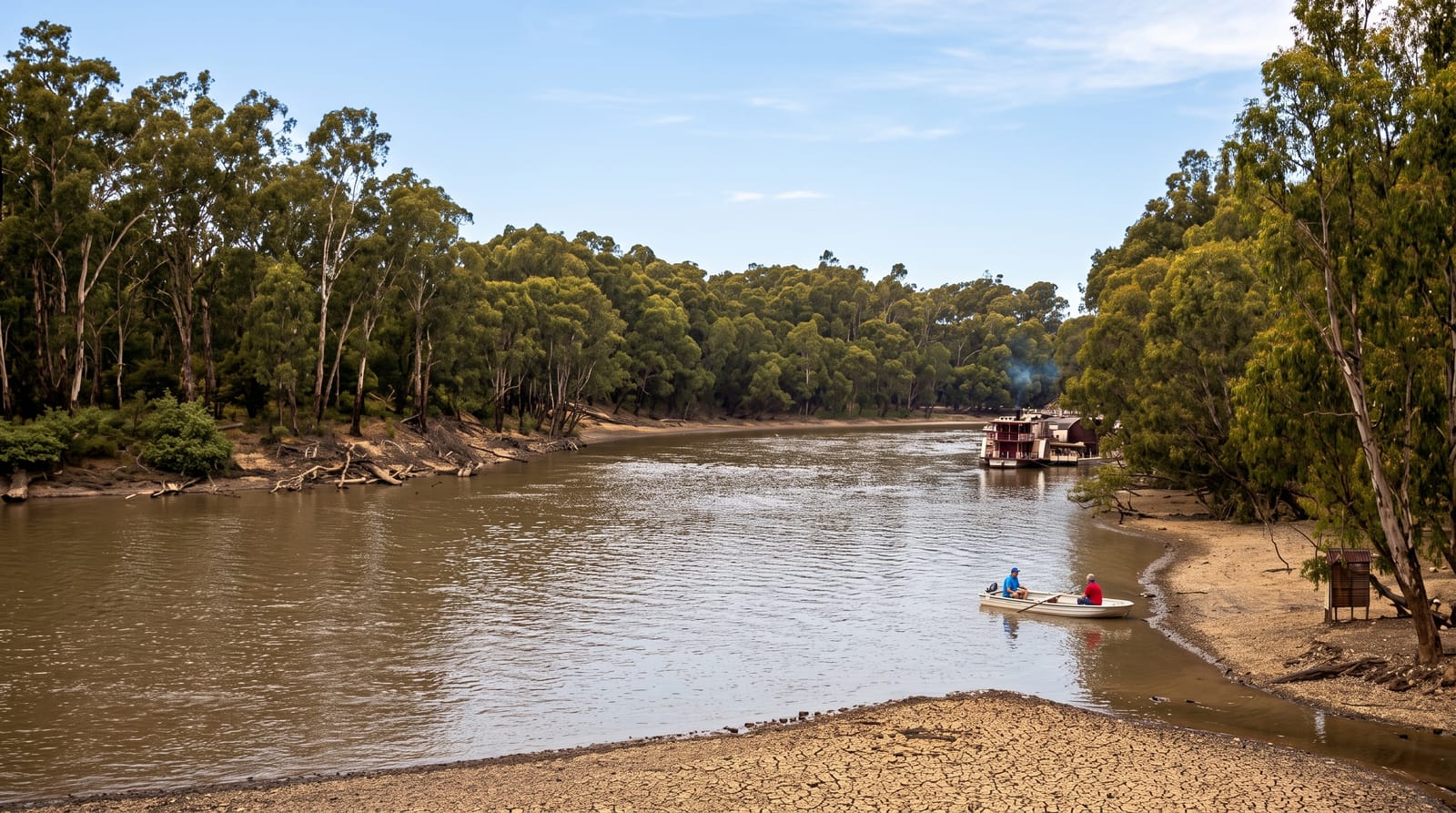
Echuca sits where the Campaspe and Goulburn rivers meet the Murray, the closest point on the river to Melbourne, and in the 1870s and 1880s it was the busiest inland port in Australia, transferring wool and timber between paddle steamers and the railway. The wharf, built of local red gum on three levels to cope with the river's changing height, still stands and forms the centre of a preserved port precinct with a working blacksmith, cooper and historic vessels. Echuca has the largest collection of operating paddle steamers in the world, several of which run cruises, including the Adelaide of 1866, among the oldest wooden-hulled paddle steamers still operating anywhere.
History
The town lies in Yorta Yorta country, and its name is their word for meeting of the waters; the Yorta Yorta, perhaps 2,400 people before contact, were driven from their lands. In 1850 the ex-convict Henry Hopwood bought a small punt to ferry people and goods across the Murray near the Campaspe junction, and Hopwood's Ferry grew into Echuca, whose post office took that name on 1 January 1855. By the 1870s it was Australia's largest inland port, where paddle steamers unloaded wool, grain, livestock and timber at the 332-metre red gum wharf for the railway to Melbourne, and its population rose from 26 in 1854 to 4,789 in 1871, but the spread of railways, better roads, a fickle river and the depression of the 1890s ended its boom (Wikipedia, Echuca).
The main sights
- The red gum wharf - the three-level timber wharf built for a changing river.
- The paddle steamer fleet - the largest working collection in the world.
- The port precinct - restored buildings, workshops and vessels.
- The Murray River - cruises and river red gum forest along the banks.
When to go
September to May for river cruises and warm weather; summer is hot but the river makes it bearable. Steam-up events and the Riverboats music festival fall in February. Low river levels occasionally restrict cruising.
Practical notes
The port precinct is a paid attraction and cruises are charged separately. Summer temperatures regularly pass thirty-five degrees. The modern town around the historic precinct is ordinary, and the preserved area is small.
Nearby
Moama is across the river in New South Wales; Bendigo lies south.
What to pack for Echuca
Chosen from what this place is for. Tap a kit for the full checklist.
- Quick-dry clothing - Board shorts or synthetics that shrug off spray and dry fast. Find on Amazon
- Comfortable walking shoes - Sightseeing means kilometres of pavement and cobbles daily. Find on Amazon
- Secure water shoes or reef boots - Grip on slippery launches and protection on rocky shores. Find on Amazon
- A slim anti-theft daypack - Zips that close properly; keep it in front in crowds and on transit. Find on Amazon
Some links on this page are Amazon affiliate links - if you buy through them we may earn a small commission at no extra cost to you.
All packing kitsPlan your trip
Where to start if Echuca is going on the list.
Booking links on this page are affiliate links - if you book through them we may earn a small commission at no extra cost to you. It never changes what we write about a place.
Opening times, ticket prices and seasonal closures change - check the official source before you go: official site.