Constantine
The city of bridges - an old town on a rock split by a 200-metre gorge, crossed on famous spans and layered from Numidian kings to Ottoman palaces.
Updated 18 October 2026
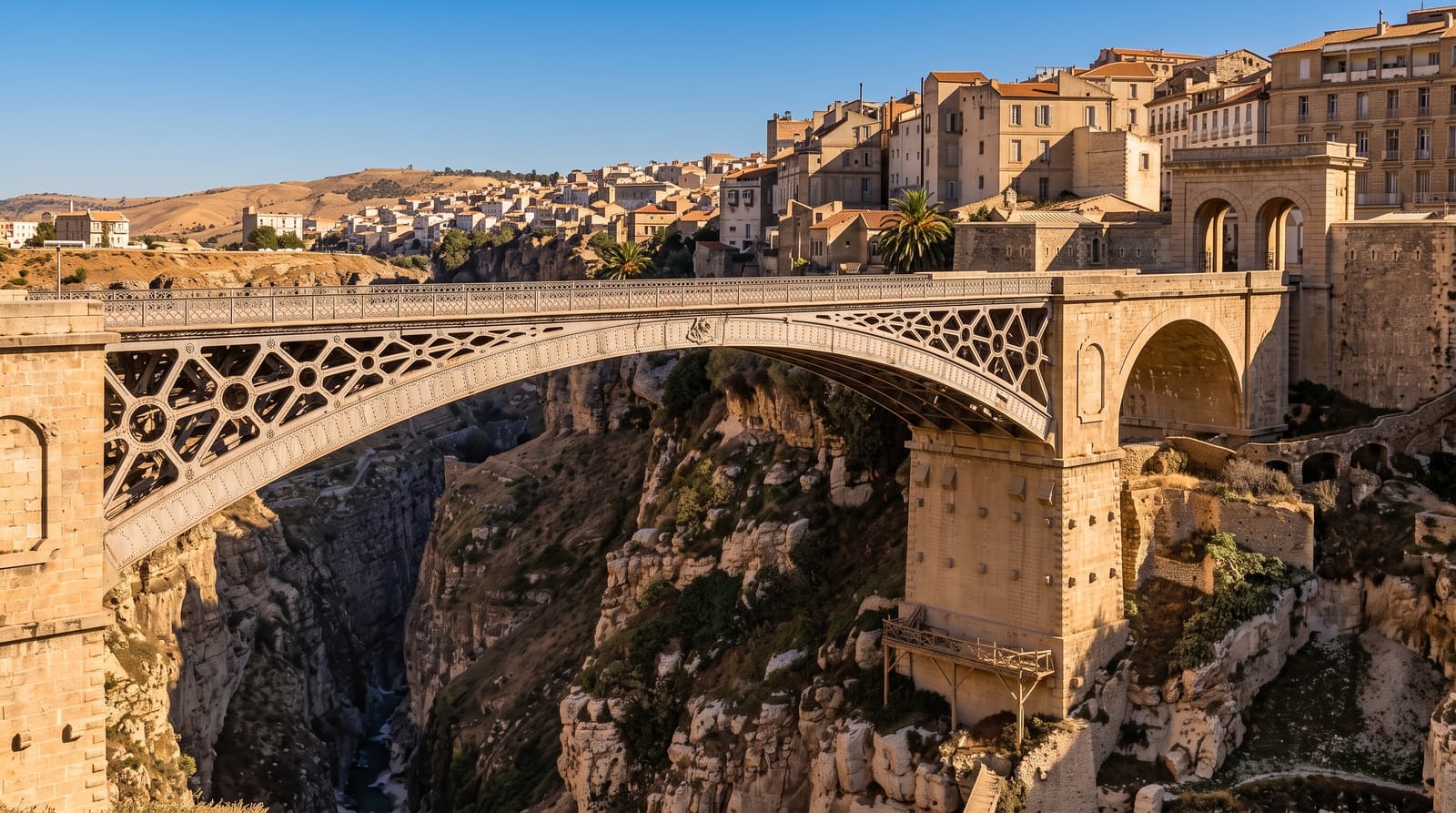
AI illustration
Constantine stands where geology wrote the city plan: the Rhumel river saws a gorge up to two hundred metres deep around a rock plateau, and the city - Numidian Cirta, renamed for the emperor who rebuilt it - lives on top, stitched to its surroundings by the bridges that are its emblem: the arched Sidi M'Cid suspension span hanging over the abyss, the stacked arcades of Sidi Rached, the old El-Kantara crossing. Between them press the medina's lanes, the Ottoman-era Palace of Ahmed Bey's painted courtyards, and viewpoints where the drop opens underfoot in ways that reorganise the stomach.
History
As Cirta the city was the capital of the Berber kingdom of Numidia, the seat of Jugurtha in 112 BC and then the base of the Roman generals Metellus and Marius in their war against him, and Julius Caesar gave its citizens special rights after the defeat of Juba I around 46 BC. Wrecked in 311 AD in the war between the emperor Maxentius and the usurper Domitius Alexander, it was rebuilt in 313 and named Constantina after Constantine the Great; the Vandals took it in 432, the Byzantines in 534, and after the Arab conquest of the 8th century it was called Qacentina. It recovered in the 12th century as a prosperous market under the Almohads and Hafsids, trading with Pisa, Genoa and Venice, came intermittently under the Ottomans from 1529, and its bey Salah Bey, who ruled from 1770 to 1792, built much of the Muslim architecture still standing; the last bey, Ahmed Bey, resisted the French until they took the city on 13 October 1837, and in 1880 Alphonse Laveran, working at the military hospital here, found that malaria is caused by a protozoan (Wikipedia, Constantine, Algeria).
Highlights
- Sidi M'Cid bridge - the suspension span 175 metres over the Rhumel.
- The gorge walks - rim paths and stairways into the chasm.
- The Palace of Ahmed Bey - the last great Ottoman residence's tiled courts.
- The medina lanes - the rock-top old town's markets and mosques.
When to go
April to June and September to October for clear gorge views and walkable heat; winter brings mist that swallows the bridges photogenically and cold that surprises. Friday quiets the medina.
Before you go
The city is a working metropolis with traffic to match - the old town rewards walking but assumes sure feet on uneven lanes; the gorge railings vary in reassurance. Interpretation is minimal; local guides earn their fee. Standard big-city awareness applies.
Nearby
Tiddis's cliffside Roman town, Setif and Djemila westward.
Key facts
Source: Wikidata, item Q187346, read on 18 October 2026.
What to pack for Constantine
Chosen from what this place is for. Tap a kit for the full checklist.
- Comfortable walking shoes - Sightseeing means kilometres of pavement and cobbles daily. Find on Amazon
- Modest clothing - Shoulders and knees covered - the single most common requirement. Find on Amazon
- A slim anti-theft daypack - Zips that close properly; keep it in front in crowds and on transit. Find on Amazon
- A scarf or shawl - To cover the head or shoulders on entry; women especially at mosques. Find on Amazon
Some links on this page are Amazon affiliate links - if you buy through them we may earn a small commission at no extra cost to you.
All packing kitsPlan your trip
Where to start if Constantine is going on the list.
Booking links on this page are affiliate links - if you book through them we may earn a small commission at no extra cost to you. It never changes what we write about a place.
Opening times, ticket prices and seasonal closures change - check the official source before you go: official site.