Kruje
Skanderbeg's mountain stronghold above Tirana - a castle museum, an Ottoman bazaar of carpets and copper, and a balcony view over the plain.
Updated 18 October 2026
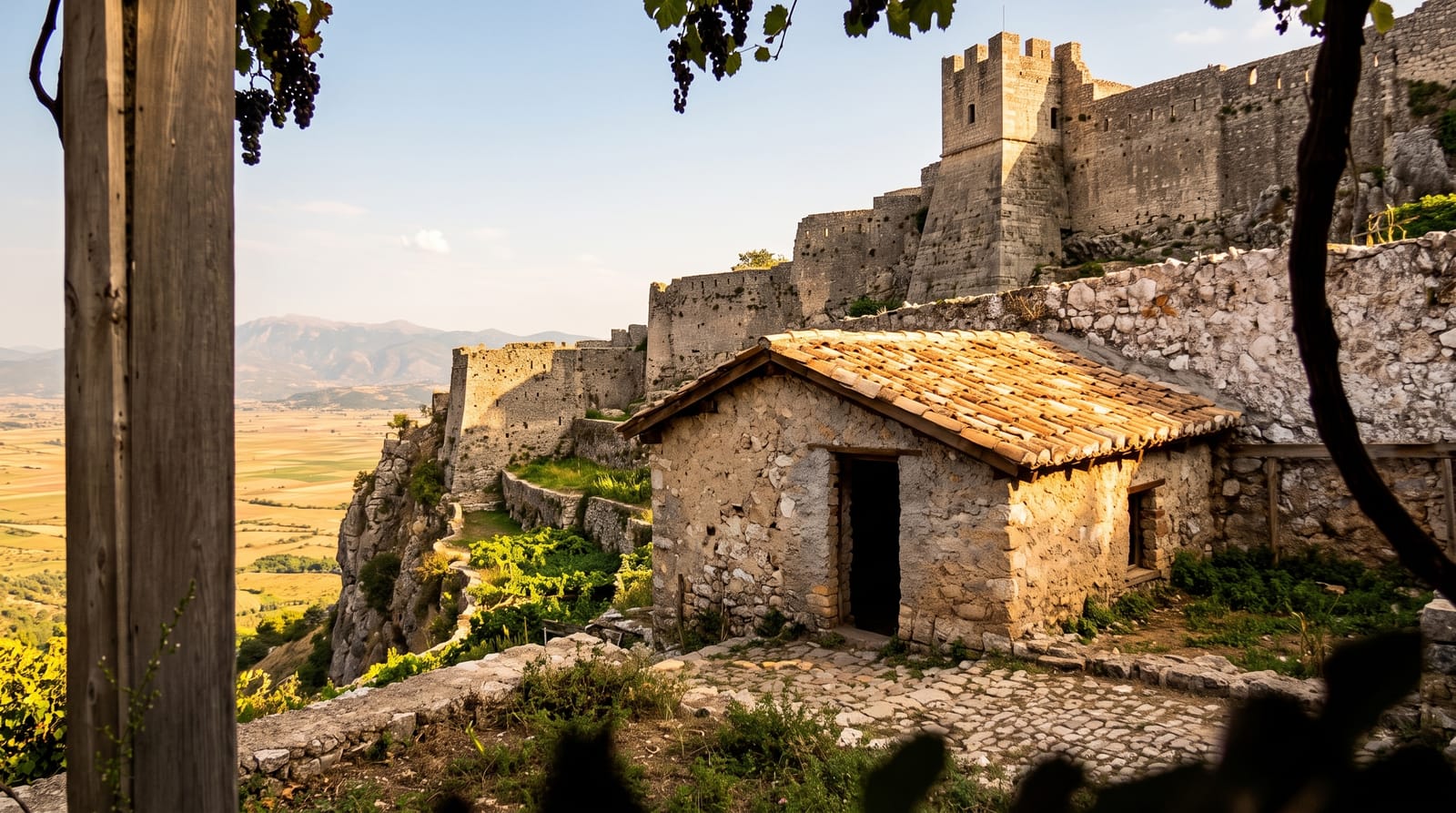
AI illustration
Kruje clings to a mountainside above the coastal plain and holds the central story of Albanian national identity: this was the base of Skanderbeg, who held off repeated Ottoman sieges through the fifteenth century and became the country's defining historical figure. The castle above the town contains the Skanderbeg Museum, built in the 1980s in a deliberately monumental style, and an ethnographic museum in a genuine Ottoman house that many visitors rate higher. Below the gate runs the old bazaar, a cobbled lane of wooden shopfronts selling carpets, copper, filigree and antiques, restored and touristic but genuinely atmospheric.
History
Its name is related to the Albanian word for a fountain or spring, and the town, first recorded as Kroai in Byzantine documents of the early 9th century, grew from a middle-sized fortress between the 6th and 9th centuries; in 1190 it became the capital of the Principality of Arbër, the first Albanian state of the Middle Ages, founded by Progon. It passed to the Kingdom of Albania, to Karl Topia in 1363 and under Ottoman vassalage by 1395, and Skanderbeg, its governor in 1437-1438, took control of it on 28 November 1443 and, as leader of the League of Lezhë, held it against three Ottoman sieges until his death in 1468. The Ottomans took it after a fourth siege in 1478, and a local revolt in 1906 came before the Albanian Declaration of Independence of 1912 (Wikipedia, Krujë).
What's there
- The Skanderbeg Museum - the national hero's story inside the castle walls.
- The Ethnographic Museum - an Ottoman-era house with original furnishings.
- The old bazaar - carpets, copperwork and filigree on the cobbled lane.
- The castle terrace - the view over the plain toward the Adriatic.
When to go
Spring and autumn are ideal, with clear views over the plain. Summer is hot and busy with day trips from Tirana and the coast. Mornings beat the coach groups. Winter brings mist that can swallow the view entirely.
Practical notes
The bazaar is restored rather than original and prices are pitched at visitors - bargaining is expected and much of the stock is not locally made. The Skanderbeg Museum's presentation is dated and heavy on nationalist framing; the ethnographic house next door is the better visit for most. Cobbles and steep lanes make it hard going for limited mobility.
Nearby
Tirana, Durres on the coast and the Sari Salltik pilgrimage site above the town.
What to pack for Kruje
Chosen from what this place is for. Tap a kit for the full checklist.
- Comfortable walking shoes - Sightseeing means kilometres of pavement and cobbles daily. Find on Amazon
- Modest clothing - Shoulders and knees covered - the single most common requirement. Find on Amazon
- A slim anti-theft daypack - Zips that close properly; keep it in front in crowds and on transit. Find on Amazon
- A scarf or shawl - To cover the head or shoulders on entry; women especially at mosques. Find on Amazon
Some links on this page are Amazon affiliate links - if you buy through them we may earn a small commission at no extra cost to you.
All packing kitsPlan your trip
Where to start if Kruje is going on the list.
Booking links on this page are affiliate links - if you book through them we may earn a small commission at no extra cost to you. It never changes what we write about a place.
Opening times, ticket prices and seasonal closures change - check the official source before you go: official site.