Cahokia Mounds
A UNESCO-listed city of earthen mounds across the river from St Louis, the largest pre-Columbian settlement north of Mexico.
Updated 18 October 2026
AI illustration
UNESCO World Heritage
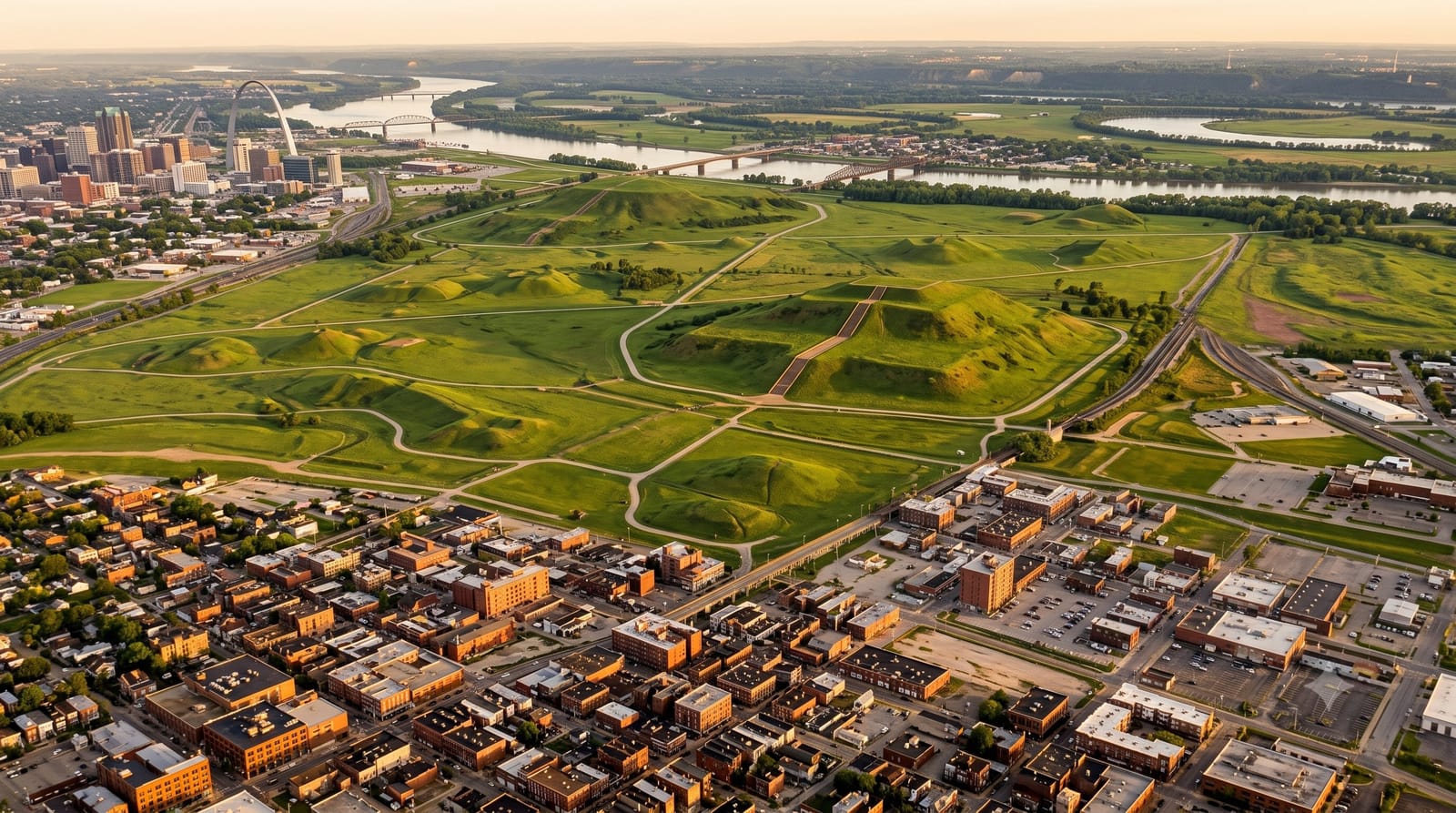
A thousand years ago Cahokia was the largest city anywhere north of Mexico, home at its height to perhaps twenty thousand people, more than London at the same date, and its people moved an extraordinary quantity of earth by hand to build it. Monks Mound, the largest earthwork anywhere north of Mexico, rises in four terraces to about thirty metres with a footprint bigger than the Great Pyramid's, and around it stand dozens more mounds, a reconstructed timber circle used to track the sun that researchers nicknamed Woodhenge, and the outline of a great plaza. The city was abandoned before Europeans arrived and nobody is certain why. Climbing Monks Mound and looking out at the St Louis skyline across the floodplain puts a thousand years into one view.
History
There are traces of people here around 1200 BC, but Cahokia was settled around 600 AD and mound building began in the 9th century, at the start of the Mississippian culture; by the late 900s a large community spread over 35 to 70 hectares, and maize took hold around 900. Around 1050 the city's three precincts were laid out on a grid oriented north along the Grand Plaza, and at its height around 1100 it covered about 16 square kilometres with some 120 earthworks and between 15,000 and 20,000 people, trading as far as the Great Lakes and the Gulf Coast in copper, chert, shark teeth and whelk shells. The city lasted until about 1350, and its mounds are now the largest and most complex archaeological site north of Mexico (Wikipedia, Cahokia).
The main sights
- Monks Mound - the largest earthwork north of Mexico, climbed by a stairway.
- Woodhenge - the reconstructed timber circle aligned to the solstices.
- The interpretive centre - the city's story and a reconstructed village scene.
- The mound field - dozens of surviving mounds across the site.
When to go
Spring and autumn are the most pleasant; the site is open in all seasons but summer is hot and humid on open ground with no shade. Sunrise and sunset gatherings at Woodhenge mark the solstices and equinoxes. Check the interpretive centre's days, as they have varied.
Things to know
It takes imagination: this is grassy mounds rather than stone architecture, and without the interpretive centre or a guide the scale of what stood here is easy to miss entirely. The setting is unglamorous, hemmed by highways and suburbs. The climb up Monks Mound is a steep stairway. It deserves far more visitors than it gets.
Nearby
St Louis and the Gateway Arch are fifteen minutes west across the river.
Key facts
Source: Wikidata, item Q333661, read on 18 October 2026.
What to pack for Cahokia Mounds
Chosen from what this place is for. Tap a kit for the full checklist.
- Strong insect repellent - DEET or picaridin; the jungle is where bites and disease risk are highest. Find on Amazon
- Comfortable walking shoes - Sightseeing means kilometres of pavement and cobbles daily. Find on Amazon
- Long, light, quick-dry clothing - Covers skin from insects and sun without cooking you in the humidity. Find on Amazon
- A slim anti-theft daypack - Zips that close properly; keep it in front in crowds and on transit. Find on Amazon
Some links on this page are Amazon affiliate links - if you buy through them we may earn a small commission at no extra cost to you.
All packing kitsPlan your trip
Where to start if Cahokia Mounds is going on the list.
Booking links on this page are affiliate links - if you book through them we may earn a small commission at no extra cost to you. It never changes what we write about a place.
Opening times, ticket prices and seasonal closures change - check the official source before you go: official site.