Saltaire
A complete Victorian mill village built by one manufacturer, listed by UNESCO, with one of the largest Hockney collections inside the mill.
Updated 18 October 2026
AI illustration
UNESCO World Heritage
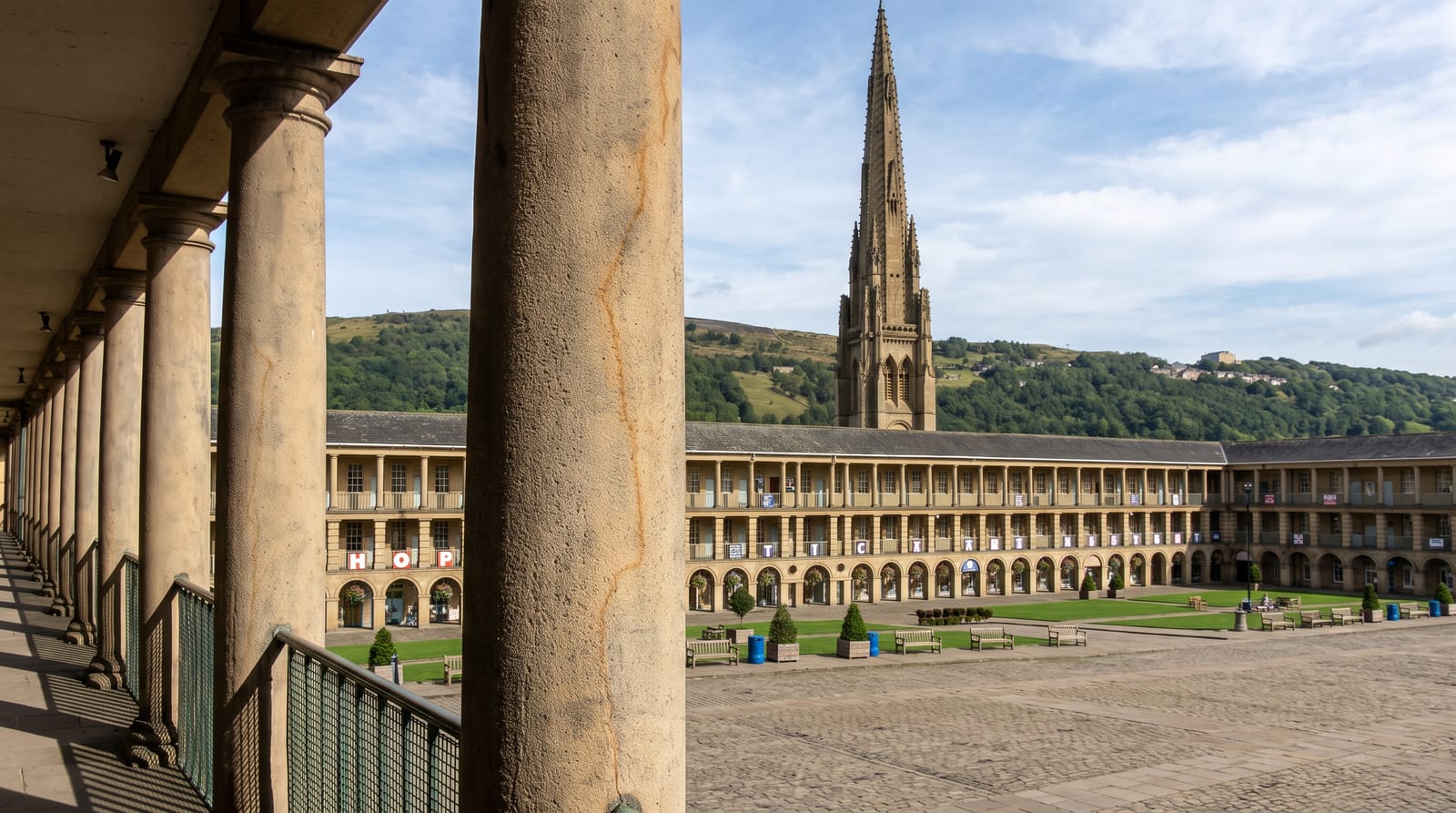
Titus Salt moved his alpaca and mohair business out of Bradford's smoke in 1851 and built a whole village beside the new mill on the Aire: eight hundred and fifty houses graded by job, almshouses, a hospital, baths, an institute and a church, but deliberately no pub, since Salt was a temperance man. The streets are named after his children. Salts Mill was the largest industrial building in the world when it opened. The village was inscribed as a UNESCO World Heritage Site in 2001 as a complete and well-preserved example of Victorian philanthropic town planning. The mill closed in 1986 and was bought by Jonathan Silver, who filled it with the work of David Hockney, born in nearby Bradford; the 1853 Gallery inside holds one of the largest collections of his work anywhere and entry is free.
History
Sir Titus Salt, a leading Yorkshire wool manufacturer, founded the village in 1851, naming it after himself and the River Aire, and moved his five Bradford mills to a single great mill here between the Leeds and Liverpool Canal and the railway, with the local architects Francis Lockwood and William Mawson. Between 1851 and 1871 he built stone terraced houses far better than the Bradford slums, wash-houses with tap water, baths, a hospital, an institute with a library, reading room, concert hall and laboratory, a school, almshouses, allotments and a park. The mill stopped production in 1986 and was turned into galleries, restaurants and offices, and the model village is a World Heritage Site (Wikipedia, Saltaire).
Highlights
- The complete village - 850 graded houses, institute, church and almshouses.
- Salts Mill - once the world's largest industrial building, now galleries and shops.
- The Hockney collection - one of the largest anywhere, free to walk through.
- The missing pub - a village built without one, on temperance principles.
When to go
Year-round; the mill and galleries are indoors and open most days. The Saltaire Festival in September fills the streets. Weekday mornings are the quietest for the galleries.
Things to know
The houses are private homes and not open. The mill's retail floors are as large as the gallery space. Parking is limited and the station is the easier arrival. Some of the village's institutional buildings are in other uses and not accessible.
Nearby
Shipley Glen and its Victorian tramway are close; Bradford and Leeds lie either side.
Key facts
Source: Wikidata, item Q838920, read on 18 October 2026.
What to pack for Saltaire
Chosen from what this place is for. Tap a kit for the full checklist.
- Comfortable walking shoes - Sightseeing means kilometres of pavement and cobbles daily. Find on Amazon
- A slim anti-theft daypack - Zips that close properly; keep it in front in crowds and on transit. Find on Amazon
- A refillable water bottle - Many cities have public fountains; save money and plastic. Find on Amazon
- A light layer + compact umbrella - For museum air-con and a sudden shower. Find on Amazon
Some links on this page are Amazon affiliate links - if you buy through them we may earn a small commission at no extra cost to you.
All packing kitsPlan your trip
Where to start if Saltaire is going on the list.
Booking links on this page are affiliate links - if you book through them we may earn a small commission at no extra cost to you. It never changes what we write about a place.
Opening times, ticket prices and seasonal closures change - check the official source before you go: official site.