Krak des Chevaliers
The finest Crusader castle on earth - the mighty Krak des Chevaliers, a UNESCO World Heritage fortress whose massive concentric walls and towers crown a hilltop in western Syria, the supreme surviving masterpiece of Crusader military architecture.
Updated 19 October 2026
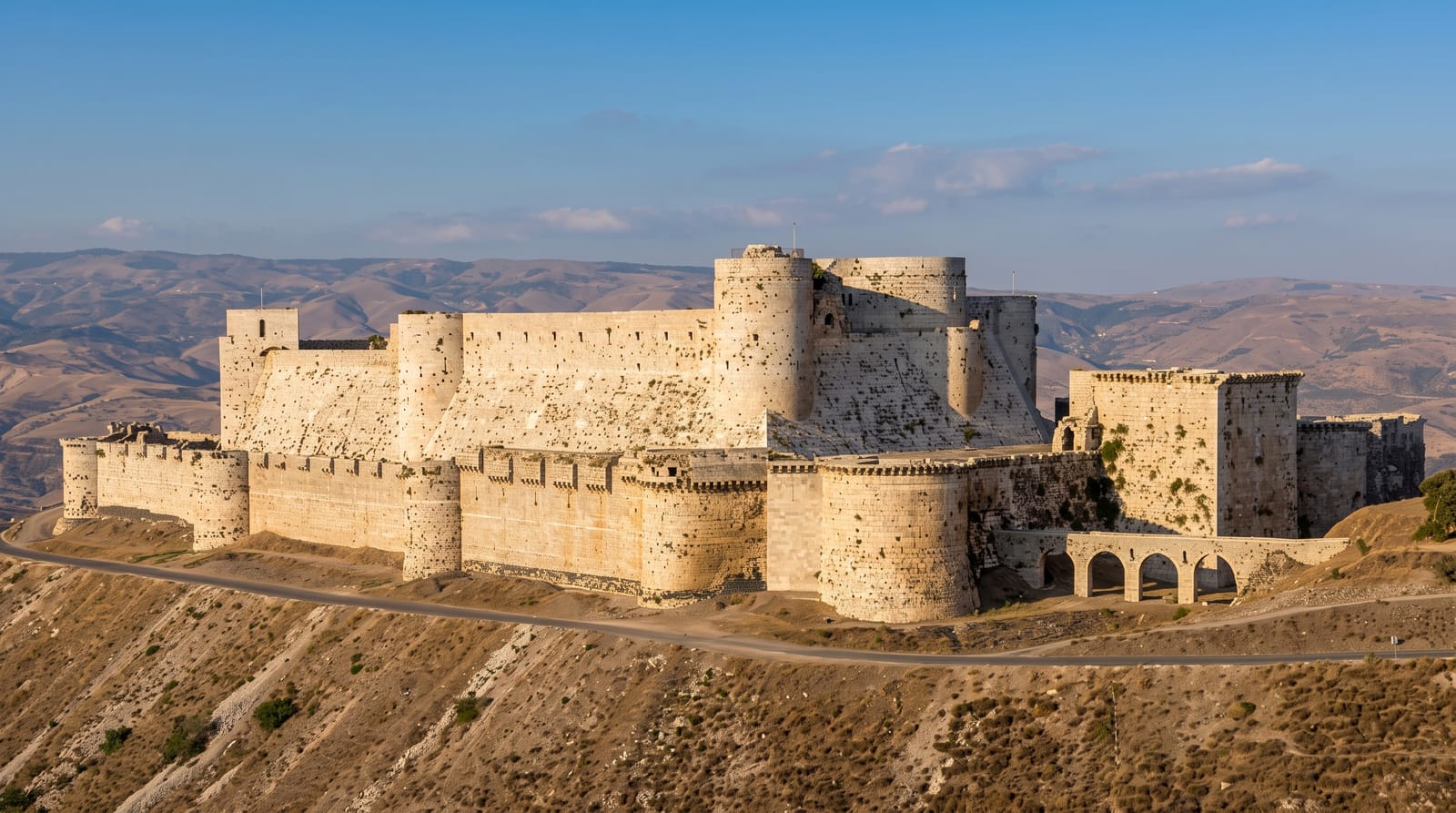
AI illustration
UNESCO World Heritage
Krak des Chevaliers, crowning a hilltop in the hills of western Syria, is widely regarded as the finest and best-preserved Crusader castle in the world, a UNESCO World Heritage site of breathtaking scale and design. Built and expanded by the Knights Hospitaller in the twelfth and thirteenth centuries, its formidable concentric rings of massive stone walls, round towers, a sloping glacis and a great vaulted hall could shelter a garrison for years. T. E. Lawrence called it the most wholly admirable castle in the world. Commanding sweeping views over the surrounding valleys, it is a supreme and awe-inspiring masterpiece of medieval military architecture.
History
In 1031 the Mirdasid emir of Aleppo and Homs settled Kurdish troops in a fort here to guard the road between Homs and Tripoli, which gave it its Arabic name, Hisn al-Akrad, fortress of the Kurds. Crusaders under Raymond IV of Toulouse found it deserted in 1099, Tancred took it for good in 1110, and in 1142 Raymond II, Count of Tripoli, gave it to the Knights Hospitaller, who rebuilt it from the 1140s until an earthquake damaged it in 1170 and made it a centre of their border castles; nothing of the earliest castle survives. The Muslims retook it in 1271, a village of some 500 people that had grown up inside the walls was moved out in 1933, when the French authorities cleared and restored the castle (Wikipedia, Krak des Chevaliers).
Highlights
- The concentric walls - the massive double rings of stone defences.
- The round towers - the great towers and sloping glacis.
- The vaulted hall - the soaring Gothic knights' hall.
- The ramparts - the sweeping views over the valleys.
When to go
Spring and autumn, roughly March to May and September to November, are the most pleasant for exploring the castle's ramparts and halls in mild weather, with green hills in spring; the hilltop can be hot in summer and cold and misty in winter. Clear days give the finest views from the walls.
What to expect
The castle remains remarkably intact, and its hilltop setting involves a fair amount of climbing stairs and ramparts. As the finest and best-preserved Crusader castle on earth, a UNESCO World Heritage masterpiece of massive walls and towers, though, Krak des Chevaliers is an awe-inspiring and unforgettable sight.
Nearby
The city of Homs and the western Syrian hills lie around the castle.
Key facts
Source: Wikidata, item Q177549, read on 18 October 2026.
What to pack for Krak des Chevaliers
Chosen from what this place is for. Tap a kit for the full checklist.
- Comfortable walking shoes - Sightseeing means kilometres of pavement and cobbles daily. Find on Amazon
- A slim anti-theft daypack - Zips that close properly; keep it in front in crowds and on transit. Find on Amazon
- A refillable water bottle - Many cities have public fountains; save money and plastic. Find on Amazon
- A light layer + compact umbrella - For museum air-con and a sudden shower. Find on Amazon
Some links on this page are Amazon affiliate links - if you buy through them we may earn a small commission at no extra cost to you.
All packing kitsPlan your trip
Where to start if Krak des Chevaliers is going on the list.
Booking links on this page are affiliate links - if you book through them we may earn a small commission at no extra cost to you. It never changes what we write about a place.
Opening times, ticket prices and seasonal closures change - check the official source before you go: official site.


