The Roman Walls of Lugo
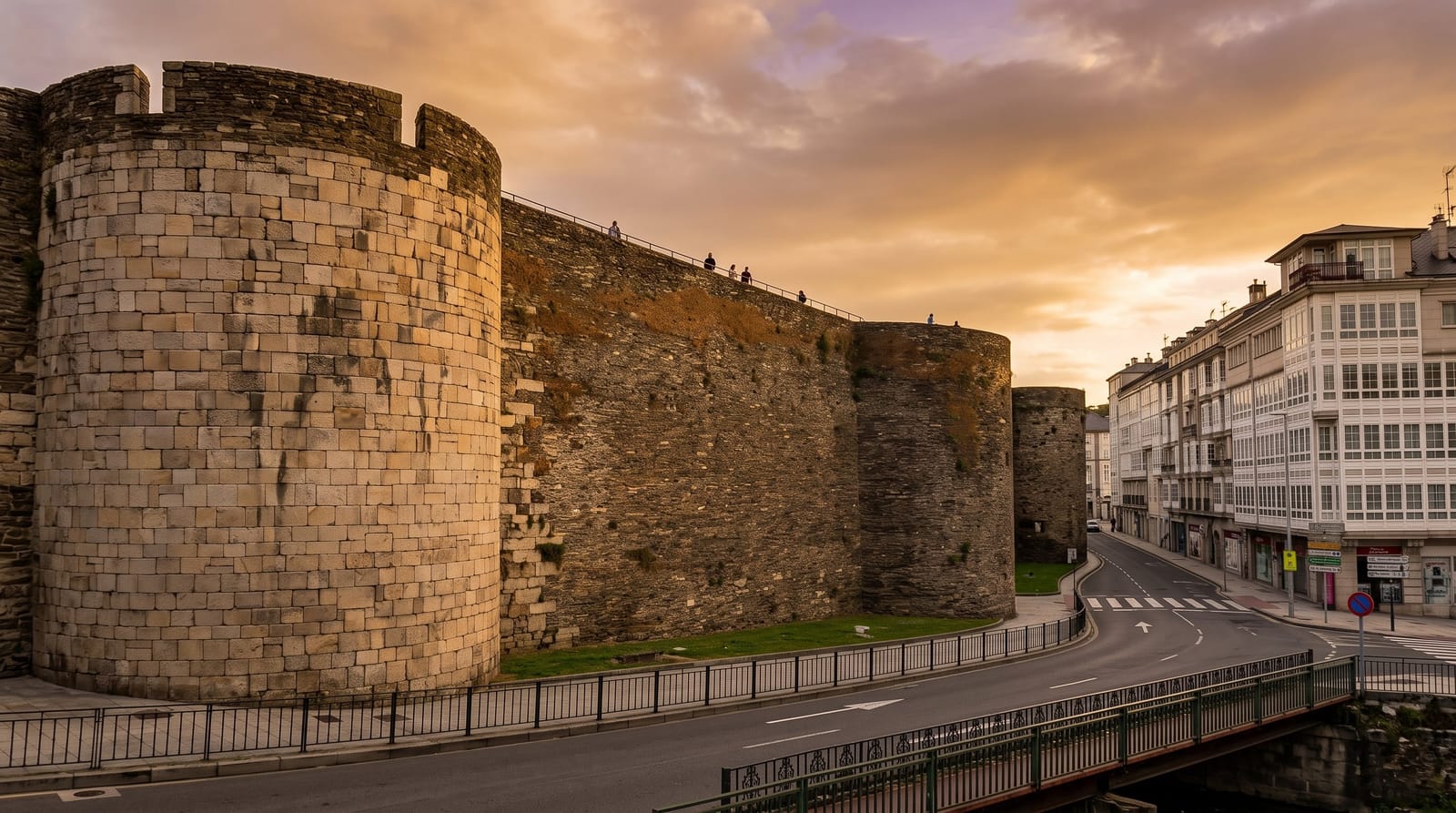
Late Roman walls still circling the old town for over two kilometres of slate and stone, with a free walkway on top - for UNESCO the finest of their kind in western Europe.
Updated 18 October 2026
AI illustration
UNESCO World Heritage
Lugo's wall was built in the late third century and never came down. Over two kilometres of slate and granite rubble faced in stone still make a closed circuit around the old town, with dozens of surviving semicircular towers and ten gates, some Roman and some cut later for traffic. The walkway on top is public, free and open long hours, so locals use it as a running track and a shortcut as much as a monument. Inside the ring are the cathedral, a Roman house preserved under a modern building and the arcaded Praza do Campo. Pilgrims on the Camino Primitivo pass straight through.
History
The walls were built between 263 and 276 to defend the Roman town of Lucus Augusti, in the province of Hispania Tarraconensis. In the Middle Ages pilgrims bound for Santiago de Compostela passed through the gates, especially the Porta Miña, which still has its original vaulted arch between two towers; of the ten gates, five are Roman and five were opened after 1853 for the growing town. The walls have been a protected monument since 1921 and joined the UNESCO list in 2000 as the finest example of late Roman fortifications in western Europe, and since then Lugo has held the Arde Lucus festival each year to celebrate its Roman past (Wikipedia, Roman walls of Lugo).
Highlights
- The full circuit - a continuous walk on top of the wall right around the old town.
- The surviving towers - dozens of semicircular projections, some with stair bases intact.
- The Roman gates - original openings alongside wider arches cut in later centuries.
- Praza do Campo - the arcaded square at the centre of the walled town.
When to go
Summer gives the best odds on dry weather, though Galicia can rain in any month and the walkway is slippery when wet. Early evening is when the town uses the wall itself, which is the nicest time to join it. The whole loop takes around forty minutes at a steady pace, more if you stop at every tower.
Good to know
From the top you look mostly at rooftops, car parks and traffic; the wall is far more impressive seen from the street below. Lugo is a modest provincial city and, once the circuit and the cathedral are done, there is not much queueing for your attention. It rains a great deal, and parking near the gates is tight.
Nearby
The Camino Primitivo trail, the Ribeira Sacra canyons and the Galician coast at A Coruna.
Key facts
Source: Wikidata, item Q2733427, read on 18 October 2026.
What to pack for The Roman Walls of Lugo
Chosen from what this place is for. Tap a kit for the full checklist.
- Broken-in walking shoes or boots - Grip and ankle support matter more than looks; never hike in brand-new boots. Find on Amazon
- Comfortable walking shoes - Sightseeing means kilometres of pavement and cobbles daily. Find on Amazon
- Modest clothing - Shoulders and knees covered - the single most common requirement. Find on Amazon
- Layers + a waterproof shell - Mountain weather turns fast; a packable rain jacket saves the day. Find on Amazon
Some links on this page are Amazon affiliate links - if you buy through them we may earn a small commission at no extra cost to you.
All packing kitsPlan your trip
Where to start if The Roman Walls of Lugo is going on the list.
Booking links on this page are affiliate links - if you book through them we may earn a small commission at no extra cost to you. It never changes what we write about a place.
Opening times, ticket prices and seasonal closures change - check the official source before you go: official site.