Hospital de Sant Pau
A hospital built as twenty-seven pavilions in gardens, on the theory that beauty and separation would help patients recover.
Updated 18 October 2026
AI illustration
UNESCO World Heritage
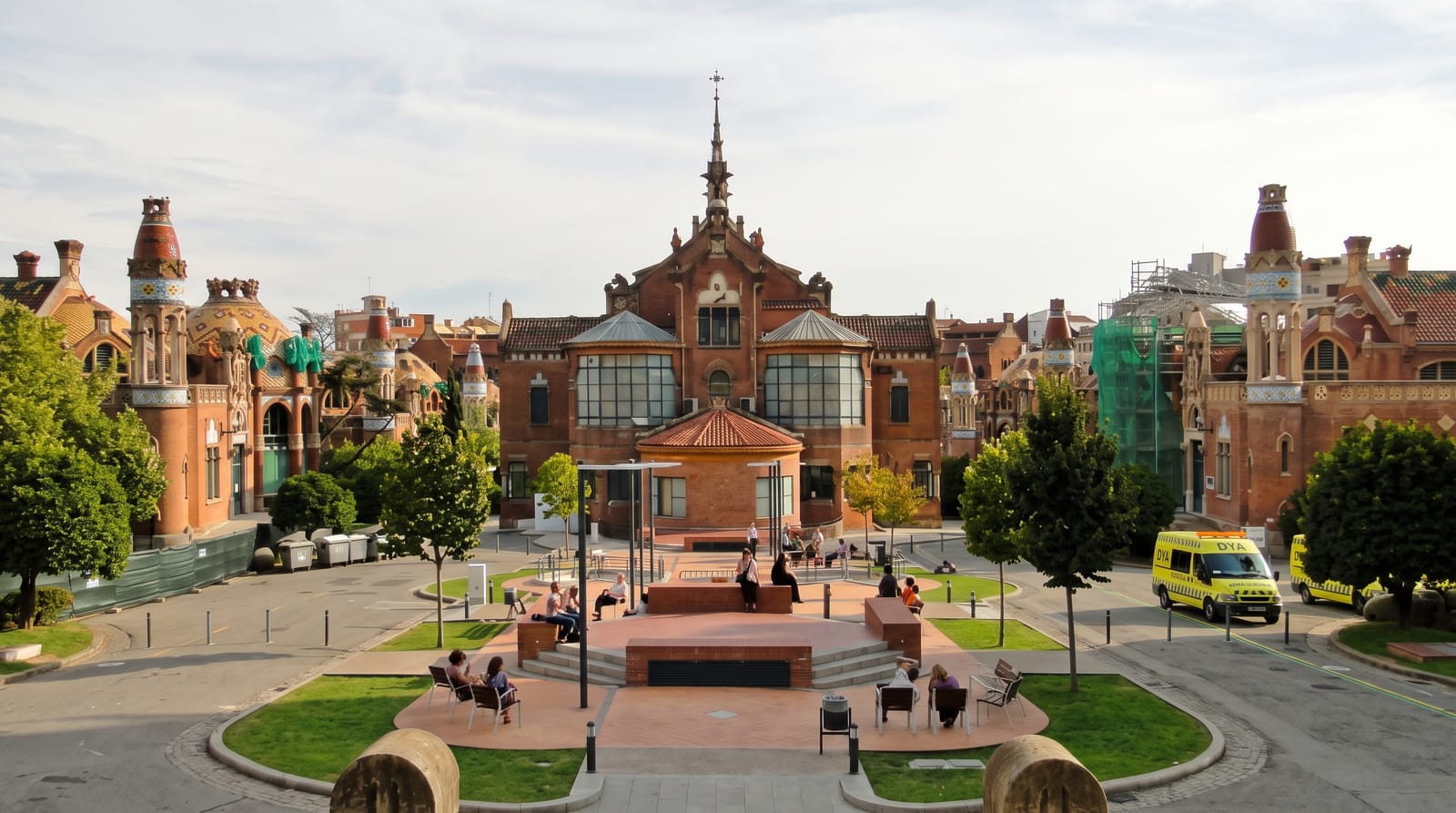
Domenech i Montaner designed Sant Pau from 1902 as a replacement for a medieval hospital, and he rejected the corridor block in favour of separate pavilions for different conditions, set at angles across nine city blocks in gardens, connected by underground tunnels for staff and supplies, on the reasoning that isolation limited infection and that surroundings affected recovery. The pavilions are covered in mosaic, sculpture and ceramic, with domed and vaulted interiors in coloured tile that look nothing like hospital wards. It functioned as a hospital until 2009, when clinical services moved to a modern building alongside, and the complex was restored and opened to visitors from 2014. UNESCO listed it with the Palau in 1997.
History
The Hospital de la Santa Creu was founded in 1401, when six small medieval hospitals merged, and its first building near the centre of Barcelona went up from 1401 to 1450, with a convalescent house added in the 17th century; those old buildings now hold the Escola Massana art school and the National Library of Catalonia. As the city grew, a new hospital by Lluís Domènech i Montaner was begun in the early 1900s, paid for by the banker Pau Gil, whose name was added as Sant Pau, and of the 48 buildings in the plan 27 were built, up to 1930. In 1997 it became a World Heritage Site with the Palau de la Música Catalana, it served as a hospital into the 2000s, when a new building to the north took over, and after restoration it reopened in 2014 as a museum and cultural centre (Wikipedia, Hospital de Sant Pau).
Highlights
- The pavilion layout - separate buildings set at angles across nine blocks.
- The tiled interiors - vaulted wards in coloured ceramic and mosaic.
- The service tunnels - underground connections between the pavilions.
- The gardens - planted grounds designed as part of the treatment.
When to go
Year-round; the complex is largely outdoors between buildings, so dry weather helps. It is far less crowded than the Gaudi sites and rarely requires advance booking except at weekends.
Things to know
Only some pavilions are open, with others used as offices and institutions. The site is large and involves considerable walking outdoors. The modern hospital alongside is visible and unattractive.
Nearby
The Sagrada Familia is a fifteen-minute walk down the avenue; the Eixample grid surrounds it.
Key facts
Source: Wikidata, item Q507282, read on 18 October 2026.
What to pack for Hospital de Sant Pau
Chosen from what this place is for. Tap a kit for the full checklist.
- Head torch + spare batteries - Hands-free light is essential; caves are truly dark. Find on Amazon
- Comfortable walking shoes - Sightseeing means kilometres of pavement and cobbles daily. Find on Amazon
- Grippy closed shoes - Cave floors are wet, muddy and slick with formations. Find on Amazon
- A slim anti-theft daypack - Zips that close properly; keep it in front in crowds and on transit. Find on Amazon
Some links on this page are Amazon affiliate links - if you buy through them we may earn a small commission at no extra cost to you.
All packing kitsPlan your trip
Where to start if Hospital de Sant Pau is going on the list.
Booking links on this page are affiliate links - if you book through them we may earn a small commission at no extra cost to you. It never changes what we write about a place.
Opening times, ticket prices and seasonal closures change - check the official source before you go: official site.