Stanjel
A stone village on a Karst hill, slowly rebuilt after heavy damage, with a terraced garden by Max Fabiani.
Updated 22 October 2026
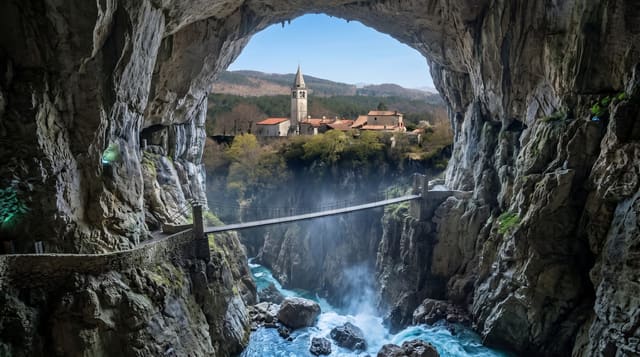
Štanjel is built up a Karst hill in courses of grey limestone with a walled top, and its silhouette, the church with its cylindrical tower and the roofs stepping down the slope, is one of the standard images of the Karst. It was heavily damaged at the end of the Second World War and has been repaired only slowly since. The architect Max Fabiani, born nearby, laid out the Ferrari Garden in 1924-1942 for his relative Enrico Ferrari, on the terraces below the castle, with a pool, pergolas and a water system.
History
Its position has made Štanjel an important settlement since the Iron Age, its growth peaked in the Romanesque period, and in the 17th century it was fortified against Ottoman raids. From 1924 to 1942 the architect Max Fabiani and his relative Enrico Ferrari laid out the terraced Ferrari Garden below the defensive wall (Wikipedia, Štanjel; Slovenian Wikipedia, Štanjel).
What you'll find
- The Ferrari Garden - Max Fabiani's terraced garden with pool, pergolas and stairs.
- The Karst stonework - courses of grey limestone in walls, roofs and lanes.
- The castle - the hilltop complex holding a gallery and the village offices.
- The church tower - the cylindrical tower that gives the village its outline.
When to go
April to October; the garden is at its best in late spring. Summer heat on the stone is heavy at midday. The bora wind is strong in winter and the village is exposed.
Things to know
Much of the village is still restoration in progress and some houses remain shells. The garden is small and can look sparse outside the growing season. Parking is below the village and the lanes are steep and cobbled.
Nearby
Vipava Valley is north, and Sezana is southwest.
Key facts
Source: Wikidata, item Q392333, read on 18 October 2026.
What to pack for Stanjel
Chosen from what this place is for. Tap a kit for the full checklist.
- Comfortable walking shoes - Sightseeing means kilometres of pavement and cobbles daily. Find on Amazon
- A slim anti-theft daypack - Zips that close properly; keep it in front in crowds and on transit. Find on Amazon
- A refillable water bottle - Many cities have public fountains; save money and plastic. Find on Amazon
- A light layer + compact umbrella - For museum air-con and a sudden shower. Find on Amazon
Some links on this page are Amazon affiliate links - if you buy through them we may earn a small commission at no extra cost to you.
All packing kitsPlan your trip
Where to start if Stanjel is going on the list.
Booking links on this page are affiliate links - if you book through them we may earn a small commission at no extra cost to you. It never changes what we write about a place.
Opening times, ticket prices and seasonal closures change - check the official source before you go: official site.