Huascarán National Park
The highest tropical mountain range on earth, with glacier lakes the colour of antifreeze and Peru's tallest peak at its centre.
Updated 18 October 2026
AI illustration
UNESCO World Heritage
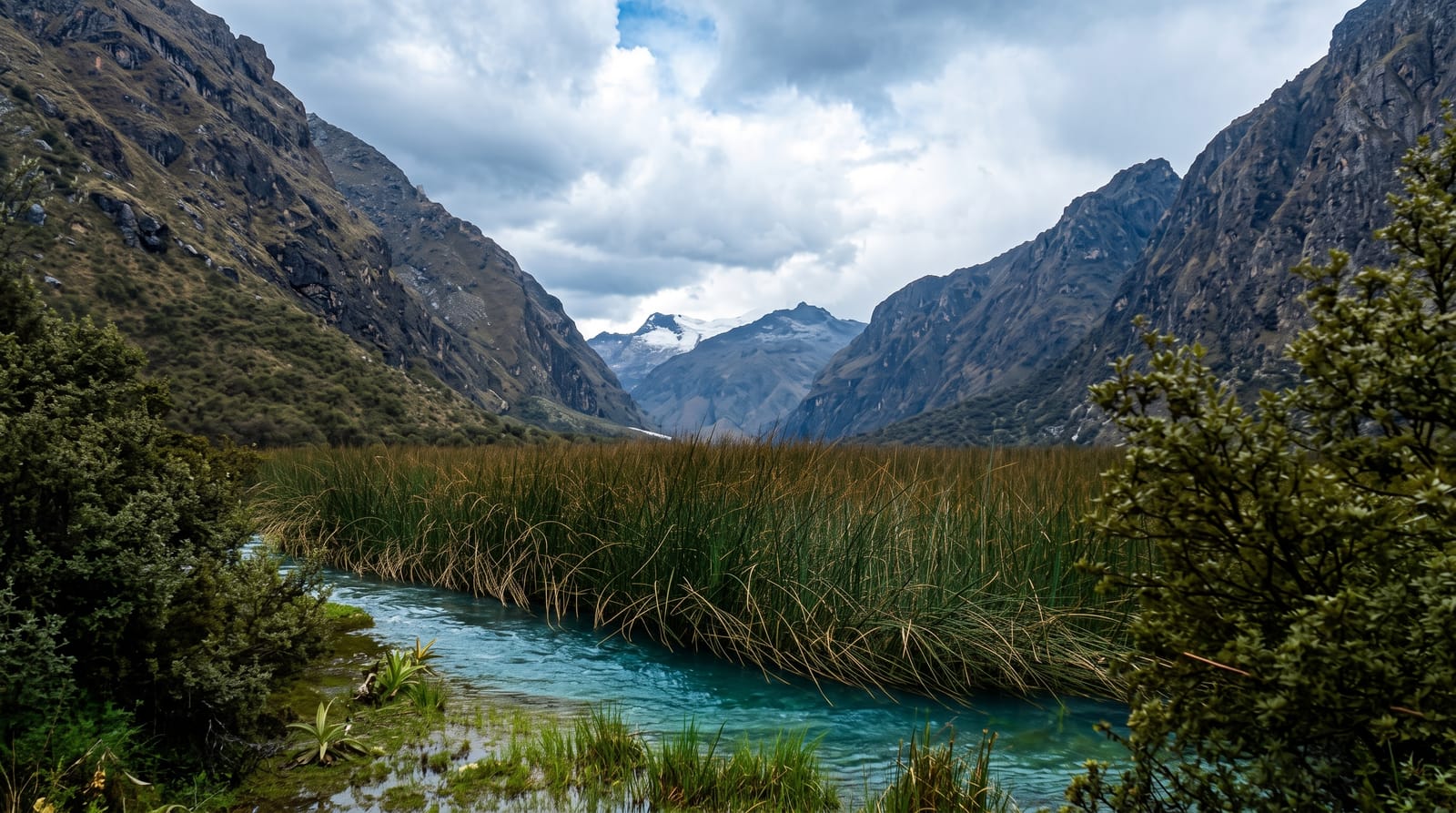
The Cordillera Blanca packs more than fifty peaks above 5,700 metres into a range roughly 180 kilometres long, which makes it the highest tropical mountain range in the world, and Huascarán National Park protects almost all of it. Huascarán itself reaches 6,768 metres, the highest point in Peru. What draws most visitors is not the summits but the lakes beneath them: glacial meltwater held in rock basins and coloured an improbable turquoise by suspended rock flour, of which Laguna 69 and Laguna Parón are the most photographed. The park also holds Puya raimondii, a bromeliad that grows for decades and then throws up a flower spike several metres tall once before dying. Everything here happens at altitude, and Huaraz sits above 3,000 metres before you start climbing.
History
Official efforts to protect the Cordillera Blanca began in 1960, when Senator Augusto Guzmán Robles put a bill for a Huascarán National Park to Congress; the Forestry and Hunting Service drafted a park of 321,000 hectares in 1963, a resolution of 18 February 1966 banned logging and hunting of native species, and in 1967 the Peace Corps volunteers Curry Slaymaker and Joel Albrecht proposed boundaries while a surveillance zone was set up for vicuñas and the Queen of the Andes. On 1 July 1975 decree No. 0622-75-AG created the park over 340,000 hectares, its final boundaries made possible by compensated expropriation of land, and in 1985 it became a World Heritage Site (Wikipedia, Huascarán National Park).
What you'll find
- Laguna 69 - the classic day hike to a turquoise glacial lake beneath Chacraraju.
- Laguna Parón - a larger lake reached by road, framed by the pyramid of Artesonraju.
- The Santa Cruz trek - the best-known multi-day route through the range.
- Puya raimondii stands - giant bromeliads in the Huascarán and Pastoruri sectors.
When to go
May to September is the dry season and effectively the only sensible window for trekking; the wet months bring cloud, mud and closed routes. Even in the dry season afternoons cloud over, so start early.
Good to know
Altitude is the real subject here. Huaraz is over 3,000 metres and Laguna 69 tops 4,600, and people underestimate it constantly. Acclimatise for two or three days before any big walk, ascend slowly, and treat headaches and breathlessness as signals rather than inconveniences. Glacial retreat is dramatic and visible; some routes described in older guidebooks no longer reach ice.
Nearby
Huaraz is the hub for the whole range; the Chavín de Huántar archaeological site lies south across the valley.
Key facts
Source: Wikidata, item Q917369, read on 18 October 2026.
What to pack for Huascarán National Park
Chosen from what this place is for. Tap a kit for the full checklist.
- Broken-in walking shoes or boots - Grip and ankle support matter more than looks; never hike in brand-new boots. Find on Amazon
- Binoculars - The single best wildlife tool - even a compact pair transforms a sighting. Find on Amazon
- Warm base layers - Merino or synthetic against the skin - never cotton, which chills when damp. Find on Amazon
- Layers for big temperature swings - Warm sun by day, near-freezing at night, even near the equator. Find on Amazon
Some links on this page are Amazon affiliate links - if you buy through them we may earn a small commission at no extra cost to you.
All packing kitsPlan your trip
Where to start if Huascarán National Park is going on the list.
Booking links on this page are affiliate links - if you book through them we may earn a small commission at no extra cost to you. It never changes what we write about a place.
Opening times, ticket prices and seasonal closures change - check the official source before you go: official site.