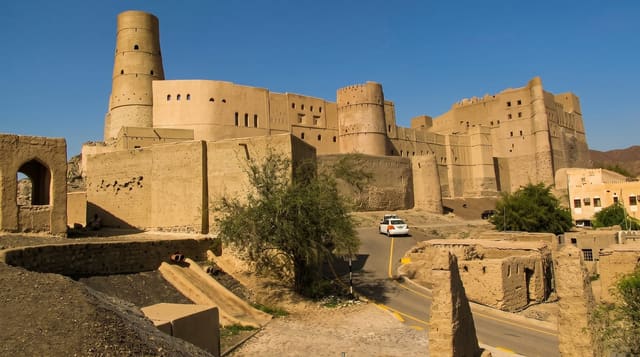
Jabrin Castle
A seventeenth-century palace-fort near Bahla with painted ceilings and rooms built for scholarship rather than defence.
Updated 1 September 2026
Jabrin was built in 1670 by Imam Bil'arab bin Sultan as a residence and a centre of learning rather than a frontier fort, and the difference shows: three storeys of rooms around courtyards, with a school, a library, guest quarters and reception halls, and ceilings of painted wood carrying floral and geometric designs and Quranic inscriptions in colours that have survived unusually well. The Sun and Moon room is the best known of them. Defensive elements are present, with towers, a well and murder holes over the entrance, but they are secondary. The imam's tomb is inside the building. It stands among date groves on the plain with the Hajar mountains behind, and it is generally considered the finest interior of any Omani fort.
Highlights
- The painted ceilings - the decorated woodwork in the upper rooms.
- The Sun and Moon room - the reception hall with its painted panels.
- The imam's tomb - the burial chamber inside the castle.
- The date groves - the plantations around the walls.
When to go
October to April; interior temperatures in summer are severe. Mornings are quieter and cooler. The castle keeps daytime hours and closes on Fridays until the afternoon in some seasons.
Good to know
Restoration in the 1980s was extensive and some surfaces are renewed rather than original. Interpretation is limited to panels in Arabic and English. Stairs between floors are steep and narrow. It combines with Bahla, which is close.
Nearby
Bahla fort lies northeast; Nizwa is further east.
Key facts
Source: Wikidata, item Q14206356, read on 18 October 2026.
What to pack for Jabrin Castle
Chosen from what this place is for. Tap a kit for the full checklist.
- Comfortable walking shoes - Sightseeing means kilometres of pavement and cobbles daily. Find on Amazon
- A slim anti-theft daypack - Zips that close properly; keep it in front in crowds and on transit. Find on Amazon
- A refillable water bottle - Many cities have public fountains; save money and plastic. Find on Amazon
- A light layer + compact umbrella - For museum air-con and a sudden shower. Find on Amazon
Some links on this page are Amazon affiliate links - if you buy through them we may earn a small commission at no extra cost to you.
All packing kitsPlan your trip
Where to start if Jabrin Castle is going on the list.
Booking links on this page are affiliate links - if you book through them we may earn a small commission at no extra cost to you. It never changes what we write about a place.
Opening times, ticket prices and seasonal closures change - check the official source before you go: official site.