Hammerfest
One of the world's northernmost towns, holding a UNESCO-listed survey column from the nineteenth-century Struve arc.
Updated 21 October 2026
AI illustration
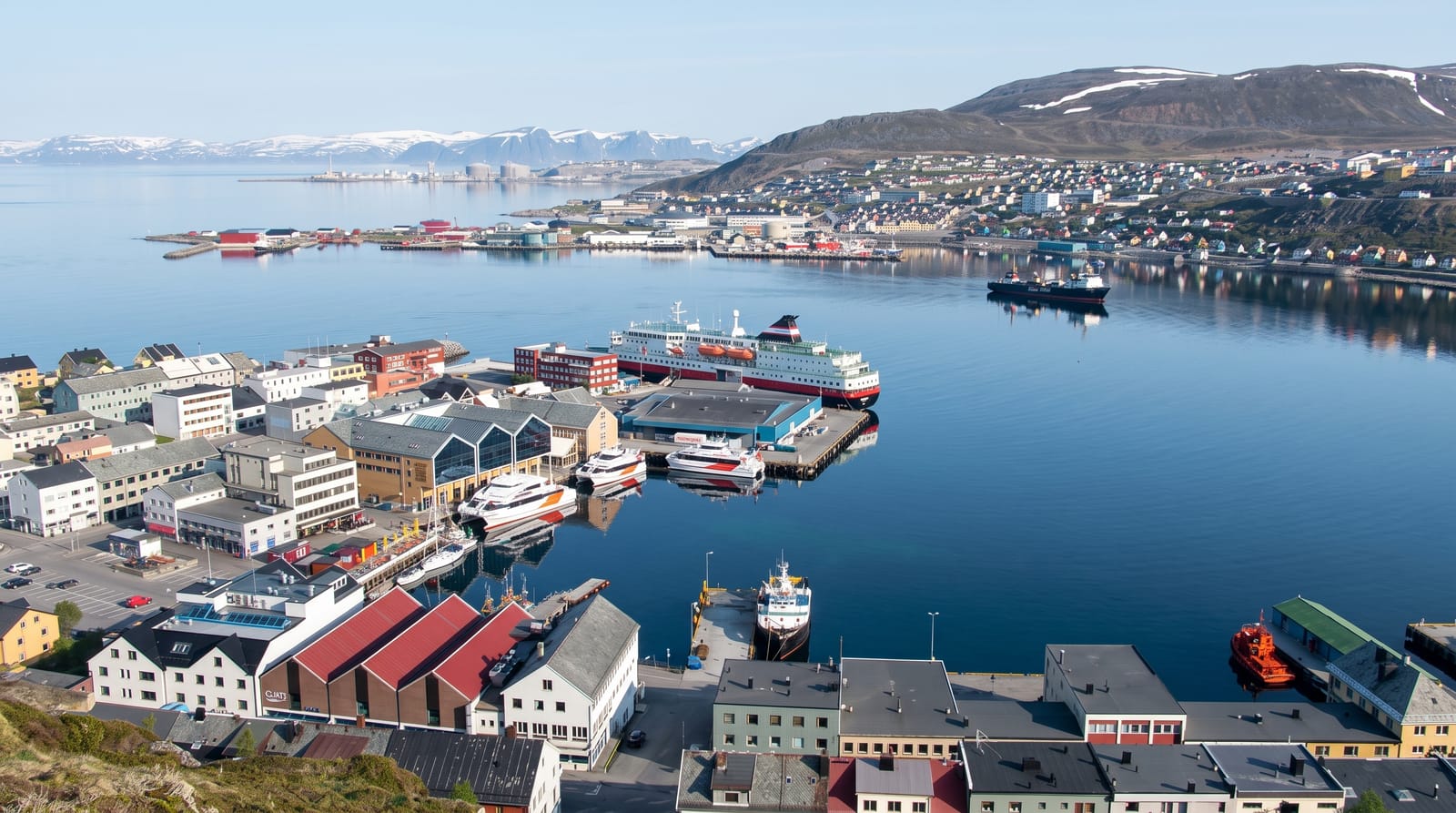
Hammerfest claims to be the world's northernmost town, a title contested with Honningsvag on technical grounds, and it was the first town in northern Europe to get electric street lighting, in 1891. On the Meridianstotten hill stands a survey column marking one end of the Struve Geodetic Arc, a chain of measurement points from Norway to the Black Sea used between 1816 and 1855 to determine the size and shape of the Earth, inscribed by UNESCO as a World Heritage Site. The town was burned in 1944 and rebuilt, so the architecture is postwar. The Royal and Ancient Polar Bear Society museum documents the Arctic hunting history, and Melkoya island offshore holds a large gas processing plant.
History
Many Stone Age grave sites lie here, and the place was a fishing and Arctic hunting settlement long before Christian VII of Denmark-Norway gave it town status on 17 July 1789; its first church dates from 1684, when about 60 people lived here, and Russian grain ships came from 1764 in the Pomor trade. After a fire took two-thirds of the town in 1890, rebuilding began in 1891, and that year Hammerfest became the first town in Norway and Northern Europe with electric streetlights (Wikipedia, Hammerfest).
Highlights
- The Struve column - a UNESCO-listed survey point on Meridianstotten.
- The Polar Bear Society - a museum of Arctic hunting and expedition history.
- The rebuilt town - postwar architecture after the 1944 destruction.
- The Arctic setting - a working town at nearly 71 degrees north.
When to go
June to August for the midnight sun, which runs from mid-May to late July; September to March for the northern lights. Winter here is dark from late November to late January.
What to expect
The town is functional postwar building rather than picturesque, and the industrial gas plant dominates the view from parts of it. Weather is wet and windy year-round. Most sights are small and take under an hour each.
Nearby
Seiland National Park lies south; Alta and the Nordkapp road are inland and east.
Key facts
Source: Wikidata, item Q721374, read on 18 October 2026.
What to pack for Hammerfest
Chosen from what this place is for. Tap a kit for the full checklist.
- Travel rod + reel - A packable multi-piece rod fits in a case and covers most holiday fishing. Find on Amazon
- Spare batteries + cards - Cold and long shoots drain power; never run out at the good light. Find on Amazon
- Warm base layers - Merino or synthetic against the skin - never cotton, which chills when damp. Find on Amazon
- Comfortable walking shoes - Sightseeing means kilometres of pavement and cobbles daily. Find on Amazon
Some links on this page are Amazon affiliate links - if you buy through them we may earn a small commission at no extra cost to you.
All packing kitsPlan your trip
Where to start if Hammerfest is going on the list.
Booking links on this page are affiliate links - if you book through them we may earn a small commission at no extra cost to you. It never changes what we write about a place.
Opening times, ticket prices and seasonal closures change - check the official source before you go: official site.