Waipoua Forest
The largest surviving stand of kauri in New Zealand, holding Tane Mahuta, the biggest known living tree of the species.
Updated 21 October 2026
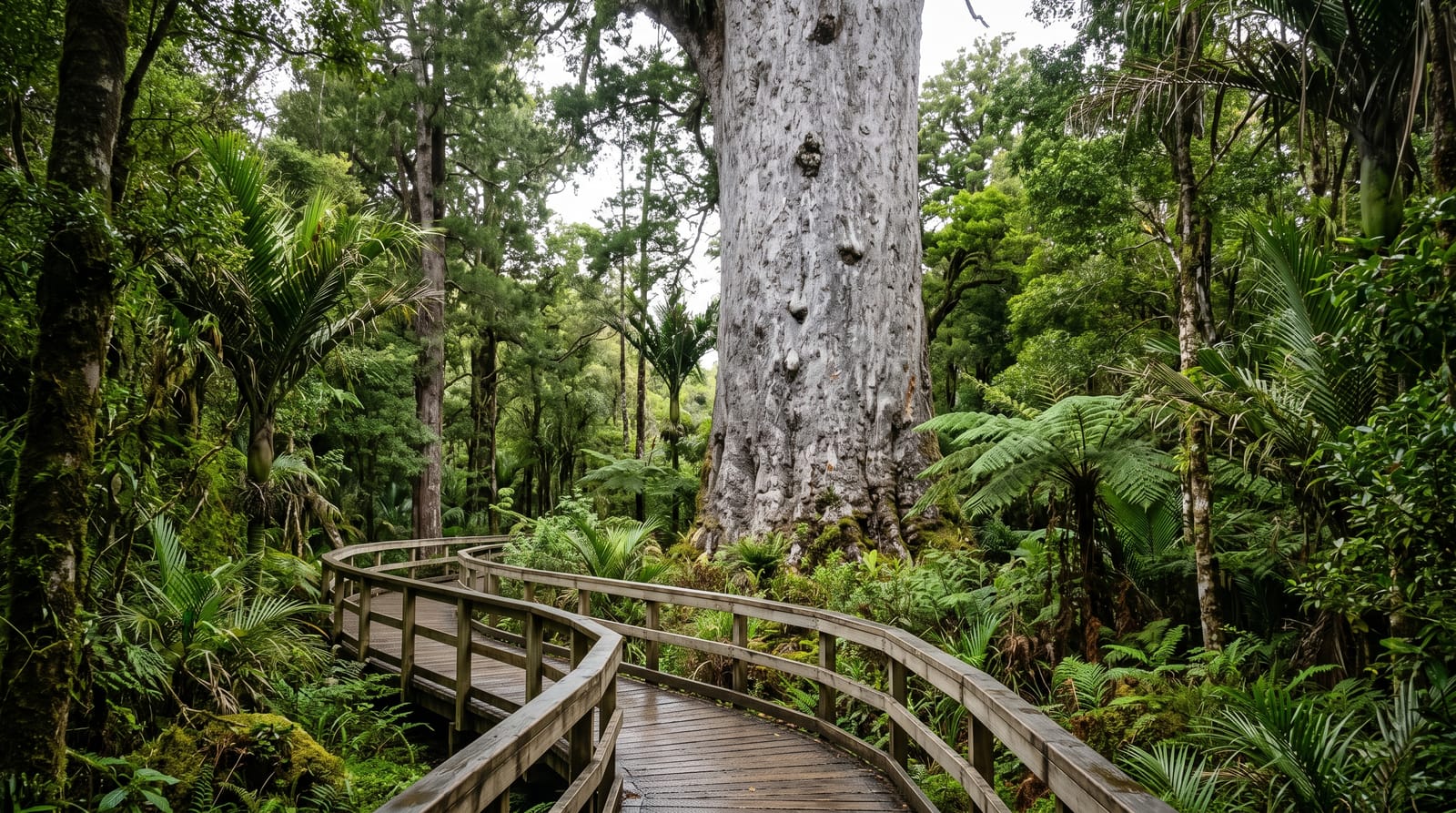
AI illustration
Waipoua, on the west coast of Northland between Dargaville and the Hokianga, holds the largest surviving stand of kauri in the country. The trees are the whole point. Tane Mahuta, the biggest known living kauri, stands a couple of minutes from the road along a short boardwalk, a grey column with no branches for most of its height, wide enough that people go quiet when they come around the corner and see it. Deeper in, Te Matua Ngahere is shorter and thicker through the trunk. Kauri are vulnerable to a soil-borne disease carried on footwear, so the tracks run on raised boardwalk, shoe cleaning stations sit at every entrance, and some paths have been closed to protect the trees.
History
The forest was bought from Tiopira Kinaka of Te Roroa and Parore Te Awha of Te Kuihi in 1876 for a little over £2,000 and became a State Forest Reserve in 1885. When it became known in the 1940s that the State Forest Service was cutting kauri here, a petition of more than 43,000 signatures was taken to parliament in a wheelbarrow on 25 September 1947, and in 1952 the forest was declared a sanctuary (Wikipedia, Waipoua Forest).
The landscape
- Tane Mahuta - the largest known living kauri, a short boardwalk from the highway.
- Te Matua Ngahere - a shorter, far thicker trunk reached on a longer forest walk.
- Guided evening walks - local guides taking small groups into the forest after dark.
- The forest itself - dense subtropical bush of ferns, nikau and rimu around the giants.
When to go
Any time of year works, since Northland is mild and the boardwalks handle wet weather. Winter is quieter and wetter, and rain makes the forest smell and drip in a way dry days do not. Early morning and late afternoon avoid the tour vans that stop at Tane Mahuta through the middle of the day. Allow a full day if you are driving the loop from Dargaville.
Practical notes
Seeing Tane Mahuta takes about ten minutes, which surprises people who drove three hours for it. There is no visitor centre at the tree, only a car park and a cleaning station, and you must scrub and spray your shoes going in and out. Some tracks have been closed to slow kauri dieback, so check before planning a longer walk. Mosquitoes are persistent in still weather.
Nearby
The Hokianga Harbour and the dunes at Opononi are north, Dargaville and the Kai Iwi Lakes to the south.
Key facts
Source: Wikidata, item Q1515785, read on 18 October 2026.
What to pack for Waipoua Forest
Chosen from what this place is for. Tap a kit for the full checklist.
- Broken-in walking shoes or boots - Grip and ankle support matter more than looks; never hike in brand-new boots. Find on Amazon
- Loose, light, long clothing - Covering up beats bare skin in the desert - and locals dress this way for a reason. Find on Amazon
- Layers + a waterproof shell - Mountain weather turns fast; a packable rain jacket saves the day. Find on Amazon
- A wide-brim hat + sunglasses - Shade for your face and eyes where there is none overhead. Find on Amazon
Some links on this page are Amazon affiliate links - if you buy through them we may earn a small commission at no extra cost to you.
All packing kitsPlan your trip
Where to start if Waipoua Forest is going on the list.
Booking links on this page are affiliate links - if you book through them we may earn a small commission at no extra cost to you. It never changes what we write about a place.
Opening times, ticket prices and seasonal closures change - check the official source before you go: official site.