Volterra
An Etruscan city on a ridge that is slowly falling into a landslide, and a town that carves alabaster.
Updated 19 October 2026
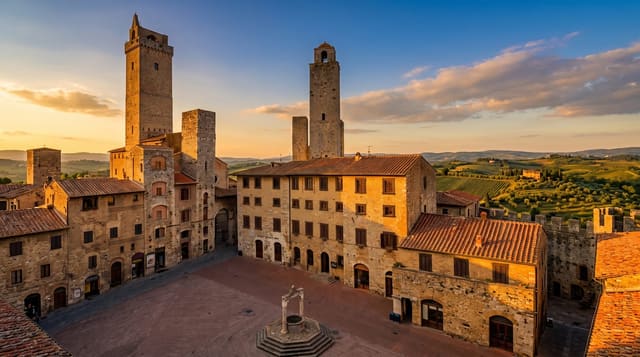
AI illustration
Volterra stands high on a ridge with a Roman theatre below the walls, an Etruscan gate still in use, and a museum holding some six hundred carved funerary urns, one of the largest Etruscan collections anywhere, including a thin elongated bronze figure that D'Annunzio named the Shadow of the Evening. On the western edge the Balze are landslide cliffs eating steadily into the plateau; they have swallowed part of the Etruscan necropolis and a monastery, and the erosion continues. Alabaster has been worked here since Etruscan times and workshops still cut and turn it. The Medici fortress has been a prison since the sixteenth century and remains one.
History
Etruscan Velathri, Roman Volaterrae, is thought to have been a city since at least the end of the 8th century BC, and it grew from a Proto-Villanovan settlement into one of the twelve cities of the Etruscan League. Allied with Rome at the end of the 3rd century BC, it became a municipium, and members of the Caecina family built its theatre (Wikipedia, Volterra).
What's there
- The Etruscan urns - some six hundred carved funerary chests in the museum.
- The Balze - landslide cliffs that have eaten part of the ancient city.
- The alabaster workshops - a craft continuous since the Etruscans.
- The Roman theatre - a first-century theatre below the walls.
When to go
April to October; the ridge is windy and cold outside summer. Volterra AD 1398 recreates the medieval town over two Sundays in August. Winter closes some workshops.
Good to know
The town is high, windy and steep, with parking outside the walls. The Balze are viewed from a fenced edge for safety. The fortress is an active prison and closed.
Nearby
San Gimignano lies northeast; the Maremma is south.
Key facts
Source: Wikidata, item Q103305, read on 18 October 2026.
What to pack for Volterra
Chosen from what this place is for. Tap a kit for the full checklist.
- Comfortable walking shoes - Sightseeing means kilometres of pavement and cobbles daily. Find on Amazon
- Modest clothing - Shoulders and knees covered - the single most common requirement. Find on Amazon
- A slim anti-theft daypack - Zips that close properly; keep it in front in crowds and on transit. Find on Amazon
- A scarf or shawl - To cover the head or shoulders on entry; women especially at mosques. Find on Amazon
Some links on this page are Amazon affiliate links - if you buy through them we may earn a small commission at no extra cost to you.
All packing kitsPlan your trip
Where to start if Volterra is going on the list.
Booking links on this page are affiliate links - if you book through them we may earn a small commission at no extra cost to you. It never changes what we write about a place.
Opening times, ticket prices and seasonal closures change - check the official source before you go: official site.