Perugia
A hill city stacked on Etruscan foundations, with a Renaissance fortress hiding a buried street beneath it.
Updated 16 October 2026

AI illustration
Perugia is built in layers: an Etruscan arch of the third century BC still carries traffic, and under the Rocca Paolina, the fortress Paul III built in 1540 after crushing a revolt over the salt tax, lies an entire medieval quarter that was buried rather than demolished, its streets, doorways and houses now walked through on escalators rising from the lower town. The Galleria Nazionale dell'Umbria holds Perugino and Piero della Francesca. Perugina chocolate was founded here in 1907 and the Baci sweet with it. Umbria Jazz fills the centre each July.
Background
The city spreads over a tall hilltop and parts of the valleys below, about 164 km north of Rome and 148 km southeast of Florence, and the River Tiber crosses its territory. Its 162,384 people make it Italy's 23rd-largest city. As Perusia it belonged to the 12 confederate cities of Etruria. It is also a university town: the University of Perugia dates from 1308, the Academy of Fine Arts "Pietro Vannucci" from 1573 and the Music Conservatory from 1788, alongside a University for Foreigners. Perugino frescoed the Sala del Cambio, Raphael left one fresco in the city, and Galeazzo Alessi is its best known architect. The griffin, the city's emblem, appears on plaques and statues around town.
Source: Wikipedia, "Perugia"
Highlights
- The buried quarter - medieval streets inside the Rocca Paolina, entered by escalator.
- The Etruscan arch - a third-century BC gate still in use.
- The Fontana Maggiore - a carved thirteenth-century fountain in the main square.
- The national gallery - Perugino, Pinturicchio and Piero della Francesca.
When to go
April to June and September to October; Umbria Jazz runs in July and Eurochocolate in October, both filling the city. Summer heat on the hill is heavy.
Before you go
The centre is high above the station and reached by escalators and a minimetro; driving in is restricted. Festival weeks are crowded and expensive.
Nearby
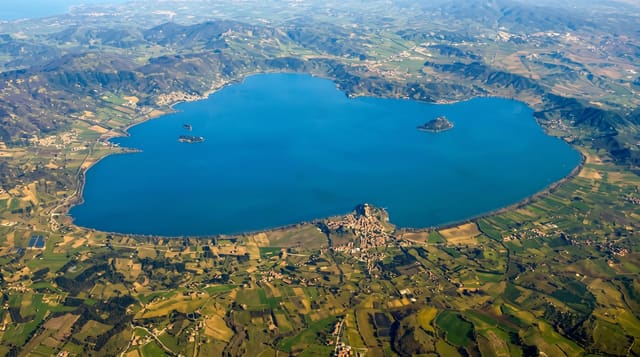
Assisi lies east; Lake Trasimeno is west.
Key facts
Source: Wikidata, item Q3437, read on 18 October 2026.
What to pack for Perugia
Chosen from what this place is for. Tap a kit for the full checklist.
- Comfortable walking shoes - Sightseeing means kilometres of pavement and cobbles daily. Find on Amazon
- A slim anti-theft daypack - Zips that close properly; keep it in front in crowds and on transit. Find on Amazon
- A refillable water bottle - Many cities have public fountains; save money and plastic. Find on Amazon
- A light layer + compact umbrella - For museum air-con and a sudden shower. Find on Amazon
Some links on this page are Amazon affiliate links - if you buy through them we may earn a small commission at no extra cost to you.
All packing kitsPlan your trip
Where to start if Perugia is going on the list.
Booking links on this page are affiliate links - if you book through them we may earn a small commission at no extra cost to you. It never changes what we write about a place.
Opening times, ticket prices and seasonal closures change - check the official source before you go: official site.