Arquà Petrarca
The village where Petrarch spent his last years, which added his name to its own in 1868.
Updated 19 October 2026

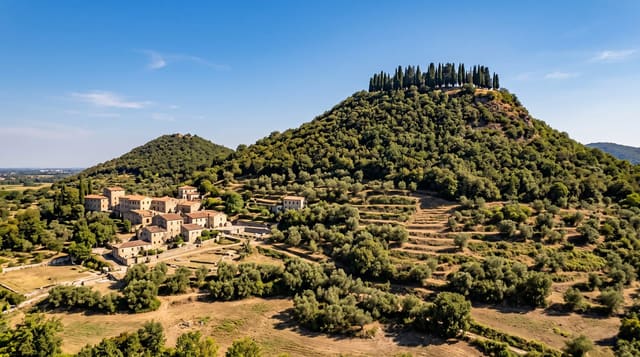
AI illustration
Francesco Petrarca settled in this village in the Euganean Hills in 1370 and died there in 1374, reportedly found at his desk. The house he lived in survives and is open, with a sixteenth-century fresco cycle added by a later owner illustrating his poems, and his tomb, a raised marble sarcophagus, stands in the square below the church. The village added his name to its own in 1868. The surrounding hills produce a jujube liqueur, brodo di giuggiole, from a fruit grown here; the Italian phrase for being delighted, andare in brodo di giuggiole, refers to it. The village keeps its medieval street plan largely intact.
History
Excavations from the second half of the 19th century showed people here in the Bronze Age, and the Coast Lake within the town's bounds is one of the Prehistoric Pile Dwellings around the Alps, a group inscribed by UNESCO in 2011 (Wikipedia, Arquà Petrarca).
Highlights
- Petrarch's house - the poet's last home with later illustrative frescoes.
- The tomb - a raised marble sarcophagus in the lower square.
- The medieval plan - a village largely unchanged in layout.
- The jujube liqueur - a local fruit drink with its own festival.
When to go
April to October; the jujube festival runs on the first two Sundays of October. The house museum closes Mondays. Summer weekends bring visitors from Padua.
Before you go
The village is very small and seen in an hour or two. The house holds few original objects. Parking is outside with a walk uphill.
Nearby
The Euganean Hills surround it; Padua lies northeast.
Key facts
Source: Wikidata, item Q34638, read on 18 October 2026.
What to pack for Arquà Petrarca
Chosen from what this place is for. Tap a kit for the full checklist.
- Comfortable walking shoes - Sightseeing means kilometres of pavement and cobbles daily. Find on Amazon
- A slim anti-theft daypack - Zips that close properly; keep it in front in crowds and on transit. Find on Amazon
- A refillable water bottle - Many cities have public fountains; save money and plastic. Find on Amazon
- A light layer + compact umbrella - For museum air-con and a sudden shower. Find on Amazon
Some links on this page are Amazon affiliate links - if you buy through them we may earn a small commission at no extra cost to you.
All packing kitsPlan your trip
Where to start if Arquà Petrarca is going on the list.
Booking links on this page are affiliate links - if you book through them we may earn a small commission at no extra cost to you. It never changes what we write about a place.
Opening times, ticket prices and seasonal closures change - check the official source before you go: official site.