Dunsink Observatory
A working observatory of 1785 on the edge of Dublin, where Hamilton lived, opening its Victorian refractor to the public on winter nights.
Updated 19 October 2026
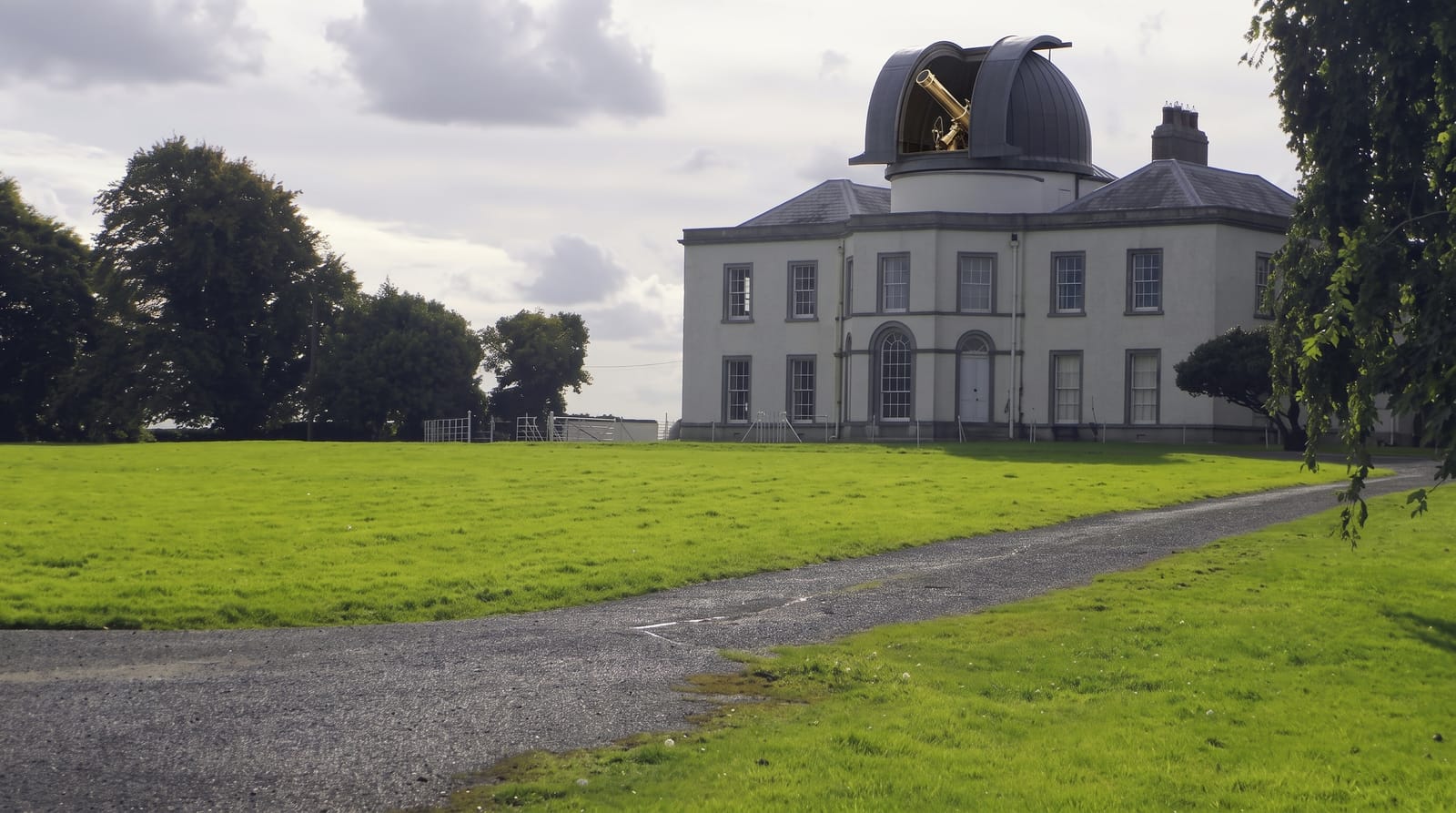
AI illustration
Dunsink was founded in 1785 on a low hill northwest of Dublin, which was open country then and is now the edge of the city. William Rowan Hamilton ran it for most of the nineteenth century and lived in the house; the walk from here to Broom Bridge, where he cut the quaternion formula into the stonework in 1843, is still a small pilgrimage for mathematicians. The main instrument is a Victorian refractor under a rotating wooden dome, and it is still used on public open nights through the darker half of the year, when volunteers point it at whatever the cloud allows. The rest of the time it is a research site and closed.
History
The observatory was founded in 1785 with a bequest of £3,000 in the will of Francis Andrews, Provost of Trinity College Dublin, who died on 18 June 1774, on the south slope of a low hill 84 m above sea level. Its directors included William Rowan Hamilton, who discovered quaternions while walking from the observatory into the city with his wife, a discovery marked each year by the Hamilton Walk (Wikipedia, Dunsink Observatory).
What you'll find
- The South Telescope - the Victorian refractor under its wooden dome.
- The 1785 building - the original observatory house on the hill.
- The open nights - winter evenings when the telescope is used by visitors.
- Broom Bridge - a short walk away, where Hamilton carved his formula in 1843.
When to go
Public open nights run in the darker months, roughly October to March, on set evenings that are booked out quickly once released. They go ahead in cloud, with talks replacing the telescope, so treat a clear sky as a bonus rather than the plan. Outside that season there is no public access and nothing to see.
What to expect
Dublin's light pollution puts faint objects out of reach, so the Moon, planets and double stars are what the telescope does well. Cloud cancels the actual observing more often than not. It is awkward to reach without a car, cold standing on the hill, and the buildings are working offices rather than a visitor centre with a shop.
Nearby
Phoenix Park and the National Botanic Gardens are both a short drive away.
Key facts
Source: Wikidata, item Q586354, read on 18 October 2026.
What to pack for Dunsink Observatory
Chosen from what this place is for. Tap a kit for the full checklist.
- Spare batteries + cards - Cold and long shoots drain power; never run out at the good light. Find on Amazon
- Comfortable walking shoes - Sightseeing means kilometres of pavement and cobbles daily. Find on Amazon
- Modest clothing - Shoulders and knees covered - the single most common requirement. Find on Amazon
- A compact tripod - Essential for night skies, aurora, waterfalls and low light. Find on Amazon
Some links on this page are Amazon affiliate links - if you buy through them we may earn a small commission at no extra cost to you.
All packing kitsPlan your trip
Where to start if Dunsink Observatory is going on the list.
Booking links on this page are affiliate links - if you book through them we may earn a small commission at no extra cost to you. It never changes what we write about a place.
Opening times, ticket prices and seasonal closures change - check the official source before you go: official site.