Nilgiri Mountain Railway
A rack and pinion hill railway climbing from the Tamil Nadu plains to Ooty, still worked by steam on its steepest section.
Updated 18 October 2026
AI illustration
UNESCO World Heritage
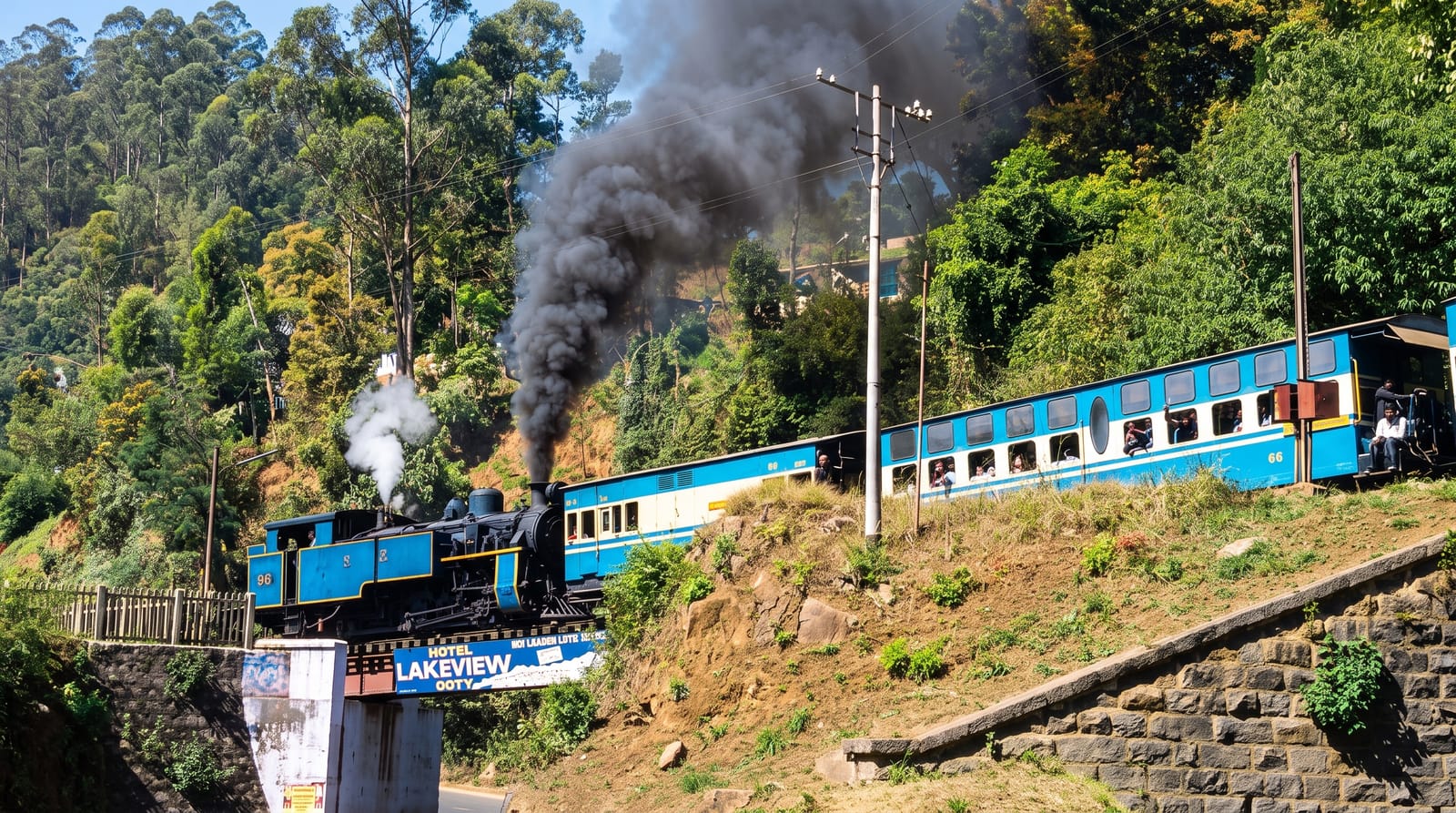
The Nilgiri Mountain Railway climbs from Mettupalayam on the plains of Tamil Nadu to Ooty in the Nilgiri hills, and the lower section uses a rack and pinion system to haul the train up gradients that plain adhesion cannot manage. That stretch is worked by steam, with the locomotive pushing from behind, moving at little more than walking pace through tunnels, over bridges and past waterfalls and eucalyptus slopes. Above Coonoor the line eases and diesel takes over for the run through tea estates to Ooty. The whole journey takes around five hours uphill, on the only rack railway in India.
History
Plans for a mountain railway from Mettupalayam to the Nilgiri Hills were made in 1854, but it took 45 years to see them through: the line opened for traffic in June 1899, worked at first by the Madras Railway under an agreement with the government until the South Indian Railway company bought it. In 1907 four Double Fairlie locomotives arrived to work the line, built by the Avonside Engine Company in 1879 and 1880 for service in Afghanistan and kept in store since 1887. The line was extended from Coonoor to Fernhill in September 1908 and on to Udhagamandalam by 15 October 1908, 18.91 kilometres at a cost of 2,440,000 rupees; it is the only rack railway in India, and in July 2005 UNESCO added it to the Darjeeling Himalayan Railway World Heritage Site, which became the Mountain Railways of India (Wikipedia, Nilgiri Mountain Railway).
What to look for
- The rack section below Coonoor - the steep climb worked by a steam locomotive pushing from behind.
- Tunnels and bridges - the engineered stretches cut into the hillside on the ascent.
- Tea estates above Coonoor - the plantation country the upper line runs through.
- Coonoor and Ooty stations - the working hill towns at either end of the upper section.
When to go
October to March is dry and clear in the Nilgiris, with cold mornings and good visibility. April and May are busy with domestic holidaymakers and everything in Ooty is expensive. The monsoon brings landslides that can suspend services for stretches at a time. Tickets for the uphill train are released well in advance and sell out quickly; the downhill run is easier to get.
What to expect
Seats are hard, carriages are basic and the uphill journey takes about five hours, which is a long time on a bench. Trains run once a day in each direction on the full route, so a missed connection wastes a day. Windows are barred and often dirty, which frustrates photographers. Ooty at the top is congested and built up, and does not match the journey.
Nearby
Coonoor's tea estates and the viewpoints of the Nilgiri plateau are the natural stops.
What to pack for Nilgiri Mountain Railway
Chosen from what this place is for. Tap a kit for the full checklist.
- Broken-in walking shoes or boots - Grip and ankle support matter more than looks; never hike in brand-new boots. Find on Amazon
- Strong insect repellent - DEET or picaridin; the jungle is where bites and disease risk are highest. Find on Amazon
- Comfortable walking shoes - Sightseeing means kilometres of pavement and cobbles daily. Find on Amazon
- Layers + a waterproof shell - Mountain weather turns fast; a packable rain jacket saves the day. Find on Amazon
Some links on this page are Amazon affiliate links - if you buy through them we may earn a small commission at no extra cost to you.
All packing kitsPlan your trip
Where to start if Nilgiri Mountain Railway is going on the list.
Booking links on this page are affiliate links - if you book through them we may earn a small commission at no extra cost to you. It never changes what we write about a place.
Opening times, ticket prices and seasonal closures change - check the official source before you go: official site.