Modhera Sun Temple
An eleventh-century sun temple aligned so the equinox sunrise reaches the sanctum, with a vast stepped tank.
Updated 19 October 2026
AI illustration
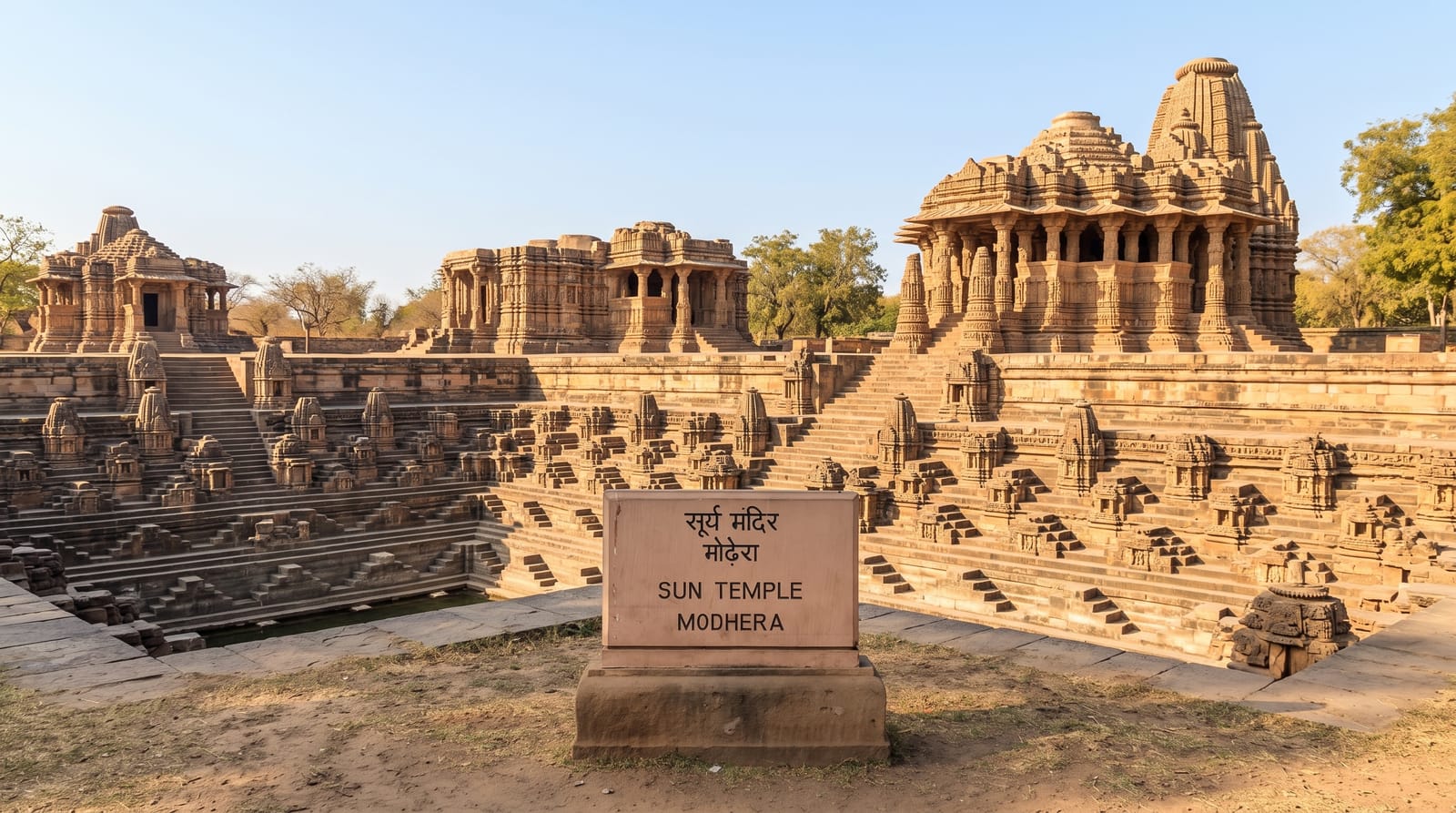
Built around 1026 under Bhima I of the Solanki dynasty, the Modhera temple is laid out on an east-west axis so that at the equinoxes the rising sun reaches through the hall to the sanctum, where an image of Surya once stood. It comes in three parts: the kunda, a stepped tank of over a hundred small shrines set into descending terraces; the sabha mandapa, an open pillared hall with carved brackets and toranas; and the sanctum itself, whose superstructure was destroyed. Carving covers the exterior in bands of deities, dancers and horses. Worship ceased centuries ago and the site is preserved as a monument.
History
The shrine was built in the reign of Bhima I of the Chaulukya dynasty; in 1024-1025 Mahmud of Ghazni invaded his kingdom, and a force of around 20,000 soldiers tried without success to stop him at Modhera, which the historian A. K. Majumdar suggests the temple may commemorate. It stands at about 23.6° latitude, near the Tropic of Cancer, worship here ended long ago, and in December 2022 it was added to UNESCO's tentative list (Wikipedia, Sun Temple, Modhera).
What you'll find
- The stepped tank - terraces of small shrines descending to the water.
- The pillared hall - carved brackets and an open assembly space.
- The solar alignment - the axis reaching the sanctum at the equinoxes.
- The exterior carving - bands of figures around the outer walls.
When to go
October to March; Gujarat summers are severe. The equinoxes in March and September are when the alignment works. A dance festival is held here each January.
What to expect
The sanctum superstructure is gone and no image remains; this is a ruin, not a working temple. There is no shade at the tank. Interpretation on site is limited.
Nearby
Patan and the Rani ki Vav stepwell lie north; Ahmedabad is south.
Key facts
Source: Wikidata, item Q2570737, read on 18 October 2026.
What to pack for Modhera Sun Temple
Chosen from what this place is for. Tap a kit for the full checklist.
- Comfortable walking shoes - Sightseeing means kilometres of pavement and cobbles daily. Find on Amazon
- Modest clothing - Shoulders and knees covered - the single most common requirement. Find on Amazon
- A slim anti-theft daypack - Zips that close properly; keep it in front in crowds and on transit. Find on Amazon
- A scarf or shawl - To cover the head or shoulders on entry; women especially at mosques. Find on Amazon
Some links on this page are Amazon affiliate links - if you buy through them we may earn a small commission at no extra cost to you.
All packing kitsPlan your trip
Where to start if Modhera Sun Temple is going on the list.
Booking links on this page are affiliate links - if you book through them we may earn a small commission at no extra cost to you. It never changes what we write about a place.
Opening times, ticket prices and seasonal closures change - check the official source before you go: official site.