Bekal Fort
A keyhole-shaped laterite fort jutting into the Arabian Sea, built with observation holes at three levels.
Updated 19 October 2026
AI illustration
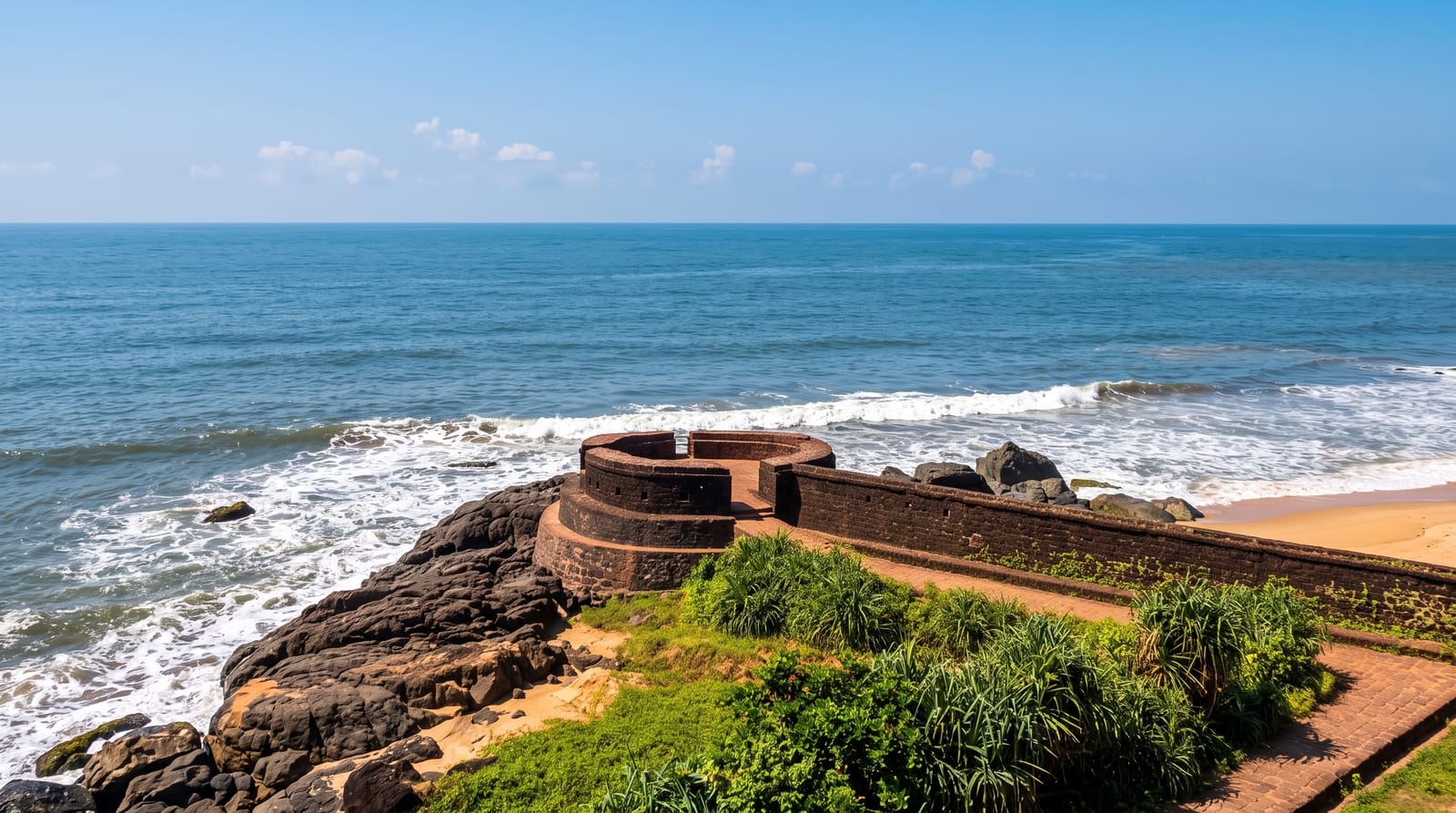
Bekal covers around forty acres on a headland in northern Kerala, built of laterite blocks in the seventeenth century under the Keladi Nayakas and later held by Tipu Sultan and the British. Its plan is roughly keyhole-shaped, with walls running to the water and a bastion at the seaward point. The distinctive feature is defensive: holes are cut through the walls at three levels, the upper for firing on distant attackers, the middle at closer range and the lowest for striking those who reached the base. An observation tower gives a view along the coast, and the beach below is broad and quiet.
History
In the age of the Perumals Bekal was part of Mahodayapuram, and from the 12th century it belonged to the Kolathiri rulers, under whom it became an important port. After the Battle of Talikota in 1565 the Keladi Nayakas rose in the region; Hiriya Venkatappa Nayaka began the fort and Shivappa Nayaka completed it in 1650, and later Hyder Ali took it, Tipu Sultan used it as a military station in his campaign in Malabar, and after Tipu's death in 1799 it passed to the British East India Company (Wikipedia, Bekal Fort).
What to look for
- The laterite walls - the fort circuit running to the water.
- The three-level loopholes - firing holes graded by range.
- The observation tower - the lookout with views along the coast.
- The sea bastion - the point projecting into the Arabian Sea.
When to go
October to March for dry weather; the northern Kerala monsoon is very heavy. Late afternoon light on the laterite is best and sunset from the walls is the usual timing.
Practical notes
The interior is largely open grass with few buildings. There is no shade on the walls. The site is used for film shoots and closes occasionally.
Nearby
Kasaragod lies north; Kannur is south.
Key facts
Source: Wikidata, item Q3519346, read on 18 October 2026.
What to pack for Bekal Fort
Chosen from what this place is for. Tap a kit for the full checklist.
- Strong insect repellent - DEET or picaridin; the jungle is where bites and disease risk are highest. Find on Amazon
- Comfortable walking shoes - Sightseeing means kilometres of pavement and cobbles daily. Find on Amazon
- Long, light, quick-dry clothing - Covers skin from insects and sun without cooking you in the humidity. Find on Amazon
- A slim anti-theft daypack - Zips that close properly; keep it in front in crowds and on transit. Find on Amazon
Some links on this page are Amazon affiliate links - if you buy through them we may earn a small commission at no extra cost to you.
All packing kitsPlan your trip
Where to start if Bekal Fort is going on the list.
Booking links on this page are affiliate links - if you book through them we may earn a small commission at no extra cost to you. It never changes what we write about a place.
Opening times, ticket prices and seasonal closures change - check the official source before you go: official site.