Arch of Galerius and Rotunda
A carved Roman arch and a vast domed rotunda, part of an imperial complex that later served as church and mosque.
Updated 18 October 2026
AI illustration
UNESCO World Heritage
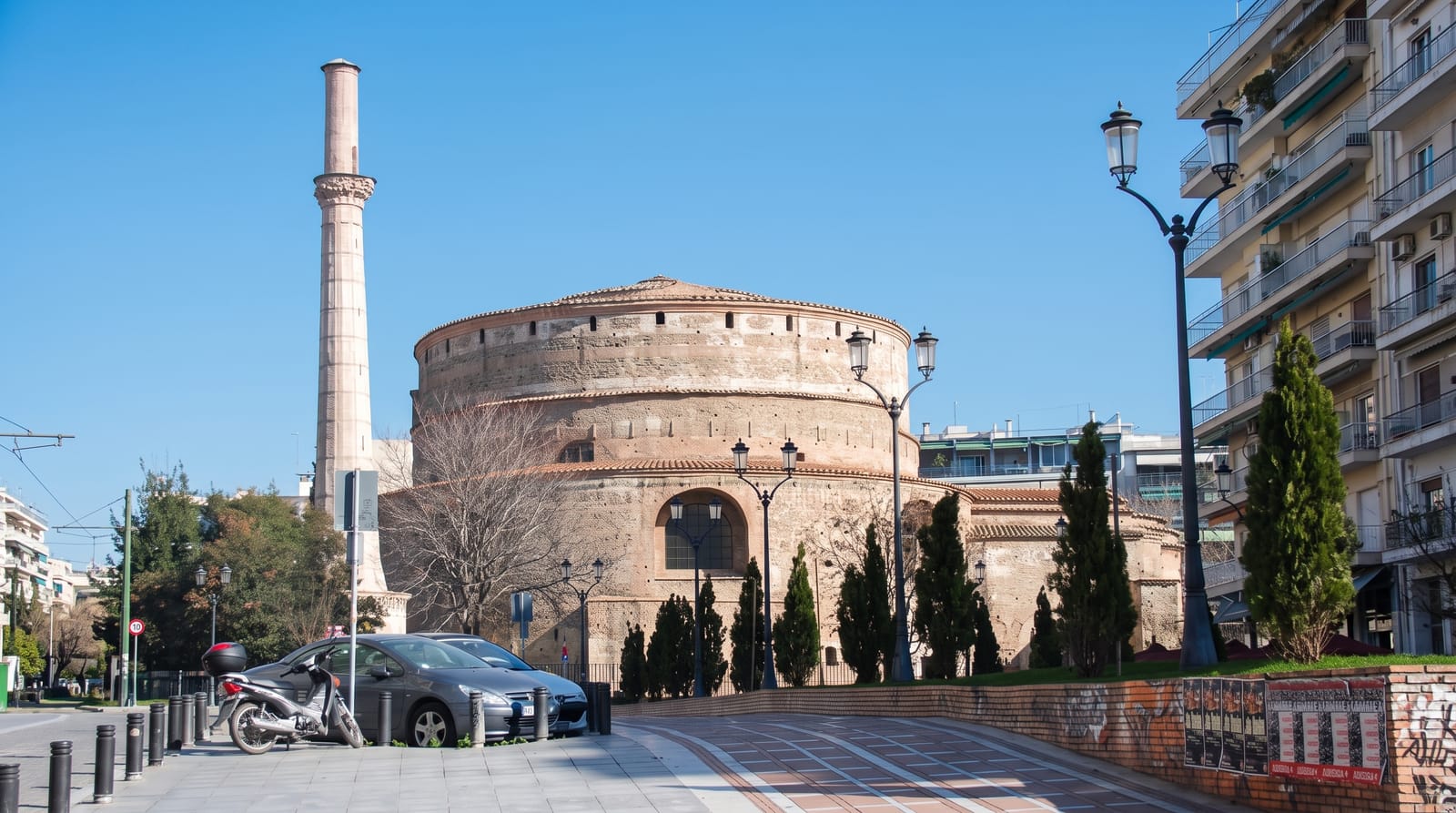
Galerius built both around AD 300 as part of a palace complex that also included the palace itself and a hippodrome. The arch, known locally as Kamara, spanned the Via Egnatia and is covered in relief panels showing his eastern campaigns, ceremonial scenes and imperial imagery, weathered but legible; only part of the original structure survives. Two hundred metres north stands the Rotunda, a cylinder over 24 metres across with walls six metres thick, probably intended as a mausoleum or temple; it was converted into a Christian church in the late fourth century and given magnificent gold mosaics of saints in the dome, then became a mosque under the Ottomans, whose minaret still stands beside it, the only one left in the city. Both are UNESCO-listed among Thessaloniki's palaeochristian monuments.
History
The emperor Galerius commissioned both as part of an imperial precinct linked to his palace in Thessaloniki, joined by a road that ran through the arch over the city's main east-west street; the arch, of which about two-thirds survives, was faced with marble panels celebrating his victory over the Sasanian ruler Narseh in 299, and the Rotunda served in turn as a mausoleum, a Christian basilica, a mosque, whose minaret still stands, and a church again. In time people forgot whom the arch honoured, and under the Ottomans it was variously called after Constantine, Philip II or Alexander, until Karl Frederik Kinch showed in 1890 that it was Galerius'. Both were inscribed in 1988 among the Paleochristian and Byzantine monuments of Thessaloniki (Wikipedia, Arch of Galerius and Rotunda).
Highlights
- The relief panels - carved scenes covering the surviving arch piers.
- The Rotunda dome - a vast brick cylinder with surviving gold mosaics.
- The minaret - the only Ottoman minaret remaining in Thessaloniki.
- The palace remains - excavated ruins of Galerius's complex nearby.
When to go
Year-round; both stand in the busy centre and are easily combined. The Rotunda keeps museum hours and closes on some weekdays, while the arch is always accessible outdoors.
Practical notes
Restoration work has kept scaffolding inside the Rotunda for long periods, and the mosaics survive only in patches, high up. The arch sits at a busy junction with traffic on all sides. Both visits are short.
Nearby
The Roman forum lies west, the White Tower and seafront south, and the upper town climbs behind.
Key facts
Source: Wikidata, item Q1258082, read on 18 October 2026.
What to pack for Arch of Galerius and Rotunda
Chosen from what this place is for. Tap a kit for the full checklist.
- Comfortable walking shoes - Sightseeing means kilometres of pavement and cobbles daily. Find on Amazon
- Modest clothing - Shoulders and knees covered - the single most common requirement. Find on Amazon
- A slim anti-theft daypack - Zips that close properly; keep it in front in crowds and on transit. Find on Amazon
- A scarf or shawl - To cover the head or shoulders on entry; women especially at mosques. Find on Amazon
Some links on this page are Amazon affiliate links - if you buy through them we may earn a small commission at no extra cost to you.
All packing kitsPlan your trip
Where to start if Arch of Galerius and Rotunda is going on the list.
Booking links on this page are affiliate links - if you book through them we may earn a small commission at no extra cost to you. It never changes what we write about a place.
Opening times, ticket prices and seasonal closures change - check the official source before you go: official site.