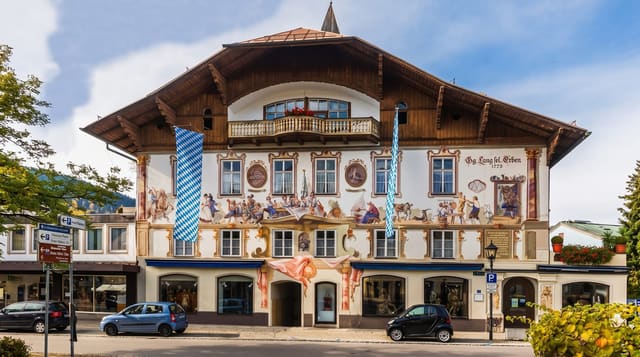
Murnau and Staffelsee
The town where Kandinsky and Münter worked toward abstraction, beside a lake with seven small islands.
Updated 19 October 2026

AI illustration
Gabriele Münter bought a house in Murnau in 1909 and she and Wassily Kandinsky worked there through the years when his painting moved toward abstraction; Franz Marc, August Macke and Alexei Jawlensky also worked in the area, and the Blue Rider group formed out of these connections. Münter kept a large number of Kandinsky's works hidden through the Nazi years and gave them to Munich in 1957, which is why the Lenbachhaus holds the collection it does. Her house is a museum. The Staffelsee beside the town has seven islands, one with a chapel, and is shallow enough to warm quickly in summer.
History
The area was settled before Christian times, with Celtic and Roman traces in the Murnauer Moos, and from the reign of Septimius Severus the Via Raetia ran through on its way to Augsburg; the market grew in the 12th century around Murnau Castle, and the name, from Mure, "mudslide", and Aue, "meadow", recalls the moor and the Loisach valley. Murnau is first recorded in 1150, the castle in 1324, and in 1350 Duke Louis V granted it high justice, staple rights and a weekly market; Swedish and French troops occupied it from 1632 to 1648 and plague struck in 1634, the church of St Nicholas was rebuilt between 1717 and 1734, and after a great fire in 1835 the town was almost entirely rebuilt. The railway came in 1879, and in 1908 Gabriele Münter and Wassily Kandinsky, with Marianne von Werefkin and Alexej Jawlensky, painted here together, the start of the "Murnau era" that ran until 1914; Münter moved into her house with Kandinsky in 1909 (Wikipedia, Murnau am Staffelsee).
What you'll find
- The Münter House - the painted furniture and rooms she and Kandinsky used.
- The Murnau museum - Blue Rider works and local painting.
- The Staffelsee islands - seven islets, one carrying a small chapel.
- The moor landscape - the wetland between town and mountains they painted.
When to go
May to October; the lake is a swimming and boating lake in summer. Museums close Mondays. The moor paths are best in spring and autumn.
What to expect
The Münter House is small with timed entry in busy periods. Most of the major paintings are in Munich, not Murnau. The lake islands need a boat.
Nearby
The Ammergau Alps rise south; Oberammergau is beyond them.
Key facts
Source: Wikidata, item Q254356, read on 18 October 2026.
What to pack for Murnau and Staffelsee
Chosen from what this place is for. Tap a kit for the full checklist.
- Reef-safe sunscreen - High SPF that will not bleach the coral you are swimming over. Find on Amazon
- Comfortable walking shoes - Sightseeing means kilometres of pavement and cobbles daily. Find on Amazon
- Quick-dry towel - A microfibre towel packs small and dries in minutes. Find on Amazon
- A slim anti-theft daypack - Zips that close properly; keep it in front in crowds and on transit. Find on Amazon
Some links on this page are Amazon affiliate links - if you buy through them we may earn a small commission at no extra cost to you.
All packing kitsPlan your trip
Where to start if Murnau and Staffelsee is going on the list.
Booking links on this page are affiliate links - if you book through them we may earn a small commission at no extra cost to you. It never changes what we write about a place.
Opening times, ticket prices and seasonal closures change - check the official source before you go: official site.