Fakarava
An atoll biosphere reserve whose southern pass holds a wall of hundreds of grey reef sharks.
Updated 19 October 2026
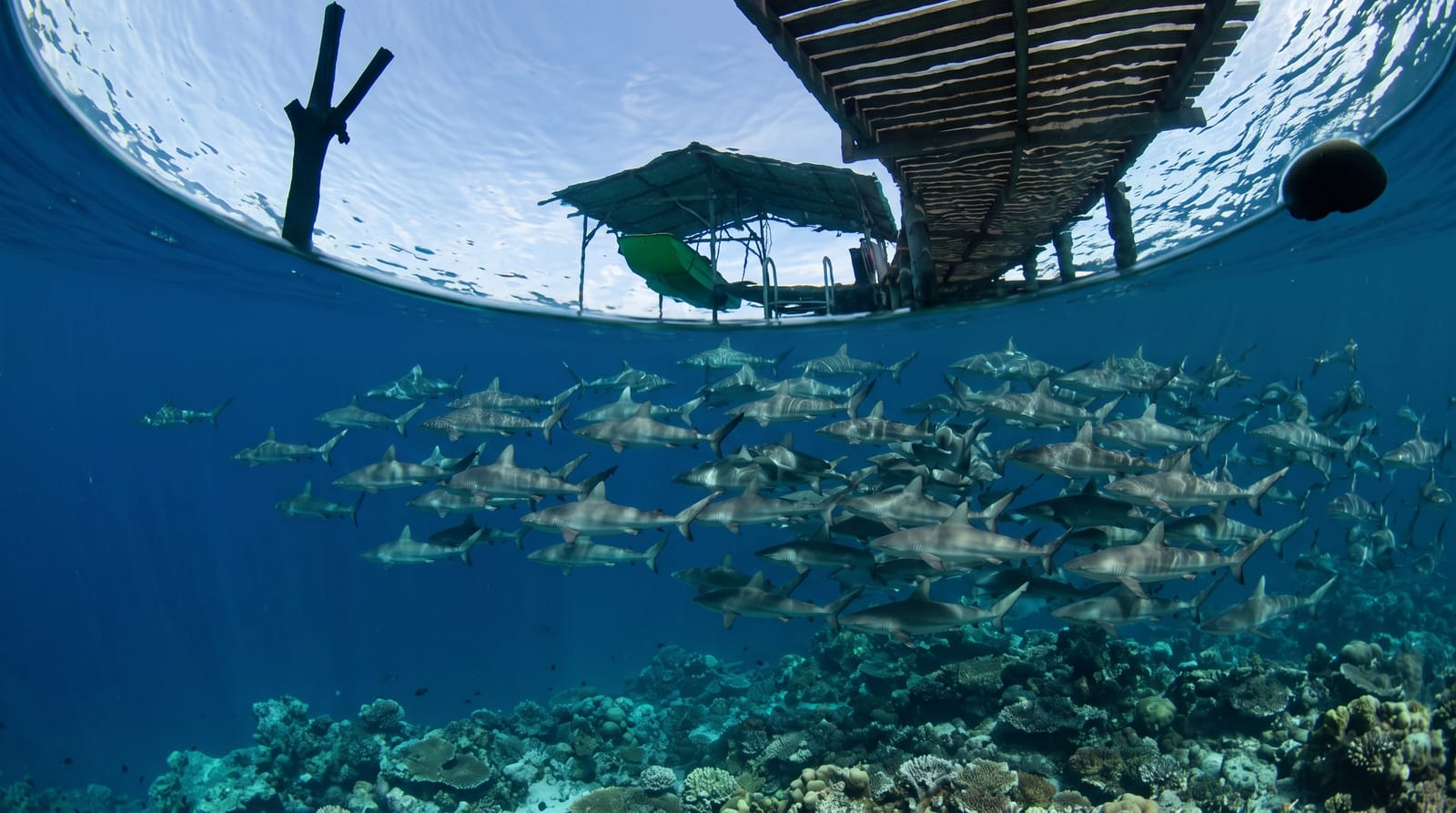
AI illustration
Fakarava is a large rectangular atoll, a UNESCO biosphere reserve, and its reputation rests on two passes through the reef. Garuae in the north is the widest pass in French Polynesia; Tumakohua in the south is the famous one, where several hundred grey reef sharks hold station in the current in a formation divers call the wall of sharks, one of the densest concentrations of reef sharks anywhere. Around the June and July full moons, grouper gather in the pass to spawn and the sharks hunt them at night, an event that draws film crews. Above water the atoll is quiet: a strip of coral and palm, a couple of villages, pearl farms, and a pink-sand beach on the southeastern rim.
History
The Pōmare dynasty came from Fakarava before it ruled Tahiti. The first European record is by the Russian navigator Fabian Gottlieb von Bellingshausen on 17 July 1820, who named it Wittgenstein Island; the British sailor Ireland came on 2 October 1831, Robert FitzRoy on 14 November 1835, and Jules Dumont d'Urville in September 1838. In the 19th century it became French, with about 375 people and a small output of coconut oil, some 7 to 8 barrels a year around 1860, but its position and its lagoon harbour made it a main centre of the coconut and mother-of-pearl trade; the Catholic priest Honoré Laval evangelised the atoll in 1849, the Rotoava church was blessed in 1850, and the Tetamanu church of 1874 was built of coral. Early in the 20th century the atoll was divided into the districts of Tehatea and Tetamanu, and in 2016 it joined the UNESCO biosphere reserve created in 1977 (Wikipedia, Fakarava).
Highlights
- Tumakohua pass - the southern pass and its wall of grey reef sharks.
- Garuae pass - the widest pass in the territory, a strong drift dive in the north.
- The pink sands - crushed coral beaches on the southeastern rim.
- Pearl farms - working black pearl operations on the lagoon.
When to go
May to October is drier and calmer. The grouper spawning and the shark feeding around the June and July full moons are the headline event, and accommodation at the south pass books out far ahead for it.
Before you go
The passes are drift dives in strong current and are not beginner sites; operators set experience minimums. Accommodation at the southern pass is a handful of very simple pensions with limited power and no shops, and everything must be brought in. Flights are limited and connections through Tahiti add cost. Nothing here is cheap.
Nearby
Rangiroa is a short flight away; Tahiti is the hub for all Tuamotu connections.
Key facts
Source: Wikidata, item Q1346999, read on 18 October 2026.
What to pack for Fakarava
Chosen from what this place is for. Tap a kit for the full checklist.
- Reef-safe sunscreen - High SPF that will not bleach the coral you are swimming over. Find on Amazon
- Your own mask + snorkel - A well-fitting mask is the single biggest comfort upgrade underwater. Find on Amazon
- Quick-dry towel - A microfibre towel packs small and dries in minutes. Find on Amazon
- Rash guard or thin wetsuit - Sun cover on the surface and warmth on longer or deeper dives. Find on Amazon
Some links on this page are Amazon affiliate links - if you buy through them we may earn a small commission at no extra cost to you.
All packing kitsPlan your trip
Where to start if Fakarava is going on the list.
Booking links on this page are affiliate links - if you book through them we may earn a small commission at no extra cost to you. It never changes what we write about a place.
Opening times, ticket prices and seasonal closures change - check the official source before you go: official site.