Ronchamp Chapel
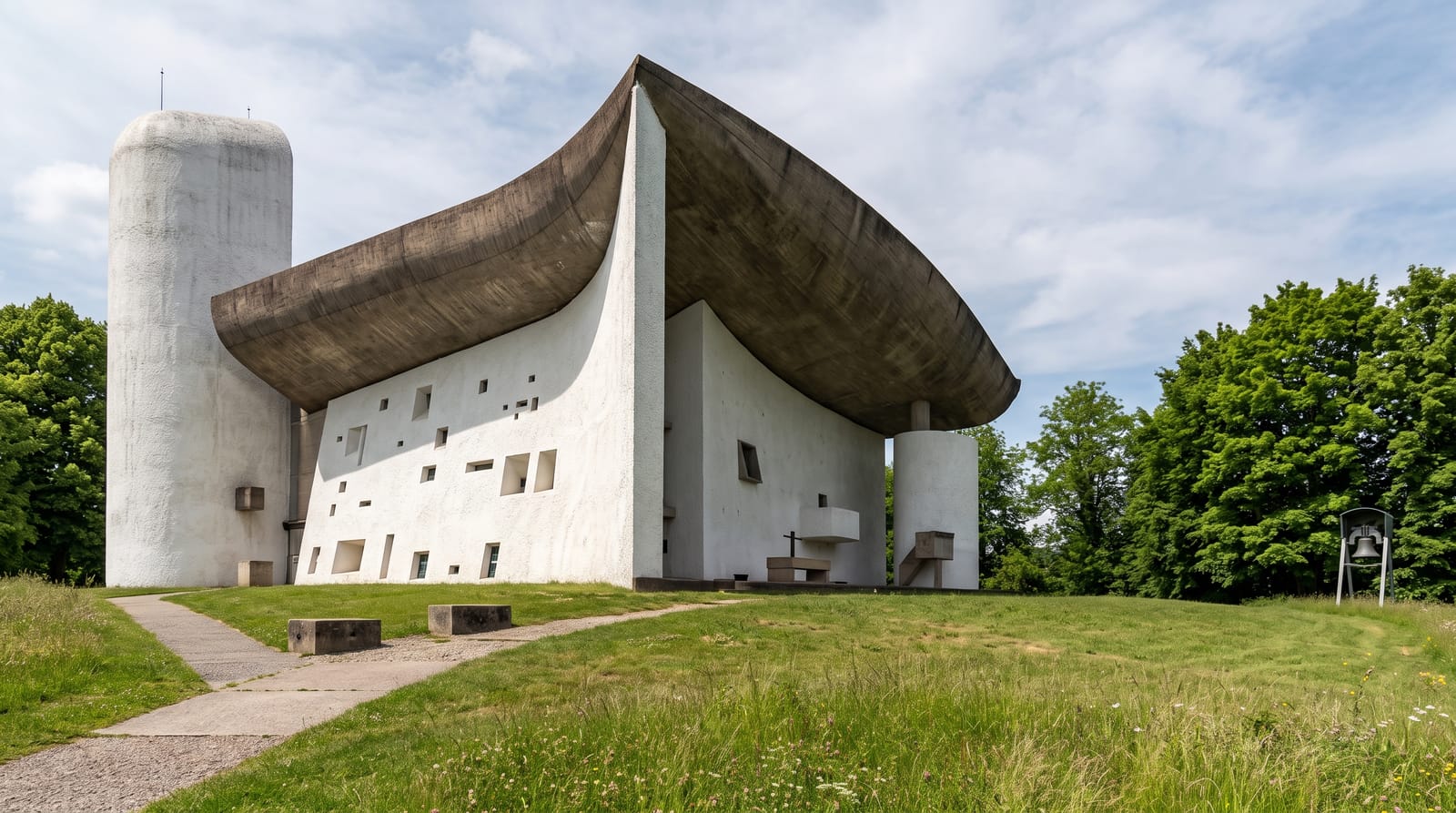
Le Corbusier's pilgrimage chapel, a curved concrete shell with a roof that floats on a line of light.
Updated 4 September 2026
AI illustration
Notre-Dame du Haut was finished in 1955 on a hill where a pilgrimage chapel had stood for centuries until it was destroyed in 1944. Le Corbusier, who had spent his career on rectilinear buildings, produced something else entirely: thick white curving walls, a heavy dark roof shaped like a shell or a wing, and a deliberate gap between wall and roof so the concrete canopy appears to hover on a line of daylight. The south wall is pierced by deep splayed openings of different sizes with coloured glass, throwing shafts of colour inside. It is part of the UNESCO listing of Le Corbusier's work made in 2016.
Highlights
- The floating roof - a dark shell separated from the walls by a light gap.
- The pierced south wall - deep splayed windows in coloured glass.
- The curved white mass - sculptural concrete walls seen from every angle.
- The Renzo Piano additions - a later monastery and gatehouse set into the slope.
When to go
April to October for the best light through the south wall; the site opens year-round with shorter winter hours. Morning and late afternoon give the strongest colour shafts inside.
What to expect
It is a working place of worship and can close for services. The hill involves a walk up from the car park. Photography inside is restricted at times.
Nearby
Belfort lies east; Besancon is southwest.
What to pack for Ronchamp Chapel
Chosen from what this place is for. Tap a kit for the full checklist.
- Comfortable walking shoes - Sightseeing means kilometres of pavement and cobbles daily. Find on Amazon
- Modest clothing - Shoulders and knees covered - the single most common requirement. Find on Amazon
- A slim anti-theft daypack - Zips that close properly; keep it in front in crowds and on transit. Find on Amazon
- A scarf or shawl - To cover the head or shoulders on entry; women especially at mosques. Find on Amazon
Some links on this page are Amazon affiliate links - if you buy through them we may earn a small commission at no extra cost to you.
All packing kitsPlan your trip
Where to start if Ronchamp Chapel is going on the list.
Booking links on this page are affiliate links - if you book through them we may earn a small commission at no extra cost to you. It never changes what we write about a place.
Opening times, ticket prices and seasonal closures change - check the official source before you go: official site.