MuCEM
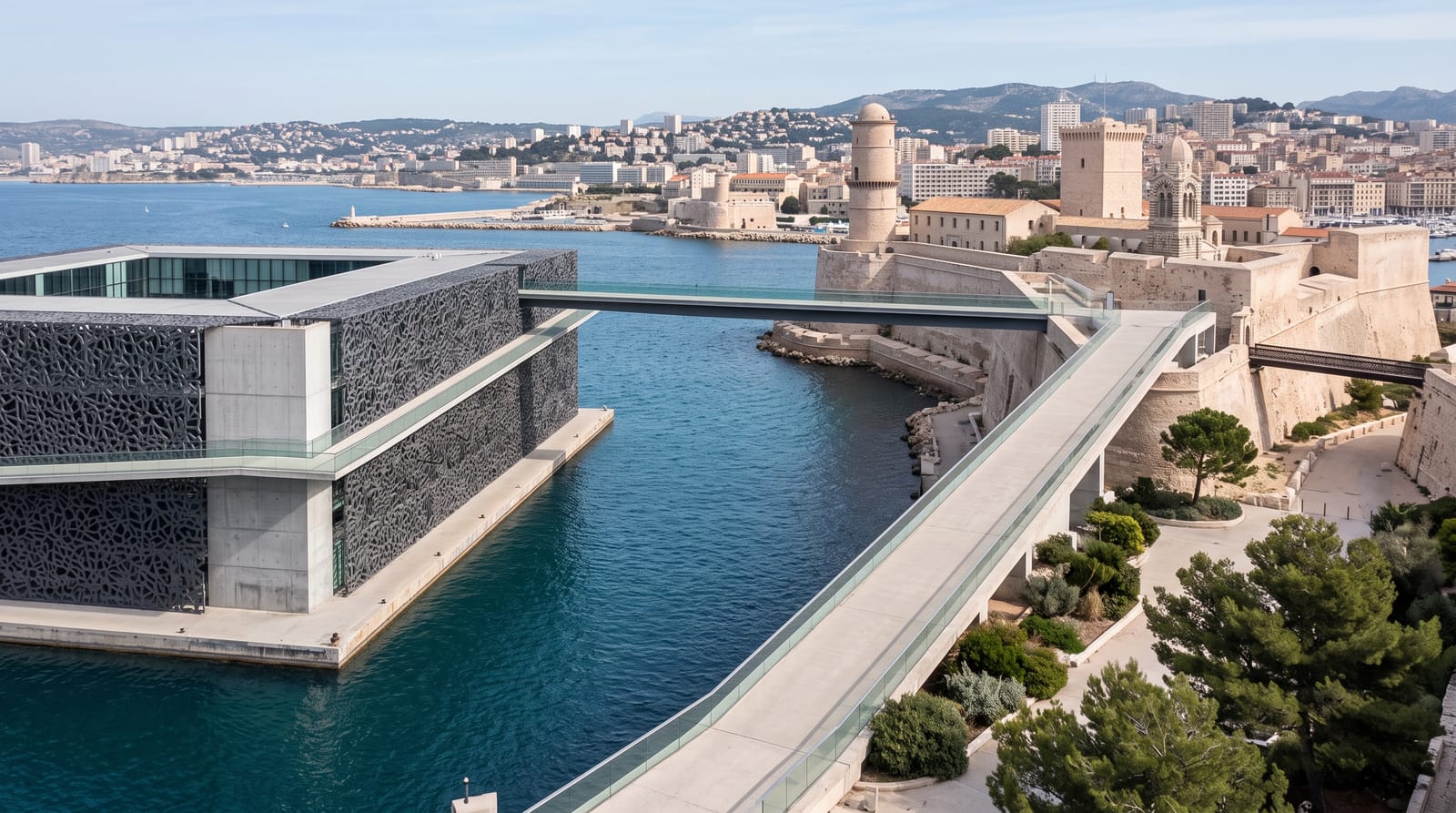
A concrete-lace cube at the harbour mouth, joined to a seventeenth-century fort by a footbridge in the air.
Updated 12 October 2026
AI illustration
The Museum of European and Mediterranean Civilisations opened in 2013 when Marseille was European Capital of Culture. Rudy Ricciotti's building is a dark cube wrapped in a lattice of fibre-reinforced concrete that reads as lace or a fishing net, casting patterned shadows on the ramps that spiral up inside the skin. A long footbridge crosses the water at height to Fort Saint-Jean, built by Louis XIV in 1660 partly to control the city rather than defend it, whose ramparts and gardens are free to walk. A second bridge reaches the Panier quarter. The collections cover Mediterranean societies rather than a single national story.
What's there
- The concrete lattice - a perforated skin throwing patterned shadows.
- The high footbridge - a walkway crossing the water to the old fort.
- Fort Saint-Jean - free ramparts, gardens and views over the harbour mouth.
- The Mediterranean collections - objects and displays across the whole basin.
When to go
Year-round; the museum closes Tuesdays. The outdoor terraces and fort are free and best at sunset. Exhibitions rotate, so check what is showing before buying a ticket.
Things to know
Much of the permanent display is thematic and abstract, which some find less engaging than expected. The rooftop and bridges are exposed to the mistral. Queues build for temporary shows.
Nearby
Le Panier is across the second bridge; the Vieux-Port is a short walk east.
Key facts
Source: Wikidata, item Q2808698, read on 18 October 2026.
What to pack for MuCEM
Chosen from what this place is for. Tap a kit for the full checklist.
- Travel rod + reel - A packable multi-piece rod fits in a case and covers most holiday fishing. Find on Amazon
- Comfortable walking shoes - Sightseeing means kilometres of pavement and cobbles daily. Find on Amazon
- A small tackle selection - Hooks, weights, line and a few lures or flies suited to local waters. Find on Amazon
- A slim anti-theft daypack - Zips that close properly; keep it in front in crowds and on transit. Find on Amazon
Some links on this page are Amazon affiliate links - if you buy through them we may earn a small commission at no extra cost to you.
All packing kitsPlan your trip
Where to start if MuCEM is going on the list.
Booking links on this page are affiliate links - if you book through them we may earn a small commission at no extra cost to you. It never changes what we write about a place.
Opening times, ticket prices and seasonal closures change - check the official source before you go: official site.