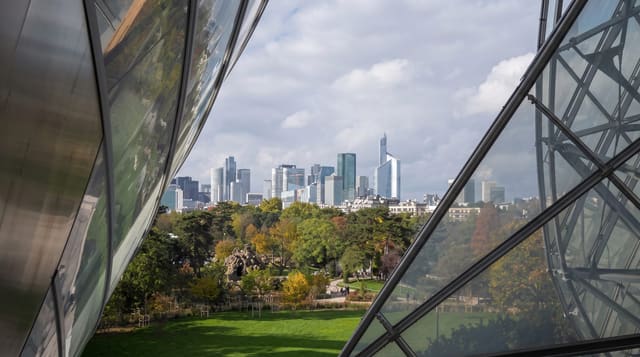
La Defense
A high-rise district built on a deck over its own roads and railways, ending in a hollow marble cube.
Updated 19 October 2026
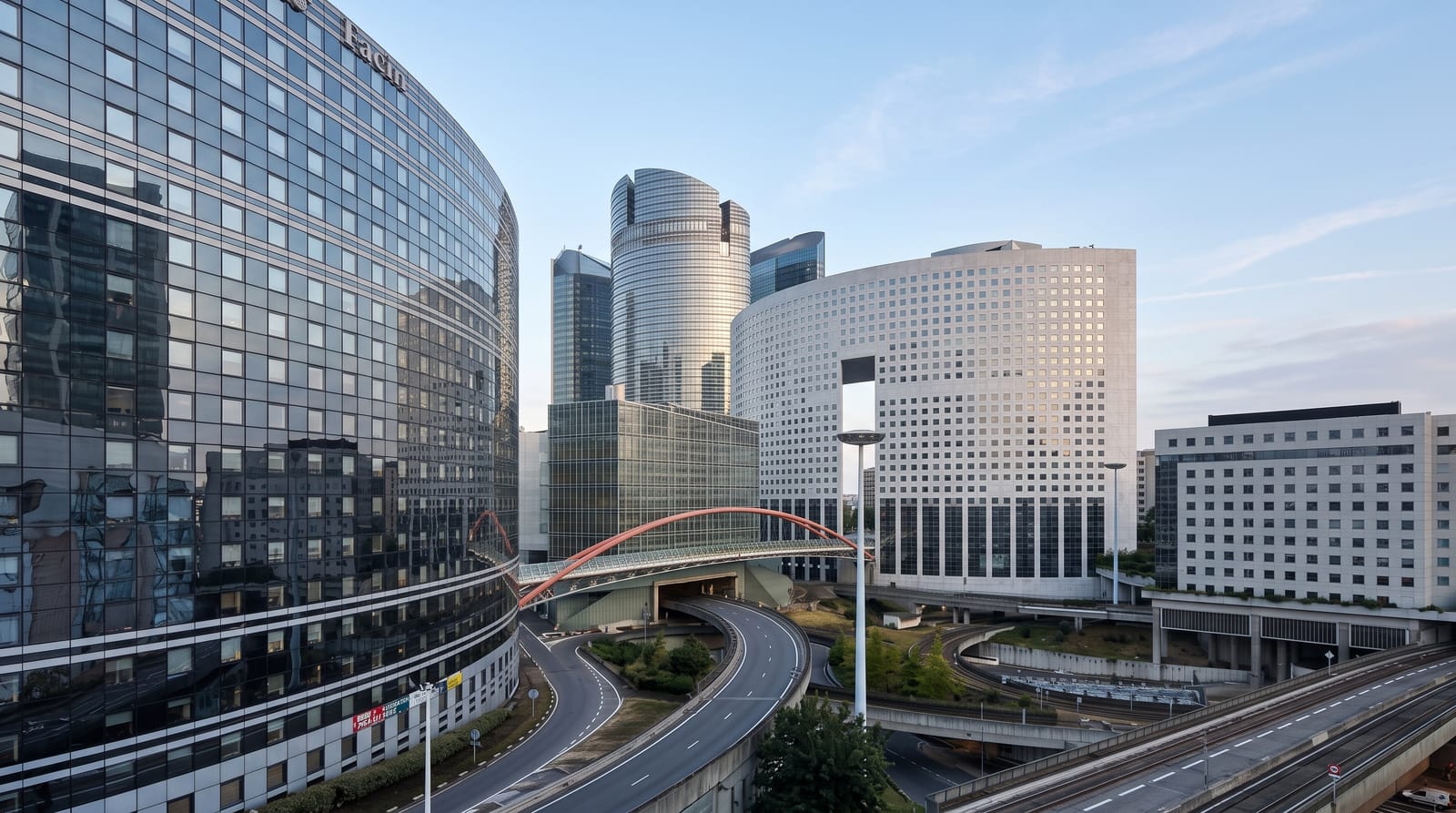
AI illustration
La Defense was planned from the 1950s to keep towers out of central Paris, and its organising idea is separation: the whole district sits on a raised pedestrian slab about a kilometre long, with roads, rail, metro and parking stacked beneath it, so nobody at street level meets a car. The Grande Arche, completed in 1989, is a hollow cube of about a hundred and ten metres faced in Carrara marble, aligned on the historic axis running from the Louvre through the Concorde obelisk and the Arc de Triomphe, and deliberately turned a few degrees off it for engineering reasons. Around sixty works of public sculpture stand on the slab.
History
La Défense takes its name from Louis-Ernest Barrias's statue La Défense de Paris, erected in 1883 in memory of the soldiers who defended the city in the Franco-Prussian War. In September 1958 the public development body EPAD began replacing the area's factories, shacks and farms with towers, the first of them the Esso Tower, beside the CNIT exhibition hall opened that year; the first generation of towers was limited to 100 metres. The RER line A reached La Défense in 1970, a second generation of buildings was slowed by the economic crisis of 1973, the Quatre Temps shopping centre opened in 1981, and the Tête Défense competition of 1982 led to the Grande Arche at the end of the historic axis; Métro line 1 arrived in 1992. On Bastille Day 1990 Jean-Michel Jarre's free concert here drew two million spectators, and the district is now the largest purpose-built business district in Europe, its tallest tower, Tour First, 231 metres high (Wikipedia, La Défense).
Highlights
- The Grande Arche - a hollow marble cube closing the historic axis.
- The pedestrian slab - a raised deck with all traffic beneath it.
- The public sculpture - Calder, Miro and around sixty other works.
- The axis view - the line running back to the Arc de Triomphe and Louvre.
When to go
Year-round; the district empties at weekends, which makes the architecture easier to see and the atmosphere strange. The Grande Arche roof terrace, reopened in 2017, closed for good in April 2023.
Good to know
At weekends and evenings the slab is deserted and windy. The area is a working business district with little for visitors beyond architecture and a large shopping centre. Wind funnelling between towers is notorious.
Nearby
The Bois de Boulogne lies southeast; central Paris is east along the axis.
Key facts
Source: Wikidata, item Q987729, read on 18 October 2026.
What to pack for La Defense
Chosen from what this place is for. Tap a kit for the full checklist.
- Comfortable walking shoes - Sightseeing means kilometres of pavement and cobbles daily. Find on Amazon
- A slim anti-theft daypack - Zips that close properly; keep it in front in crowds and on transit. Find on Amazon
- A refillable water bottle - Many cities have public fountains; save money and plastic. Find on Amazon
- A light layer + compact umbrella - For museum air-con and a sudden shower. Find on Amazon
Some links on this page are Amazon affiliate links - if you buy through them we may earn a small commission at no extra cost to you.
All packing kitsPlan your trip
Where to start if La Defense is going on the list.
Booking links on this page are affiliate links - if you book through them we may earn a small commission at no extra cost to you. It never changes what we write about a place.
Opening times, ticket prices and seasonal closures change - check the official source before you go: official site.