Chateau d'Amboise
A royal chateau on a terrace above the Loire, with horsemen's ramps inside its towers and Leonardo's grave in the chapel.
Updated 19 October 2026
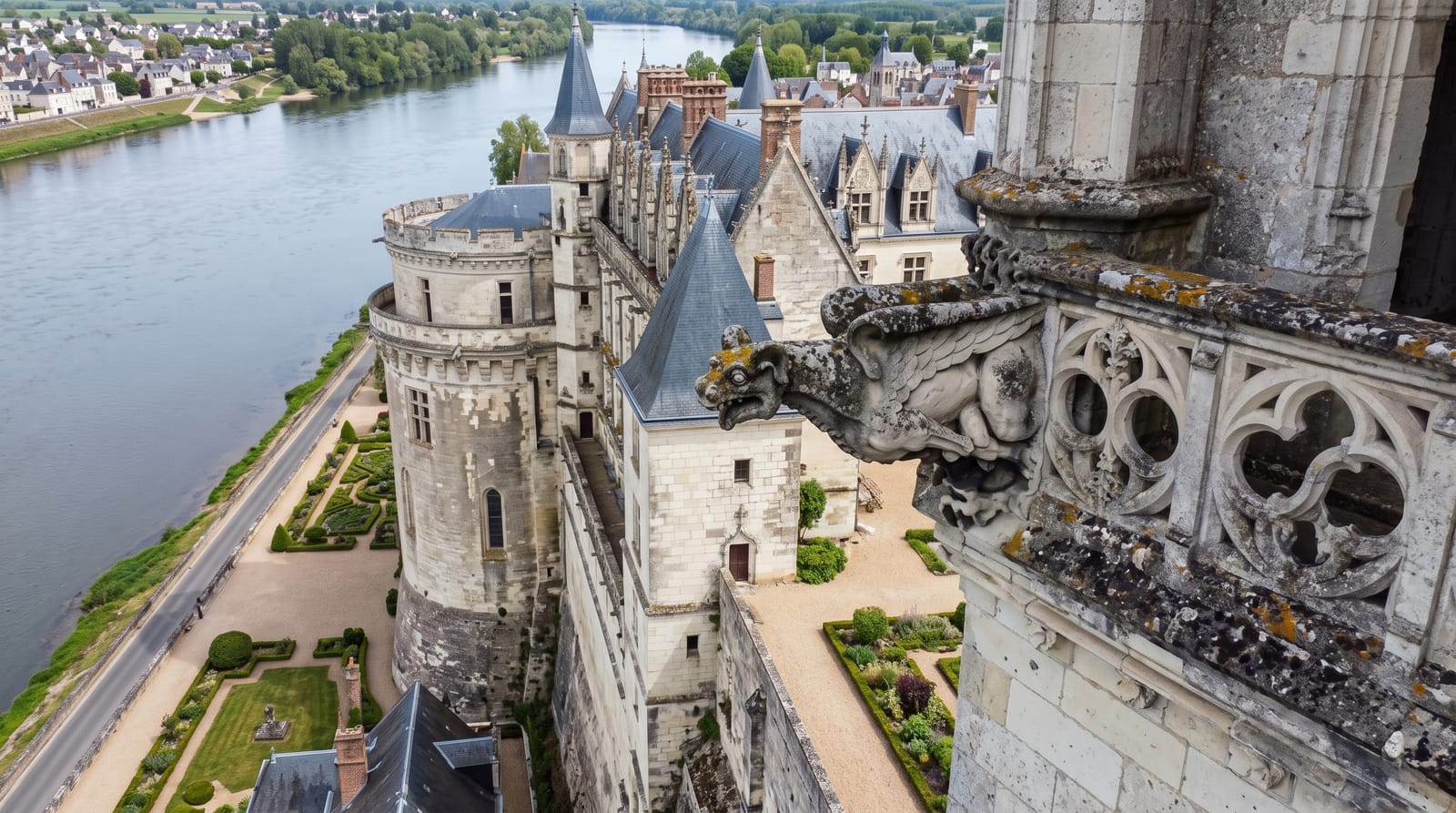
AI illustration
Amboise was the first Loire chateau rebuilt in Italian taste, after Charles VIII came back from Italy in 1495 with craftsmen and ideas; he died here in 1498 after striking his head on a door lintel. Two great round towers contain spiral ramps wide and shallow enough for horses and carriages to be ridden up from the riverside to the terrace, which is the building's cleverest feature. Only about a fifth of the original chateau survives; the rest was demolished after the Revolution. Leonardo da Vinci, who spent his last years nearby, is buried in the chapel of Saint-Hubert on the terrace.
History
A Gallic oppidum stood on the spur above the Loire before the castle, and in the late 9th century Ingelger, later count of Anjou, married Adelais of Amboise, whose family held it; it passed to his son Fulk the Red and in 987 to Fulk Nerra, who defended it against Odo I, Count of Blois. On 4 September 1434 Charles VII seized it from Louis d'Amboise, and in royal hands it became a favourite residence of the kings from Louis XI to Francis I. Charles VIII began rebuilding it in 1492 in the late Gothic style and, after his Italian campaign of 1494-1495, brought Italian builders such as Domenico da Cortona and Fra Giocondo and the garden designer Pacello da Mercogliano, making it the first Italianate palace in France; he died here in 1498 after hitting his head on a door lintel. The château declined from the second half of the 16th century and most of its buildings were later demolished, and it has been a monument historique since 1840 (Wikipedia, Château d'Amboise).
What you'll find
- The horse ramps - spiral carriage ramps inside the round towers.
- The chapel of Saint-Hubert - the small Gothic chapel holding Leonardo's grave.
- The terrace - a wide platform with long views over the Loire and roofs.
- The furnished rooms - the surviving royal apartments above the river.
When to go
April to October; the chateau opens year-round with shorter winter hours. Summer evenings bring a historical sound and light show staged by local volunteers.
Good to know
Only a fraction of the original building survives, so the interior is smaller than the exterior suggests. Leonardo's remains were disturbed after the Revolution and the identification of the grave is traditional rather than certain.
Nearby
Clos Luce is a short walk uphill; Chenonceau lies southeast.
Key facts
Source: Wikidata, item Q389908, read on 18 October 2026.
What to pack for Chateau d'Amboise
Chosen from what this place is for. Tap a kit for the full checklist.
- Comfortable walking shoes - Sightseeing means kilometres of pavement and cobbles daily. Find on Amazon
- A slim anti-theft daypack - Zips that close properly; keep it in front in crowds and on transit. Find on Amazon
- A refillable water bottle - Many cities have public fountains; save money and plastic. Find on Amazon
- A light layer + compact umbrella - For museum air-con and a sudden shower. Find on Amazon
Some links on this page are Amazon affiliate links - if you buy through them we may earn a small commission at no extra cost to you.
All packing kitsPlan your trip
Where to start if Chateau d'Amboise is going on the list.
Booking links on this page are affiliate links - if you book through them we may earn a small commission at no extra cost to you. It never changes what we write about a place.
Opening times, ticket prices and seasonal closures change - check the official source before you go: official site.


