Fontenay Abbey
A complete Cistercian abbey of the 1100s in a wooded Burgundy valley, kept deliberately bare of decoration, with its water-powered forge intact.
Updated 18 October 2026
AI illustration
UNESCO World Heritage
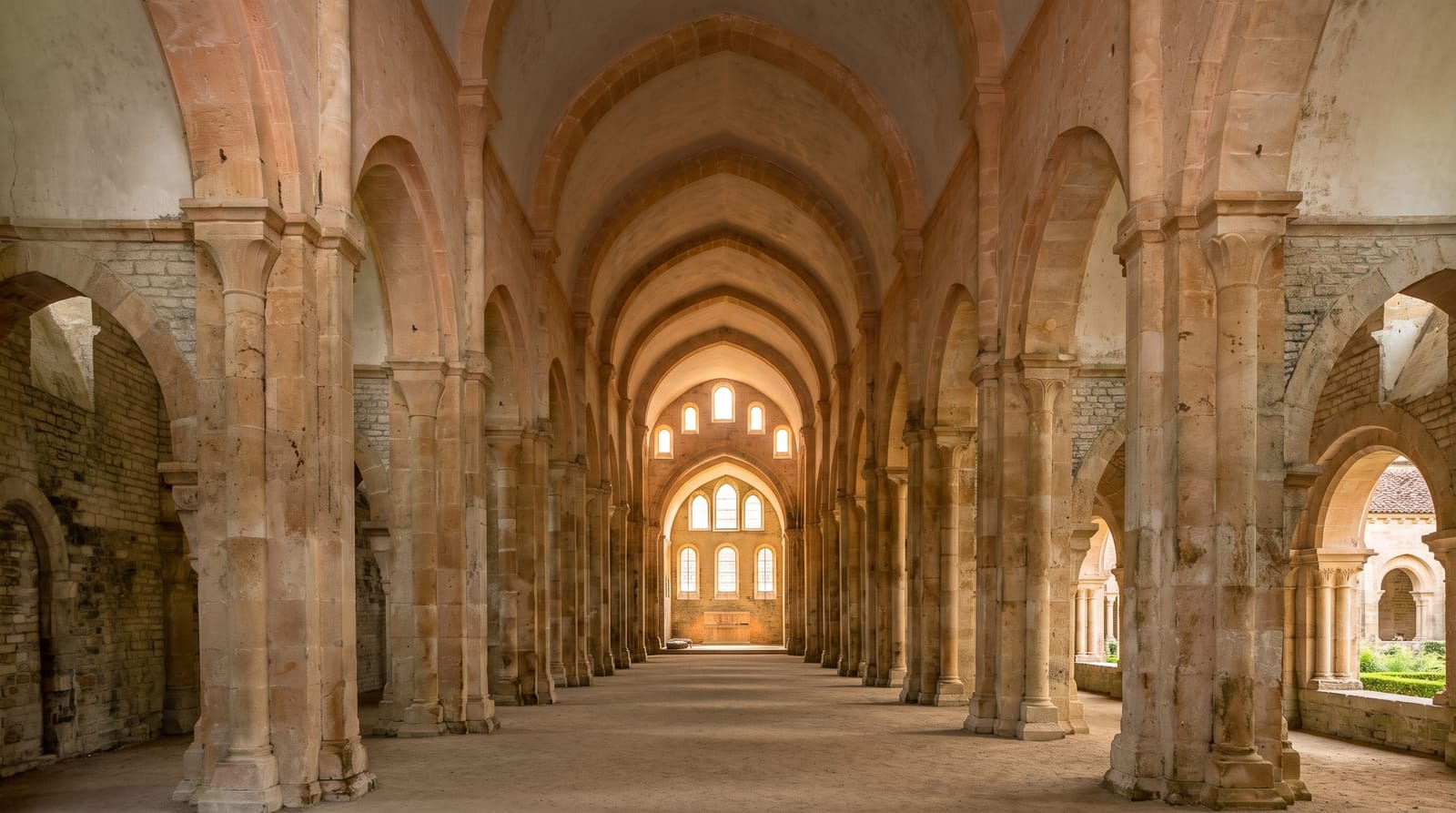
Fontenay was founded in 1118 by Bernard of Clairvaux and survives as one of the most complete Cistercian complexes anywhere: church, cloister, chapter house, monks' dormitory, bakery and forge, set in a narrow valley with its own stream. The Cistercian rule stripped away towers, stained glass and carving, so the church is a plain box of warm stone lit by clear windows, and the effect is closer to a barn than a cathedral. That is the point. The forge, driven by the stream, was among the earliest metalworking halls in Europe. The abbey was sold off in the 1790s and worked as a paper mill for a century before being stripped back to its medieval form.
History
Bernard of Clairvaux, who felt even Cîteaux was not austere enough, founded Fontenay in a Burgundian valley in 1118, and the monks moved to the present site in 1130; the Bishop of Norwich, who fled here in 1139, helped pay for the church, which Pope Eugene III consecrated in 1147, and by 1200 the complex could house as many as 300 monks. King Louis exempted the abbey from all taxes in 1259 and ten years later it became a royal abbey; it was pillaged by the armies of Edward III of England in 1359 and damaged again in the Wars of Religion, the refectory was pulled down in 1745, and after the monks left during the Revolution it became a paper mill in 1791, run by the Montgolfier brothers. In 1906 the Lyon banker Édouard Aynard bought it and restored it by 1911, it is still owned by his family, and in 1981 it became a World Heritage Site (Wikipedia, Abbey of Fontenay).
Highlights
- The abbey church - no tower, no colour, clear glass and bare stone.
- The cloister - short paired columns and vaulted walks around a lawn.
- The monks' dormitory - one long room under an oak roof frame.
- The forge - a water-driven metalworking hall from the twelfth century.
When to go
Open through the year, with the gardens at their best from May to September; the valley holds mist early and the light in the cloister is strongest before midday. Weekdays are quiet. Winter opening is shorter and the unheated buildings are genuinely cold, so dress for standing still rather than walking.
Things to know
This is a place with almost nothing in it, which is the reason to come and the reason some people leave flat after forty minutes. It is privately owned and the entry price reflects that. There is no public transport to the gate, the site spreads over grass and gravel, and rain leaves the walk between buildings muddy.
Nearby
Montbard on the main line, the Chatillonnais woods and the wine villages south towards Dijon.
Key facts
Source: Wikidata, item Q464918, read on 18 October 2026.
What to pack for Fontenay Abbey
Chosen from what this place is for. Tap a kit for the full checklist.
- Comfortable walking shoes - Sightseeing means kilometres of pavement and cobbles daily. Find on Amazon
- Modest clothing - Shoulders and knees covered - the single most common requirement. Find on Amazon
- A slim anti-theft daypack - Zips that close properly; keep it in front in crowds and on transit. Find on Amazon
- A scarf or shawl - To cover the head or shoulders on entry; women especially at mosques. Find on Amazon
Some links on this page are Amazon affiliate links - if you buy through them we may earn a small commission at no extra cost to you.
All packing kitsPlan your trip
Where to start if Fontenay Abbey is going on the list.
Booking links on this page are affiliate links - if you book through them we may earn a small commission at no extra cost to you. It never changes what we write about a place.
Opening times, ticket prices and seasonal closures change - check the official source before you go: official site.