Keren
The highland market city - Monday camel markets, a shrine inside a baobab and Italian-era streets in Eritrea's most atmospheric town after Asmara.
Updated 19 October 2026
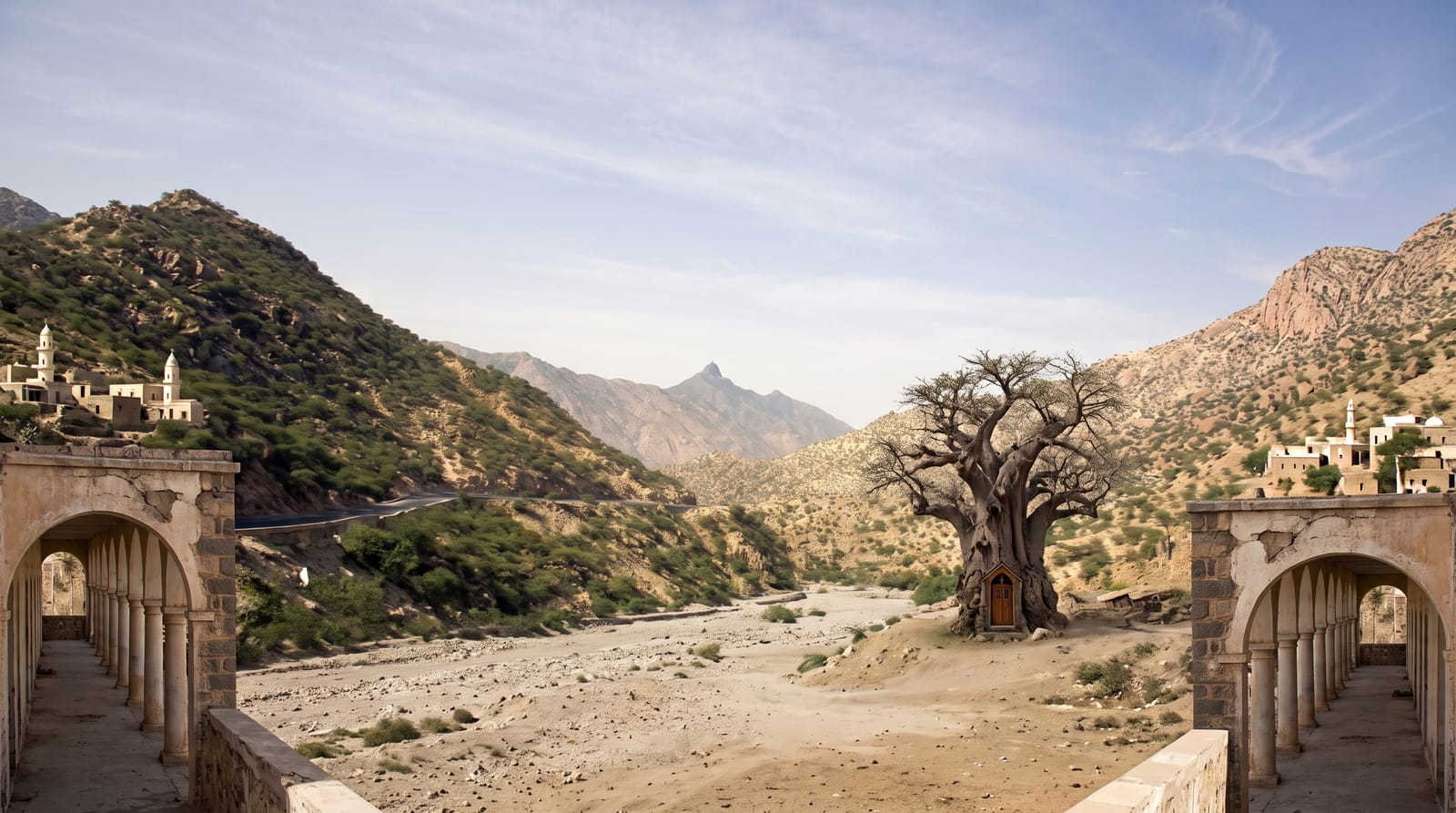
AI illustration
Two hours' winding descent northwest of Asmara, Keren spreads its Italian-era arcades and mosques across a bowl in the Anseba hills - a crossroads town where highland and lowland Eritrea meet to trade, most famously at the Monday livestock market, when camels, goats and their negotiating owners fill the wadi in a spectacle unchanged for generations. The town's oddest treasure is the Mariam Dearit shrine: a chapel built inside the hollow trunk of a giant baobab, pilgrimage site for Christians and respected by all, standing in a grove outside town. Silversmiths' lanes, the old railway station and hill viewpoints complete the amble.
History
Keren began as a trading settlement on an arid plain between the Anseba and Barka rivers, on the route from Massawa to Sudan: traders from Arkiko dominated its market, carrying grain on the camels of the local Hedareb, and cotton cloth from Sennar and Egypt changed hands with ivory, skins, ostrich feathers and maize from the highlands. In the middle of the 19th century it had about 350 huts and 2,000 inhabitants. The Lazarist missionaries Giuseppe Sapeto and Giovanni Stella toured the area in 1851, and Stella later founded an Italian farming colony here on land granted by Dejazmach Haylu of Hamasien, which fell apart after his death in 1869. Soon after, the Egyptian governor Werner Munzinger took over Keren and built a fort on the hill of Sanhit, the town's old name, and the Lazarists opened a school in 1874; the Egyptians left in 1885, and in December 1889 the Italians took the town, which became part of the colony of Eritrea proclaimed in 1890. Italian rule brought merchants of many origins, Greeks among them, who built a Greek church, and the Italian administration building went up between 1906 and 1916 (Wikipedia, Keren, Eritrea).
What to look for
- The Monday camel market - the wadi filling with livestock and argument.
- Mariam Dearit - the chapel inside the great baobab.
- The Italian-era centre - arcades, cafes and the old station.
- The silversmith lanes - Keren's jewellery-working tradition.
When to go
October to March is the cool, dry window; Mondays are non-negotiable if the market is the aim, and the May festival at Mariam Dearit brings the shrine its great pilgrimage day.
Things to know
Eritrean travel runs on permits for movement beyond Asmara - arrange them in the capital as required, and let local practice guide photography, especially at the market and shrine. Facilities are simple hotels and honest food. The charm is entirely real and entirely unpolished.
Nearby
The Anseba valley, the old rail route toward the coast and Asmara's plateau.
Key facts
Source: Wikidata, item Q534409, read on 18 October 2026.
What to pack for Keren
Chosen from what this place is for. Tap a kit for the full checklist.
- Loose, light, long clothing - Covering up beats bare skin in the desert - and locals dress this way for a reason. Find on Amazon
- Comfortable walking shoes - Sightseeing means kilometres of pavement and cobbles daily. Find on Amazon
- Modest clothing - Shoulders and knees covered - the single most common requirement. Find on Amazon
- Shelter suited to the place - Tent, tarp or hut booking - match it to the terrain and rules. Find on Amazon
Some links on this page are Amazon affiliate links - if you buy through them we may earn a small commission at no extra cost to you.
All packing kitsPlan your trip
Where to start if Keren is going on the list.
Booking links on this page are affiliate links - if you book through them we may earn a small commission at no extra cost to you. It never changes what we write about a place.
Opening times, ticket prices and seasonal closures change - check the official source before you go: official site.